PSIR Optional
VisionIAS VAM 2026 PSIR Paper-I Section-A: Strengthen Political Theory and Thought for UPSC Mains






Political Science and International Relations is one of the most analytical and concept-rich optional subjects in the UPSC Civil Services Examination. Within PSIR, Paper-I Section-A forms the theoretical foundation of the subject. It introduces aspirants to the core ideas, thinkers, debates and ideological frameworks that shape political understanding.
This section is not just about remembering definitions of justice, equality, rights, democracy, state, sovereignty or power. It requires aspirants to understand concepts deeply, compare thinkers, apply theories to contemporary politics, and write answers with conceptual clarity and analytical maturity.
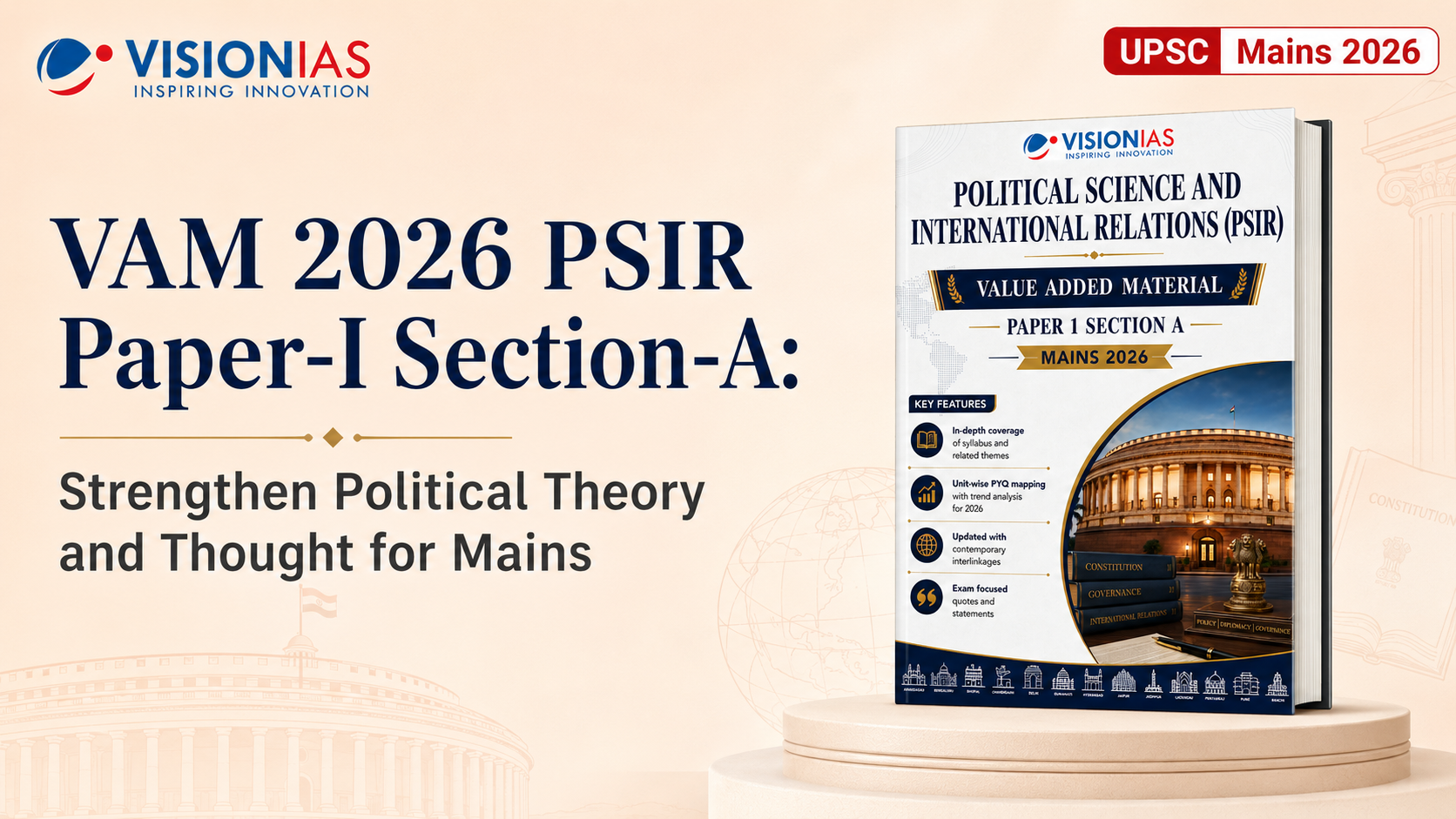
This is where VisionIAS Value Added Material (VAM) PSIR Paper-I Section-A 2026 becomes highly useful. It has been designed as an exam-focused and answer-enrichment resource for aspirants preparing PSIR Optional for UPSC Mains 2026.
[Download PSIR Paper-I Section-A VAM 2026 PDF]
Why PSIR Paper-I Section-A Needs Focused Preparation
PSIR Paper-I Section-A deals with political theory, political ideologies, Indian political thought and Western political thought. It provides the conceptual vocabulary through which aspirants understand politics, institutions, state, rights, justice, democracy, citizenship and power.
A strong answer in PSIR Paper-I Section-A usually requires:
- Conceptual clarity
- Thinker-based understanding
- Precise definitions
- Comparative analysis
- Use of relevant quotes and statements
- PYQ-oriented preparation
- Contemporary interlinkages
- Balanced criticism
- Clear structure and conclusion
For example, a question on justice cannot be answered only by defining justice. It may require discussion on distributive justice, procedural justice, substantive justice, Rawls’ theory of justice, communitarian critique, Sen’s capability perspective and contemporary relevance.
Similarly, a question on political theory may require aspirants to compare normative, empirical, behavioural, post-behavioural, philosophical, historical, legal and institutional approaches.
Therefore, PSIR preparation must go beyond reading standard thinkers. It must focus on writing answer-ready, conceptually sharp and well-structured responses.
What Makes VisionIAS PSIR Paper-I Section-A VAM 2026 Useful?
1. In-Depth Coverage of Syllabus and Related Themes
The VAM provides structured coverage of major themes from PSIR Paper-I Section-A. It covers the theoretical, ideological and thinker-based portions in a systematic manner.
The major units include:
- Political Theory: Meaning and Approaches
- Theories of State
- Justice
- Equality
- Rights
- Democracy
- Power, Hegemony, Ideology and Legitimacy
- Political Ideologies
- Indian Political Thought
- Western Political Thought
This structure helps aspirants revise the syllabus unit-wise and identify how each theme connects with the broader PSIR framework.
2. Unit-Wise PYQ Mapping with Trend Analysis
One of the strongest features of the VAM is its unit-wise PYQ mapping. Previous Year Questions are placed at the beginning of relevant units, followed by trend analysis and focus areas.
This helps aspirants understand:
- Which themes are repeatedly asked
- How UPSC frames questions
- Whether a question demands explanation, comparison, criticism or contemporary linkage
- Which areas need priority for 2026 preparation
- How to convert a theoretical topic into an exam-ready answer
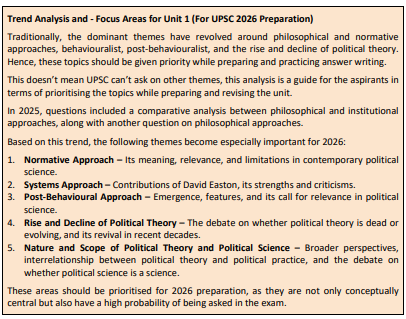
For example, in Unit 1 on Political Theory, PYQs show recurring focus on normative approach, behaviouralism, post-behaviouralism, systems approach, decline and resurgence of political theory, and the nature and scope of political theory.
3. Updated with Contemporary Interlinkages
Political theory is not a dead body of old ideas. It remains relevant for understanding contemporary debates on democracy, rights, equality, justice, state capacity, citizenship, identity, feminism, post-colonialism, multiculturalism, liberalism, populism, globalisation and political legitimacy.
The VAM helps aspirants connect theoretical concepts with contemporary politics. For instance:
- Rights can be linked with human rights, cultural relativism and post-colonial critique.
- Democracy can be linked with representative, participatory and deliberative models.
- Power can be linked with hegemony, ideology, legitimacy and civil society.
- Liberalism can be linked with classical liberalism, modern liberalism and post-Covid debates.
- Feminism can be linked with state, rights, equality and social justice.
- Ambedkar can be linked with social justice, constitutionalism and democracy.
- Gandhi can be linked with truth, non-violence, Swaraj, rights and duties.
Such interlinkages help aspirants write answers that are not merely static but analytically relevant.
4. Exam-Focused Quotes and Statements
PSIR answers become stronger when supported by relevant thinkers, quotes and precise statements. The VAM includes exam-focused statements and conceptual references that can enrich introductions, arguments and conclusions.
For example:
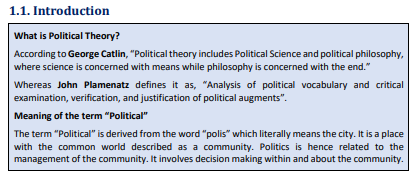
- George Catlin’s understanding of political theory as including political science and political philosophy
- John Plamenatz’s view of political theory as critical examination and justification of political arguments
- David Easton’s role in behaviouralism and post-behaviouralism
- Isaiah Berlin’s defence of political theory
- Rawls’ theory of justice
- Dworkin and Amartya Sen on equality
- Gramsci on hegemony
- Gandhi, Ambedkar and Aurobindo in Indian political thought
- Plato, Aristotle, Machiavelli, Hobbes, Locke, Mill, Gramsci and Hannah Arendt in Western political thought
How VAM Helps in PSIR Answer Writing
1. From Definition to Conceptual Clarity
In PSIR, definitions are important, but they are only the beginning. A strong answer must explain the idea, locate it within a debate, add thinkers, provide criticism and connect it with contemporary relevance.
For example, while writing on political theory, an aspirant can begin with the idea that political theory studies concepts such as justice, freedom, equality, power and democracy. But a stronger answer will go further and explain how political theory performs the task of description, criticism and reconstruction of political ideas.
2. Comparative Tables for Better Understanding
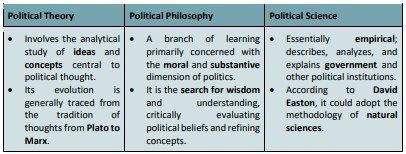
The VAM uses tables to clarify difficult distinctions. These are extremely useful for PSIR because many UPSC questions require comparison.
Useful comparison areas include:
- Political Theory vs Political Philosophy vs Political Science
- Political Theory vs Political Science
- Traditional Approach vs Contemporary Approach
- Normative Approach vs Empirical Approach
- Representative Democracy vs Participatory Democracy vs Deliberative Democracy
- Classical Liberalism vs Modern Liberalism
- Monistic Sovereignty vs Pluralistic Sovereignty
- Liberal, Marxist, Post-Colonial and Feminist theories of state
3. Trend-Based Focus for 2026
The VAM helps aspirants prioritise important themes for UPSC Mains 2026. For example, in Political Theory, the trend analysis highlights the importance of:
- Normative approach
- Systems approach
- Post-behavioural approach
- Rise and decline of political theory
- Nature and scope of political theory and political science
- Behavioural and institutional approaches
- Philosophical approach
Such focus areas help aspirants use limited revision time more effectively.
4. Contemporary Application of Thinkers
A common problem in PSIR answers is that thinkers are written in isolation. The VAM helps aspirants use thinkers as analytical tools.
For example:
- Rawls can be used in questions on justice, fairness, equality and welfare state.
- Dworkin and Sen can be used in questions on equality and capabilities.
- Gramsci can be used in questions on hegemony, civil society and ideology.
- Habermas can be used in legitimacy, deliberative democracy and public sphere.
- Gandhi can be used in debates on means and ends, non-violence, Swaraj and duties.
- Ambedkar can be used for social justice, constitutional morality and caste critique.
- Machiavelli can be used for realism, power and statecraft.
- Hannah Arendt can be used for power, action, totalitarianism and the banality of evil.
This thinker-based application helps aspirants write sharper and more mature answers.
Key Areas Covered in VisionIAS PSIR Paper-I Section-A VAM 2026
1. Political Theory: Meaning and Approaches
This unit covers the meaning of political theory, political philosophy, political science, the meaning of “political”, significance of political theory, approaches to political theory, normative and empirical approaches, traditional approaches, behaviouralism, post-behaviouralism, decline and resurgence of political theory.
This unit is highly important because it provides the base for the entire theoretical portion of PSIR.
2. Theories of State
This unit covers evolution of the concept of state, criteria of statehood, sovereignty, monistic and pluralistic theories of sovereignty, liberal theory of state, Marxist theory of state, post-colonial theory of state and feminist theory of state.
This section is useful for questions on state power, sovereignty, legitimacy, welfare state, class character of state, colonial legacy and gendered understanding of state.
3. Justice
This unit covers distributive justice, procedural justice, substantive justice, Rawls’ theory of justice, original position, veil of ignorance, principles of justice, communitarian critique and Rawls’ response to critiques.
This unit helps aspirants frame answers around justice, fairness, redistribution, rights and constitutional values.
4. Equality
This unit covers meaning and dimensions of equality, fair treatment vs equal treatment, equality of welfare, Dworkin’s equality of resources, Sen’s equality of capabilities, affirmative action, equality of outcome, equality of opportunity, liberty and equality, and complex equality.
This section is highly useful for questions related to social justice, affirmative action, welfare, capability and democratic equality.
5. Rights
This unit covers natural rights, human rights, three generations of human rights, implementation of human rights, theoretical and philosophical debates, Bhikhu Parekh’s post-colonial perspective, Asian values, cultural relativism and multiculturalism.
It helps aspirants connect classical rights theory with contemporary global debates.
6. Democracy
This unit covers theories and models of democracy, classical theories, empirical theories, elitist theory, economic theory, pluralist theory, representative democracy, participatory democracy and deliberative democracy.
This section is important for questions on democratic theory, citizen participation, representation, deliberation and legitimacy.
7. Power, Hegemony, Ideology and Legitimacy
This unit covers liberal, Marxist, elitist and pluralist theories of power, authority, legitimacy, Habermas’ legitimation crisis, Max Weber’s legitimacy theory, ideology, end of ideology thesis and end of history thesis.
This unit is useful for writing answers on power relations, state authority, consent, domination, hegemony and political legitimacy.
8. Political Ideologies
This unit covers idealism, liberalism, Marxism, socialism, post-modernism, fascism and feminism. It explains the evolution, core assumptions, internal variations, criticisms and contemporary relevance of these ideologies.
This section helps aspirants understand ideological debates and apply them to contemporary political questions.
9. Indian Political Thought
This unit covers Dharmashastra, Manu Smriti, Arthashastra, Buddhist political thought, Sir Syed Ahmed Khan, M.N. Roy, Gandhi, Ambedkar and Sri Aurobindo.
This section is central for writing thinker-based answers with Indian context. Aspirants should focus on comparison, criticism and contemporary relevance.
Important thinkers include:
- Kautilya for statecraft and governance
- Buddhist thought for Dhamma and political emancipation
- Gandhi for truth, non-violence, Swaraj, Sarvodaya and rights-duties relationship
- Ambedkar for social justice, caste critique, constitutionalism and state socialism
- M.N. Roy for radical humanism and radical democracy
- Aurobindo for nationalism and spiritual evolution
10. Western Political Thought
This unit covers Socrates, Plato, Aristotle, Machiavelli, Hobbes, Locke, J.S. Mill, Gramsci and Hannah Arendt.
This section helps aspirants develop thinker-based clarity on justice, state, power, liberty, sovereignty, social contract, realism, hegemony, totalitarianism and political action.
Important answer-enrichment areas include:
- Plato’s theory of justice and philosopher king
- Aristotle’s theory of state, citizenship and constitution
- Machiavelli’s political realism
- Hobbes’ absolute sovereignty
- Locke’s natural rights and limited government
- J.S. Mill’s liberty and representative government
- Gramsci’s hegemony and civil society
- Hannah Arendt’s theory of action, power and totalitarianism
How to Use PSIR Paper-I Section-A VAM 2026 Effectively
Step 1: Start with the PYQ Mapping
Before revising each unit, read the PYQs and trend analysis. This will help you understand the exam demand and prioritise topics.
Step 2: Prepare Conceptual Definitions
Prepare crisp definitions for core concepts such as political theory, state, sovereignty, justice, equality, rights, democracy, power, ideology and legitimacy.
Step 3: Make Thinker Sheets
For each thinker, prepare a one-page sheet with:
- Core ideas
- Important works
- Key quotes or statements
- Criticism
- Contemporary relevance
- Links with other thinkers
Step 4: Use Comparative Frameworks
PSIR rewards comparison. Prepare tables such as:
- Hobbes vs Locke
- Plato vs Aristotle
- Gandhi vs Ambedkar
- Liberalism vs Marxism
- Representative vs Participatory vs Deliberative Democracy
- Rawls vs Sen
- Normative vs Empirical Approach
Step 5: Build Interlinkages
Do not revise topics in isolation. Link concepts across units:
- Justice with equality and rights
- State with sovereignty and legitimacy
- Democracy with participation and deliberation
- Power with ideology and hegemony
- Feminism with state, rights and equality
- Ambedkar with justice, equality and democracy
- Gramsci with power, ideology and civil society
Step 6: Use Contemporary Examples Carefully
Where relevant, connect theoretical concepts with contemporary debates such as rights protection, affirmative action, democratic participation, populism, constitutionalism, gender justice, multiculturalism, social justice and legitimacy of institutions.
Step 7: Practise Answer Writing
For PSIR, answer writing must be precise. A strong answer should include:
- Direct introduction
- Conceptual explanation
- Thinker or theory
- Criticism
- Contemporary relevance
- Balanced conclusion
Last-Mile Benefits of VisionIAS PSIR Paper-I Section-A VAM 2026
During the final phase before Mains, aspirants need compact and answer-ready material. The VAM helps by providing:
- In-depth syllabus coverage
- Unit-wise PYQ mapping
- Trend analysis for 2026
- Contemporary interlinkages
- Exam-focused quotes and statements
- Conceptual clarity on core political ideas
- Thinker-wise coverage of Indian and Western political thought
- Comparative frameworks
- Answer-enrichment content
It helps aspirants move from scattered preparation to structured revision and from memorisation to analytical answer writing.
[Download PSIR Paper-I Section-A VAM 2026 PDF]
Final Word
PSIR Paper-I Section-A can become a strong scoring area when aspirants develop conceptual clarity, thinker-based understanding and analytical answer-writing ability. The section should not be treated as a list of theories and thinkers to memorise. It should be approached as a framework for understanding politics, power, justice, rights, democracy and the state.
VisionIAS PSIR Paper-I Section-A VAM 2026 is designed to support this approach. It helps aspirants revise the syllabus systematically, identify PYQ trends, use quotes and thinkers effectively, and connect political theory with contemporary relevance.
Use it as an answer-enrichment resource. Read the PYQ mapping, prepare definitions, revise thinkers, practise comparisons, and write answers that are conceptually clear and analytically balanced.
When political concepts meet structured presentation and thinker-based depth, PSIR answers become stronger. Let VisionIAS PSIR Paper-I Section-A VAM 2026 be your focused companion for UPSC Mains PSIR Optional preparation.
FAQs on VisionIAS PSIR Paper-I Section-A VAM 2026
1. What is VisionIAS PSIR Paper-I Section-A VAM 2026?
VisionIAS PSIR Paper-I Section-A Value Added Material 2026 is an exam-oriented resource for UPSC Mains PSIR Optional. It covers political theory, theories of state, justice, equality, rights, democracy, power, political ideologies, Indian political thought and Western political thought.
2. How does this VAM help in PSIR answer writing?
It helps aspirants write better answers through unit-wise PYQ mapping, trend analysis, conceptual clarity, thinker-based notes, comparative frameworks, contemporary interlinkages and exam-focused quotes.
3. What are the major areas covered in this VAM?
The major areas include Political Theory, Theories of State, Justice, Equality, Rights, Democracy, Power and Legitimacy, Political Ideologies, Indian Political Thought and Western Political Thought.
4. Is this useful for last-minute revision?
Yes. Its unit-wise structure, PYQ mapping, trend analysis, tables, thinkers and interlinkages make it useful for focused revision before Mains.
5. What is the best way to use PSIR Paper-I Section-A VAM 2026?
Start with PYQ mapping, revise conceptual definitions, prepare thinker sheets, practise comparison-based answers, build interlinkages and use contemporary examples wherever relevant.