Ethics
VisionIAS VAM 2026 Ethics Section-A: From Concepts to Application in GS Paper-IV






The UPSC Civil Services Mains Examination does not test Ethics as a subject of definitions alone. It tests moral reasoning, administrative judgement, value clarity, and the ability to apply ethical principles to real-life governance situations. This is especially true for GS Paper-IV Ethics, Integrity and Aptitude, where aspirants are expected to combine conceptual clarity with practical wisdom.
In Ethics Section-A, many aspirants know the basic terms such as integrity, attitude, empathy, accountability, probity and emotional intelligence. Yet, they often struggle with a critical question: how to convert these concepts into crisp, analytical and high-scoring answers?
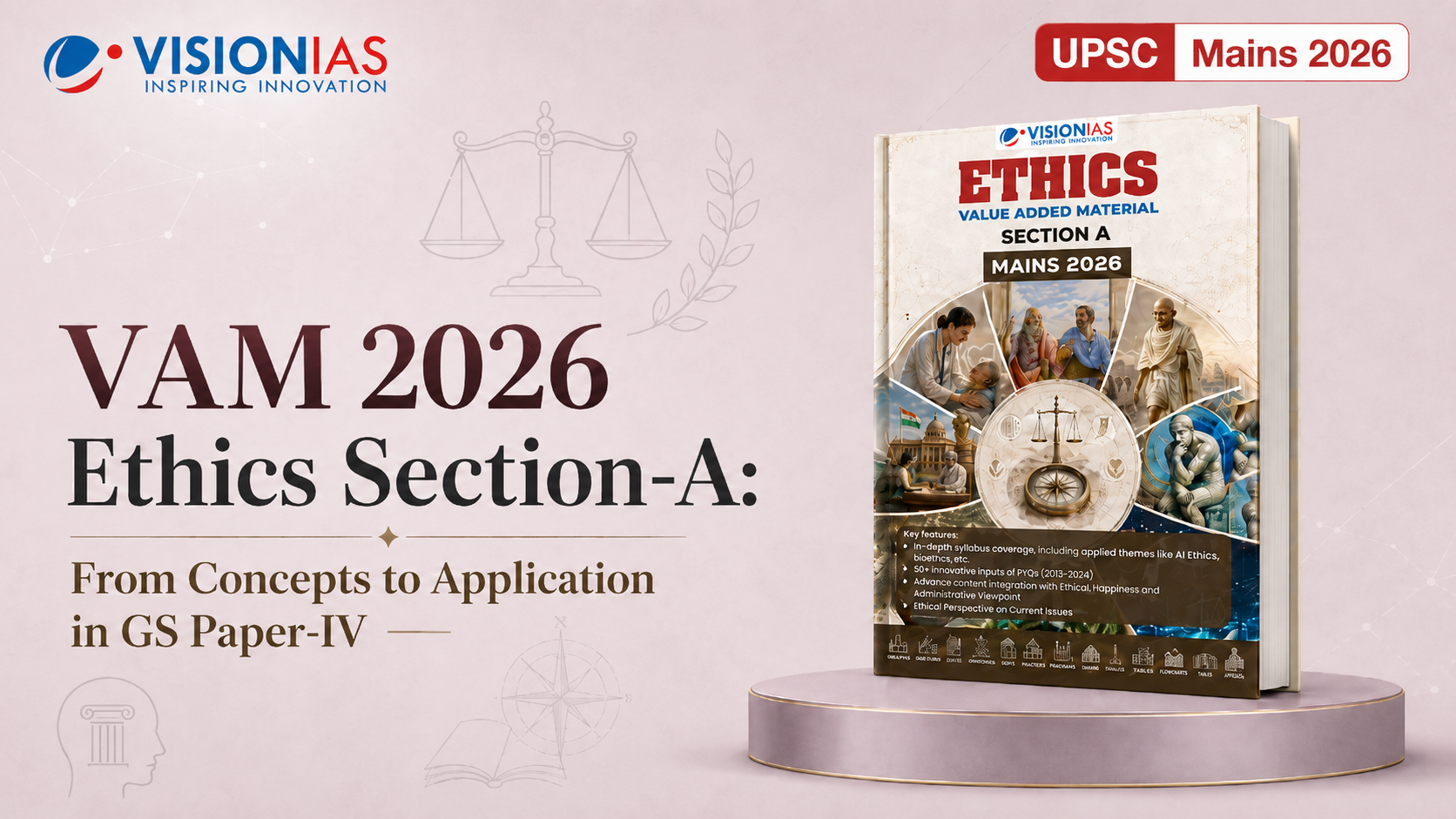
This is where VisionIAS Value Added Material (VAM) Ethics Section-A 2026 becomes highly useful. It is designed as an exam-oriented answer-enrichment resource that helps aspirants build conceptual depth, use thinkers meaningfully, integrate contemporary examples, and write Ethics answers with clarity and administrative relevance.
[Download VAM Ethics Section-A 2026 PDF]
Why Ethics Section-A Requires a Different Preparation Strategy
Ethics is different from other GS papers. In Polity or Economy, factual knowledge and policy understanding play a major role. In Ethics, the examiner looks for something more: clarity of values, balance in judgement, and the ability to connect ethical concepts with human conduct and public administration.
A good Ethics Section-A answer usually requires:
- Clear definition of the concept
- Contextual introduction
- Ethical reasoning
- Relevant thinker or theory
- Administrative example
- Contemporary relevance
- Balanced analysis
- Positive and practical way forward
- Simple but mature language
For example, a question on “ethics and law” should not merely define both terms. It should explain that law sets the minimum standard, while ethics raises the moral standard. It should show how an action may be legal but unethical, or illegal but ethically justified in certain historical contexts. Similarly, a question on emotional intelligence should not only list components; it should show how EI helps civil servants manage conflict, build trust, handle pressure and improve service delivery.
Therefore, Ethics preparation must move from memorising definitions to developing answer-ready ethical reasoning.
Also, Read blog to know VAM 2025 Reflection in UPSC Mains 2025 Ethics paper
The Changing Nature of UPSC Ethics Questions
UPSC Ethics questions have evolved over the years. Earlier, the focus was more on definitions and conceptual clarity. Now, the trend has increasingly shifted towards “why” and “how”.
The paper now tests whether aspirants can:
- Analyse the relevance of ethical values in governance
- Apply moral principles to real administrative situations
- Handle dilemmas between rules and compassion
- Understand ethics in technology, media, bioethics and public life
- Use thinkers ethical ideas without making answers theoretical or heavy
- Connect concepts with current issues
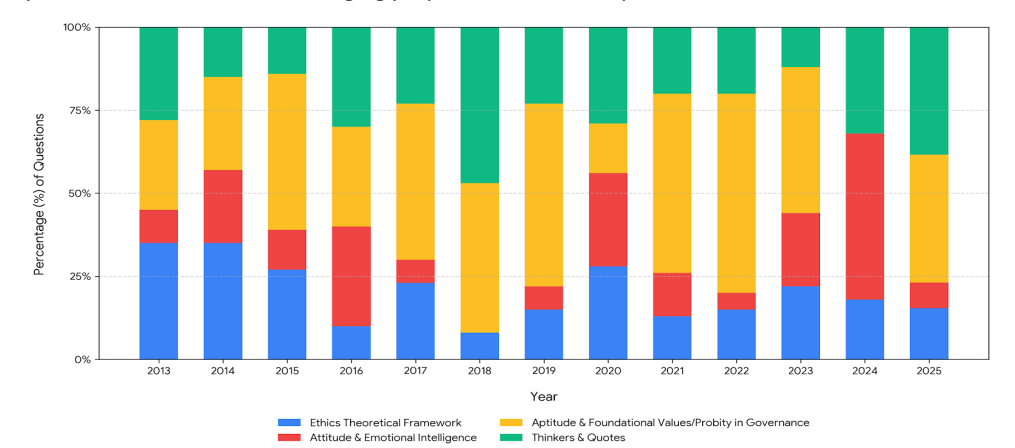
This shift makes VAM Ethics Section-A 2026 particularly relevant because it focuses not only on “what the concept means” but also on “why it matters” and “how it can be applied in answers”.
What Makes VisionIAS VAM Ethics Section-A 2026 Useful?
1. Structured and Thematic Organisation
The document is organised into seven logical parts, covering the major areas of Ethics Section-A:
- Ethics and Human Interface
- Attitude
- Aptitude and Foundational Values
- Emotional Intelligence
- Ethics in Public Administration
- Probity in Governance
- Contributions of Moral Thinkers and Philosophers from India and the World
This structure helps aspirants move step by step from basic ethical foundations to applied administrative ethics and probity in governance.
2. Topic-wise Mapping of PYQs
One of the most useful features of the VAM is topic-wise mapping of PYQs from 2013 to 2025. Each sub-section begins with relevant previous year questions mapped to the exact topic.
This helps aspirants understand:
- Which concepts are repeatedly asked
- How UPSC frames questions
- Whether the question is definitional, analytical, quote-based or application-based
- What kind of answer structure is expected
For example, in “Essence of Ethics”, PYQs are mapped to themes such as ethics and law, ethics vs morals vs values, crisis of conscience, consequences of ethics, purpose of ethics and political ethics.
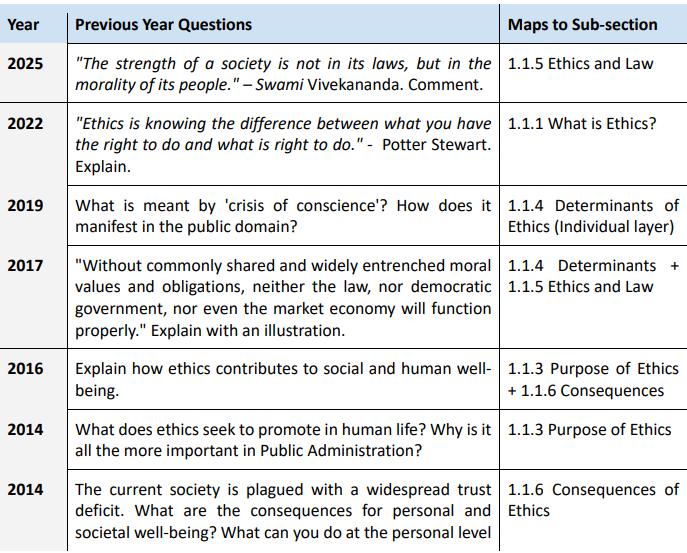
Such mapping helps aspirants avoid random preparation and revise Ethics with exam precision.
3. Answer Deconstruction for Better Structuring
Many aspirants struggle not because they lack content, but because they do not know how to structure answers. VAM Ethics Section-A includes answer deconstruction that helps aspirants understand the demand of the question.
For example, in a quote-based question such as:
“The strength of a society is not in its laws, but in the morality of its people.” — Swami Vivekananda. What does this convey to you in the present context?
A good answer must:
- Distinguish between law and morality
- Explain why morality is the deeper foundation
- Connect the idea with contemporary issues
- Use examples from public life, digital behaviour, disasters, corruption or constitutional morality
- End with a value-based conclusion
This kind of answer deconstruction helps aspirants understand not just content, but answer technique.
4. Thinkers’ Ethical Ideas for Answer Enrichment
Ethics answers become richer when thinkers are used correctly. However, overloading answers with names can make them artificial. VAM Ethics Section-A uses thinkers as practical enrichment tools, not as a memory burden.
Thinkers and ideas covered include:
- Aristotle for virtue ethics and eudaimonia
- Immanuel Kant for duty-based ethics and categorical imperative
- Bentham and Mill for utilitarianism
- Rawls for fairness and justice
- Gandhi for means and ends, trusteeship and moral politics
- Ambedkar for constitutional morality
- Kautilya for administrative ethics
- Vivekananda for morality and social strength
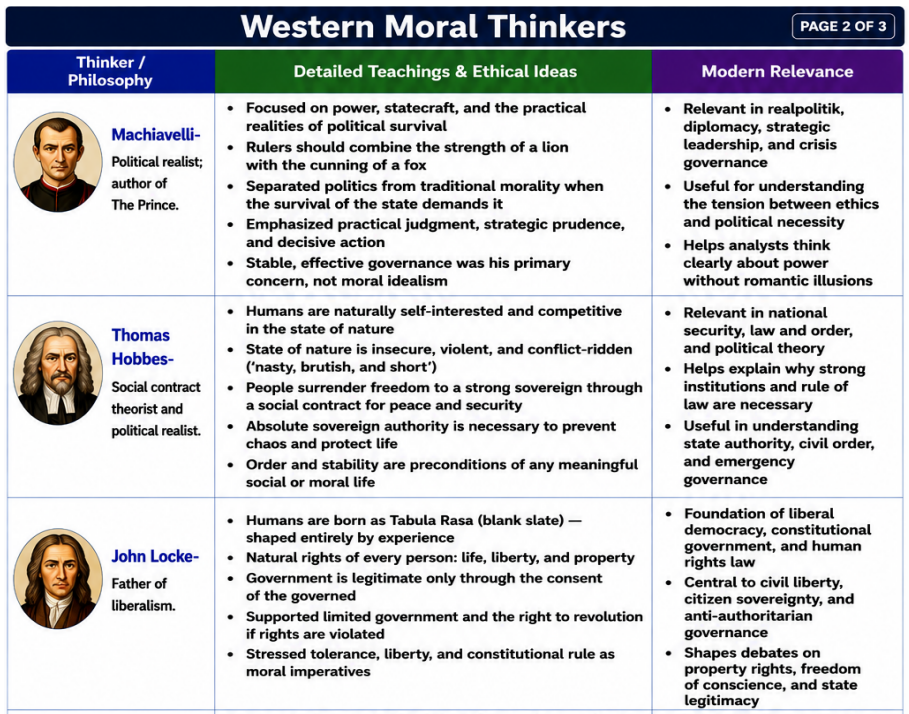
Aspirants can use one relevant thinker to strengthen an answer without making it theoretical.
5. Administrative Viewpoint and Practical Examples
Ethics is not only about philosophy. It is about public administration. VAM Ethics Section-A connects ethical concepts with administrative examples, helping aspirants write answers from the perspective of a future civil servant.
For example:
- Ethics helps a District Magistrate resist pressure and take fair decisions.
- Emotional intelligence helps an officer manage conflict and respond with empathy.
- Objectivity ensures decisions are based on evidence rather than bias.
- Probity ensures public funds are used transparently.
- Accountability strengthens trust in governance.
- Compassion humanises administration.
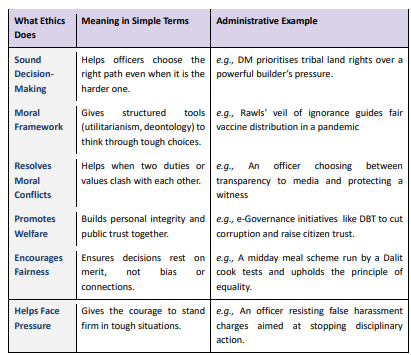
This administrative orientation is important because GS Paper-IV expects answers that reflect both moral clarity and governance practicality.
How VAM Ethics Section-A Improves Answer Writing
1. Contextual Introductions
A strong Ethics answer begins with a contextual introduction. Instead of writing a mechanical definition, aspirants should introduce the core issue, relevant concept, thinker or contemporary example.
For example, in a question on ethics and law, the answer may begin: “Law represents the minimum enforceable standard of conduct, while ethics represents the higher moral standard that guides human action even when no legal compulsion exists.”
This creates immediate clarity and sets up the answer well.
2. Clear and Impressive Presentation
Ethics answers should be easy for the examiner to read. The VAM shows how clear presentation, subheadings, underlining, diagrams and structured points can make answers more effective.
Aspirants should focus on:
- Short paragraphs
- Ethical keywords
- Simple diagrams
- Relevant examples
- Crisp conclusions
- Balanced arguments
3. Use of Ethical Theories and Thinkers
Ethical theories should be used as analytical tools. For instance:
- Kant can be used when duty, rights or human dignity are central.
- Utilitarianism can be used when outcomes and public welfare are central.
- Virtue ethics can be used when character, integrity and moral habits are central.
- Rawls can be used when fairness and justice are central.
- Gandhi can be used when means and ends are central.
The goal is not to show off knowledge, but to strengthen reasoning.
4. Linking Arguments to Contemporary Issues
Ethics answers become more relevant when they include current examples. VAM Ethics Section-A includes ethical perspectives on contemporary themes such as:
- AI Ethics
- Digital Ethics
- Media and Information Ethics
- Bioethics
- Environmental Ethics
- Business Ethics
- Happiness and governance
- Public trust
- Crisis of conscience
- Constitutional morality
- Good Samaritan ethics
Such examples help aspirants show that they understand Ethics not as an abstract theory, but as a living administrative and social concern.
5. Positive Way Forward
In issue-based Ethics questions, the conclusion should be constructive and solution-oriented. A strong way forward may include:
- Value education
- Ethical leadership
- Institutional accountability
- Transparency
- Citizen-centric governance
- Use of technology with safeguards
- Strengthening conscience and public service values
- Promoting compassion and empathy in administration
This gives the answer a practical and optimistic ending.
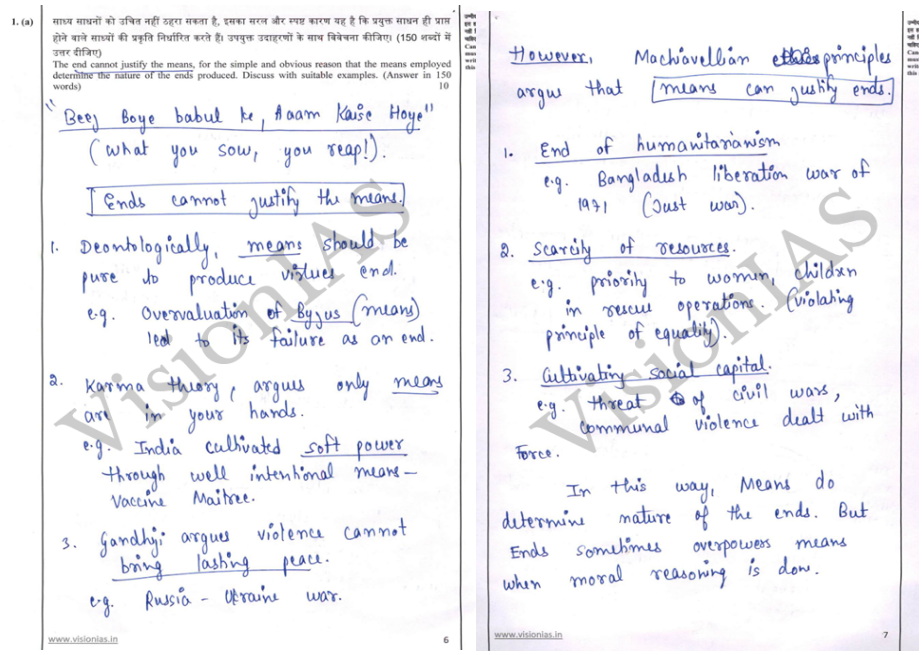
[Download Ethics High Scorer Topper Copies]
Key Areas Covered in VAM Ethics Section-A 2026
1. Ethics and Human Interface
This part covers the essence of ethics, ethics vs morals vs values, purpose of ethics, determinants of ethics, ethics and law, consequences of ethics in human action, dimensions of ethics, applied ethics, ethics in private and public relationships, and human values.
It also covers contemporary domains such as digital ethics, media ethics, bioethics, environmental ethics and business ethics.
2. Attitude
This section explains the content, structure and function of attitude, formation of attitude, influence of attitude on thought and behaviour, attitude-aptitude-behaviour linkage, changing attitude, moral and political attitudes, social influence and persuasion.
3. Aptitude and Foundational Values
This section covers aptitude for civil service and foundational values such as integrity, impartiality, non-partisanship, objectivity, dedication to public service, empathy, tolerance and compassion.
These values are central to both Section-A theory answers and Section-B case studies.
4. Emotional Intelligence
This section covers emotional intelligence, EI vs IQ, components of EI, utility of EI and application of EI in administration and governance.
EI is especially useful for questions on conflict management, public dealing, leadership, crisis response and citizen-centric administration.
5. Ethics in Public Administration
This part covers the status and problems of ethics in public administration, ethical competence, ethical dilemmas, conflict of interest, laws, rules, regulations and conscience as sources of ethical guidance, accountability, ethical governance, international relations ethics, corporate governance and CSR.
This section helps aspirants connect ethical theory with real governance challenges.
6. Probity in Governance
This section covers public service, philosophical foundations of governance, information sharing, transparency, Right to Information, codes of ethics and conduct, citizen charter, work culture, quality of service delivery, utilisation of public funds and corruption.
Probity is one of the most important areas of GS Paper-IV and needs repeated revision.
7. Moral Thinkers and Philosophers
This part covers Indian and Western moral thinkers, including ancient Indian traditions, Buddhist, Jain, Sikh, Bhakti and Sufi thought, modern Indian thinkers, reformers, nation builders and Western moral philosophers.
This section helps aspirants use thinkers selectively in introductions, body arguments and conclusions.
How to Use VAM Ethics Section-A 2026 Effectively
Step 1: Start with PYQ Trend Analysis
Begin with the trend analysis to understand how Ethics questions have shifted from definitions to analytical and application-based framing.
Step 2: Prepare Conceptual Definitions
For every major term, prepare a one-line definition and a one-line administrative relevance. For example:
- Integrity: consistency between values, words and actions.
- Objectivity: decision-making based on evidence and reason, not bias.
- Empathy: ability to understand another person’s suffering from their perspective.
- Probity: strict adherence to integrity, transparency and accountability in public life.
Step 3: Make a Thinkers Sheet
Prepare a compact thinker sheet. Keep one thinker for each major theme:
- Aristotle for virtue
- Kant for duty
- Mill for utility
- Rawls for justice
- Gandhi for means and ends
- Ambedkar for constitutional morality
- Kautilya for administrative ethics
Step 4: Create an Ethics Examples Bank
Collect examples from the VAM such as:
- Shop without shopkeepers in Mizoram
- Good Samaritan ethics
- Harish Rana case
- Crisis of conscience examples
- Digital ethics issues
- Bioethics issues
- Environmental ethics examples
- Administrative examples from public service
Step 5: Practise Quote-Based Questions
For quote-based questions, follow this structure:
- Explain the meaning
- Identify the ethical idea
- Connect with thinker or theory
- Add examples
- Analyse present relevance
- Conclude with a value-based statement
Step 6: Practise Theory + Application
Ethics Section-A answers should not remain abstract. For every concept, ask:
- What does it mean?
- Why is it important?
- How does it apply in administration?
- What example can prove it?
- What value-based conclusion can be written?
Step 7: Revise Keywords
Use keywords such as:
- Public trust
- Constitutional morality
- Crisis of conscience
- Ethical governance
- Value internalisation
- Compassionate administration
- Moral courage
- Accountability
- Transparency
- Probity
- Justice
- Human dignity
- Common good
Last-Mile Benefits of VAM Ethics Section-A 2026
In the final phase before Mains, aspirants need a resource that helps them revise quickly and improve answer quality. VAM Ethics Section-A 2026 provides:
- Topic-wise PYQ mapping
- Answer deconstruction
- Ethical theories and thinkers
- Administrative examples
- Contemporary ethical issues
- Keywords for answer enrichment
- Frameworks for theory answers
- Guidance for quote-based questions
- Structured coverage of Ethics Section-A syllabus
It helps aspirants move from scattered preparation to organised and exam-ready answer writing.
Final Word
Ethics can become a scoring paper when preparation is clear, structured and application-oriented. Aspirants should not treat Ethics as a subject of memorised definitions or copied quotes. It should be prepared as a discipline of judgement, values and governance.
VisionIAS VAM Ethics Section-A 2026 is designed to support this approach. It helps aspirants understand ethical concepts, apply them to public administration, use thinkers intelligently, enrich answers with examples, and write with clarity and balance.
Use it as an answer-enrichment tool. Read the PYQ mapping, revise concepts, prepare examples, practise quote-based questions, and connect every value with administrative relevance.
When ethical clarity meets structured presentation and practical application, GS Paper-IV answers become stronger. Let VAM Ethics Section-A 2026 be your strategic companion for UPSC Mains Ethics (GS Paper-IV).
[Download VAM Ethics Section-A 2026 PDF]
VisionIAS Value added Material (VAM) Reflections in UPSC GS paper 2025
Below are the related links showcasing how VisionIAS VAM (Value added material) were reflected in UPSC GS Papers 2025 and how they proved helpful in enhancing UPSC Mains answer writing.
| GS Paper 1 : Reflections from VAM | GS Paper 2 : Reflections from VAM |
| GS Paper 3 : Reflections from VAM | GS Paper 4 (Ethics) : Reflections from VAM |
FAQs on VisionIAS VAM Ethics Section-A 2026
1. What is VisionIAS VAM Ethics Section-A 2026?
VisionIAS Value Added Material Ethics Section-A 2026 is an exam-oriented resource for UPSC CSE Mains GS Paper-IV theory portion. It covers ethical concepts, attitude, aptitude, emotional intelligence, public administration ethics, probity and moral thinkers.
2. How does this VAM help in Ethics answer writing?
It helps aspirants write better answers through PYQ mapping, answer deconstruction, ethical frameworks, thinkers’ helpline, keywords, administrative examples and contemporary ethical issues.
3. Is this useful for quote-based Ethics questions?
Yes. The document provides guidance on evaluating quotes by understanding the main idea, interpreting the ethical meaning, connecting it with current relevance, using examples and writing a strong conclusion.
4. Does this VAM cover applied ethics themes?
Yes. It includes applied themes such as digital ethics, media and information ethics, bioethics, environmental ethics and business ethics.
5. What is the best way to use VAM Ethics Section-A 2026?
Start with trend analysis, revise topic-wise PYQ mapping, prepare definitions and examples, make a thinkers sheet, practise quote-based questions, and use keywords and administrative examples to enrich answers.