General Studies 1
VisionIAS VAM 2026 Society: Strengthen Your Understanding for UPSC Mains GS Paper-I


The UPSC Civil Services Mains Examination tests much more than information. It tests the ability to understand society, analyse change, present balanced arguments, and write answers with clarity under time pressure. This becomes especially important in the Indian Society section of GS Paper-I, where the difference between “knowing the topic” and “writing a high-scoring answer” is often very wide.
Society is not a static subject. It changes with technology, economy, migration, urbanisation, globalisation, gender relations, caste dynamics, poverty, population shifts, and identity-based politics. Therefore, aspirants need a preparation resource that does not merely list facts, but helps them understand how Indian society is changing and how UPSC frames questions around that change.
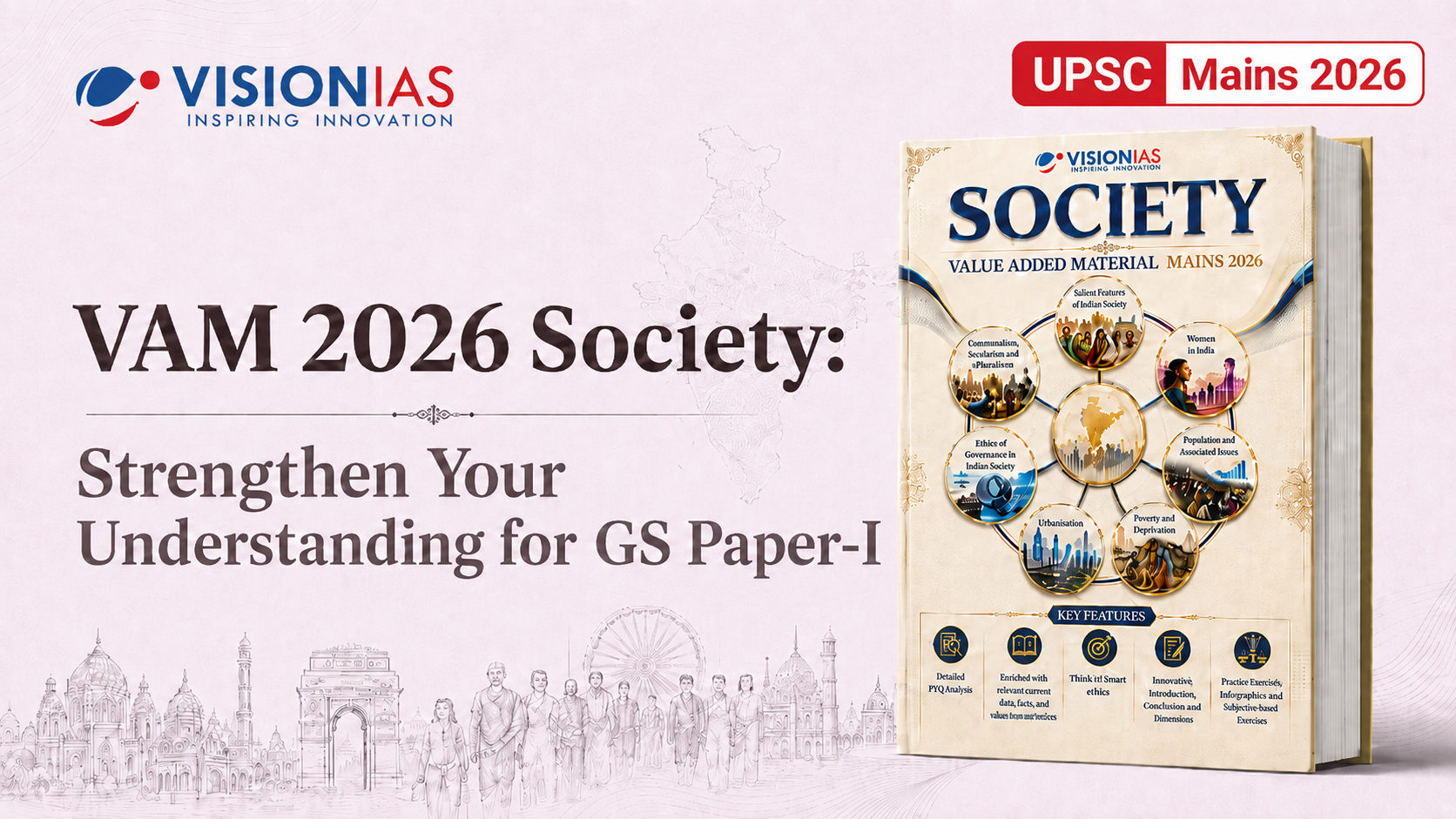
This is where VisionIAS Value Added Material (VAM) Society 2026 becomes highly useful. It has been designed as a focused, exam-oriented and answer-enrichment resource for aspirants preparing for UPSC CSE Mains 2026.
Why Society Requires a Different Approach in GS Paper-I
The Indian Society section is unique because it does not have one single standard textbook that covers all UPSC requirements. Questions can emerge from classical themes like caste, family, diversity and secularism, but they are often asked through contemporary lenses such as Work From Home, mobile phone-based socialisation, urban segregation, cultural homogenisation, women’s autonomy, caste surveys, migration, AI, climate change and poverty.
A strong Society answer usually requires:
- Conceptual clarity
- Sociological vocabulary
- Current data and examples
- Balanced and nuanced analysis
- Constitutional and ethical perspective
- Case studies from Indian society
- Ability to connect one theme with another
- Simple diagrams or frameworks for presentation
For example, a question on caste today cannot be answered only through Varna and Jati. It may require discussion on caste-class overlap, political mobilisation, endogamy, urban caste networks, caste census demands, reservation debates and everyday discrimination. Similarly, a question on women’s empowerment may require linkage with unpaid care work, labour force participation, political representation, safety, patriarchy, law and social norms.
Therefore, Society preparation must go beyond description. It must become analytical, updated and answer-oriented.
Also, Read blog to know VAM 2025 Reflection in UPSC Mains 2025 GS- 1 paper
Why VisionIAS VAM Society 2026 is Useful for Mains Preparation
1. PYQ-Based and Exam-Oriented Preparation
A major strength of VAM Society 2026 is its UPSC-oriented design. Every chapter begins with a structured set of:
- Key Data and Facts
- Glossary of important terms
- Previous Year Questions
- PYQ Analysis
- Strategic insights for preparation
This helps aspirants read each chapter with the right exam lens. Instead of preparing randomly, aspirants understand what UPSC has asked, how the framing has evolved, and what kind of analytical depth is expected.
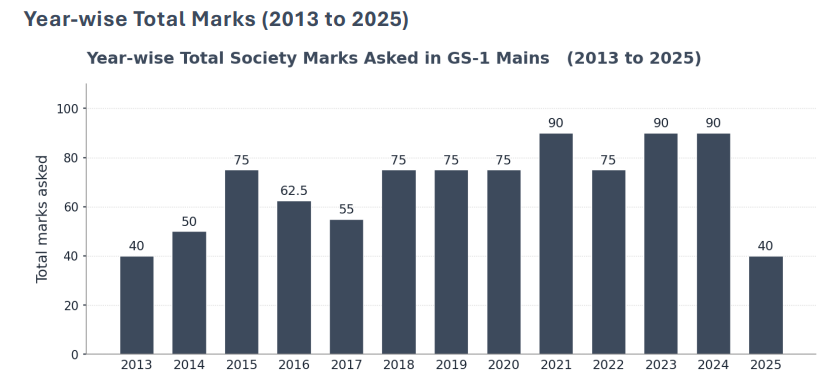
The thematic analysis of UPSC Mains GS-I Society questions from 2013 to 2025 shows that Society continues to remain an important part of GS Paper-I. It also highlights that recent questions increasingly connect multiple themes, such as urbanisation with poverty, globalisation with women’s autonomy, and post-liberalisation economy with communalism.
2. Strategic Prioritisation of High-Weightage Themes
VAM Society 2026 helps aspirants identify which areas require deeper preparation. The document classifies Society themes into seven major chapters:
- The Salient Features of Indian Society
- Women in India: Their Issues, Role and Organisations
- Population and Associated Issues
- Poverty and Deprivation in Indian Society
- Urbanisation
- Effects of Globalisation on Indian Society
- Secularism, Communalism and Regionalism
The chapter-wise analysis shows that some themes have received consistently higher attention in UPSC Mains. Salient Features of Indian Society, Communalism-Secularism-Regionalism, Women in India, and Globalisation form the core priority areas. Poverty, Urbanisation and Population also remain important and need thorough preparation.
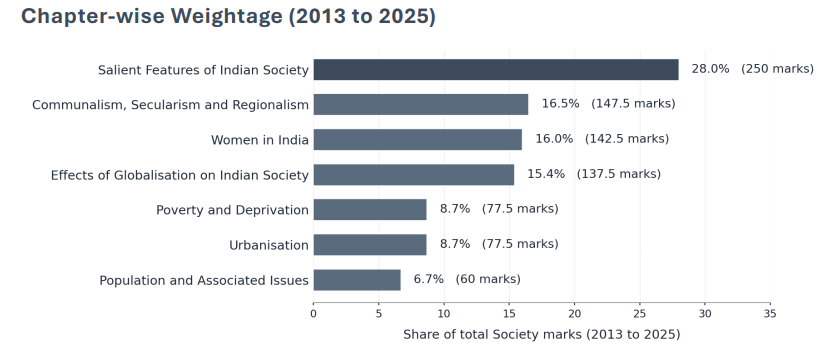
This helps aspirants use limited time more effectively and revise Society with a clear order of priority.
3. Analytical Depth, Not Factual Recitation
Many aspirants make the mistake of writing Society answers as general essays. UPSC, however, expects sociological insight. A good answer should explain the “why” and “how” of a social phenomenon, not just the “what”.
VAM Society 2026 addresses this by adding conceptual clarity and analytical frameworks. It explains themes through:
- Sociological concepts
- Thinkers and perspectives
- Current examples
- Case studies
- Diagrams
- Interlinkages between themes
- Contemporary Indian evidence
This allows aspirants to write answers that are more mature, balanced and exam-relevant.
What Makes VAM Society 2026 Answer-Oriented?
1. Key Data and Facts at a Glance
Data makes Society answers specific and credible. VAM Society includes key data boxes in chapters so that aspirants can use precise facts in introductions, body points and conclusions.
For example, in the chapter on Salient Features of Indian Society, the data box includes useful facts on:
- Linguistic diversity
- Religious composition
- Scheduled Castes and Scheduled Tribes
- OBC estimates
- Inter-caste and inter-religious marriage
- Caste-economy gaps
- Caste-based violence
- Family and marriage in transition
- Constitutional provisions
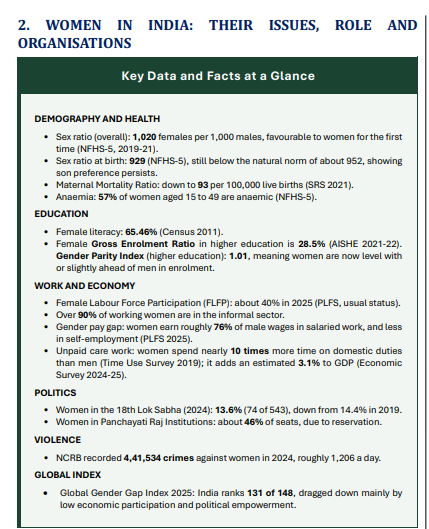
Such data points help aspirants avoid vague statements and write answers with evidence.
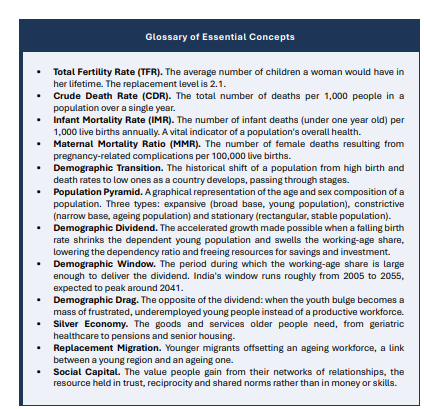
2. Glossary of Essential Sociological Concepts
Society answers become stronger when they use precise terminology. VAM Society provides a glossary of important concepts such as:
- Syncretism
- Pluralism
- Cross-cutting cleavages
- Composite culture
- Varna and Jati
- Endogamy
- Commensality
- Jajmani system
- Ascribed and achieved status
- Dominant caste
- Sanskritisation
- Social capital
- Relative deprivation
- Functional jointness
These terms allow aspirants to write with sociological precision.
3. Case Studies Grounded in Indian Reality
Case studies make Society answers more grounded. Instead of writing only theoretical points, aspirants can use real Indian examples to make their answers more persuasive.
VAM Society includes named and reusable case studies such as:
- Niyamgiri
- Dharavi
- Telangana caste survey
- Bezwada Wilson story
- Mithila as a cultural region
- Matriliny among Khasi and Nair
- Caste, class and power examples
- Urban segregation and exclusion
- Gender and work-related examples
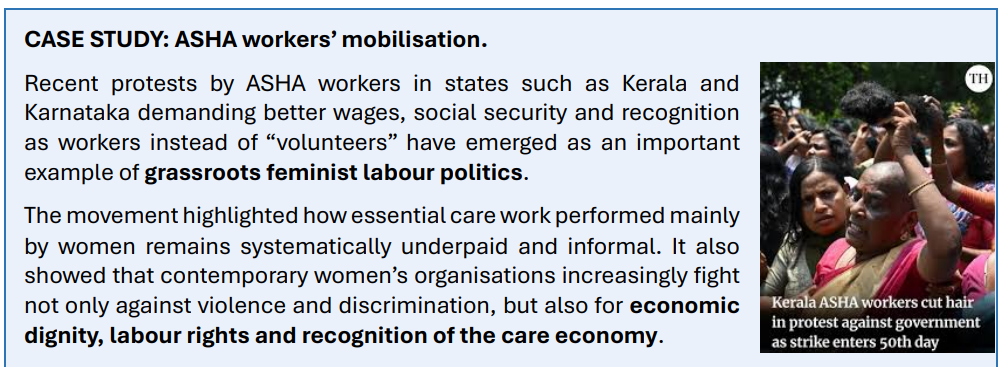
Aspirants can use such examples across multiple question types. For instance, Dharavi can be used in urbanisation, informal economy, migration, poverty, and social resilience. Niyamgiri can be used in tribal rights, development, environment, displacement and marginalisation.
4. Simple Replicable Diagrams
A good diagram can make an answer more organised and examiner-friendly. VAM Society uses diagrams that can be reproduced quickly in the exam.
These diagrams help aspirants present complex issues in a compact form. For example:
- Diversity vs Pluralism
- Cross-cutting cleavages
- Caste-Class-Power overlap
- Features of traditional caste system
- Jajmani system
- Forces reshaping Indian society
- Poverty and deprivation frameworks
- Urban exclusion and segregation models
- Globalisation’s social impact framework
Such visual presentation improves answer structure without consuming too much time.
5. Thinkers as Enrichment, Not Burden
Society answers can be enriched with thinkers, but aspirants should not overload answers with names. VAM Society uses thinkers selectively and practically. The idea is not to memorise every scholar, but to use one or two relevant thinkers in the right place.
For example:
- André Béteille can be used for caste, class and power
- Yogendra Singh can be used for modernisation of Indian tradition
- M.N. Srinivas can be used for Sanskritisation and dominant caste
- Louis Wirth can be used for urbanism as a way of life
- Amartya Sen can be used for poverty, capabilities and deprivation
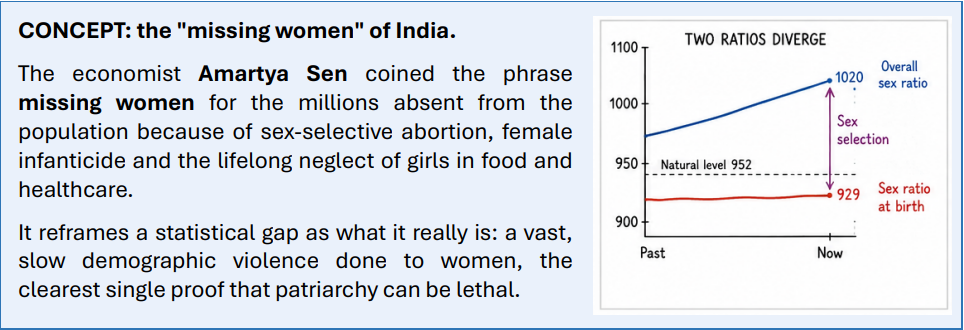
Used carefully, thinkers can make an answer more authoritative and mature.
Sample: How VAM Society Can Improve an Answer
Let us take an example from the theme of caste in modern India.
Possible UPSC-Style Question
“Why is caste identity in India both static and fluid? Discuss with suitable examples.”
A basic answer may only say that caste is static because it is based on birth and fluid because of education, migration and politics. However, this would remain generic.
Using VAM Society, the answer can be made sharper.
Introduction
Begin by stating that caste in India remains static in terms of birth-based identity and endogamy, but fluid in terms of class mobility, political mobilisation, occupational change and associational forms.
Body Part 1: Why Caste is Static
Explain the continuing features of caste:
- Hereditary membership
- Endogamy
- Ritual hierarchy
- Commensality and social boundaries
- Caste-based discrimination
- Caste-economy overlap
- Caste-based violence and exclusion
Body Part 2: Why Caste is Fluid
Then explain how modern forces are reshaping caste:
- Education and urban employment
- Reservation and political representation
- Migration and urban anonymity
- Caste associations and vote-bank mobilisation
- Rise of dominant castes
- Dalit assertion and identity movements
- New caste-based economic networks
Body Part 3: Analytical Enrichment
Use André Béteille’s framework of caste, class and power. Ritual rank may weaken, but caste can persist as a source of political mobilisation and economic networking. This explains why caste is neither simply disappearing nor remaining unchanged.
Conclusion
Conclude that caste in India is undergoing transformation rather than disappearance. It has weakened as a ritual order in many spheres, but continues to operate through marriage, politics, networks, inequality and identity.
This structure makes the answer conceptual, current, data-backed and analytical.
Key Areas Covered in VAM Society 2026
1. Salient Features of Indian Society
This chapter covers diversity, unity in diversity, hierarchy, community, civilisational continuity, assimilation, caste, class, power, family, kinship, village, religion, culture, region, and interlinkages.
It also provides useful concepts such as pluralism, composite culture, cross-cutting cleavages, functional jointness, Jajmani system, Varna-Jati distinction, Sanskritisation and dominant caste.
2. Women in India: Issues, Role and Organisations
This chapter helps aspirants understand gender through multiple dimensions such as patriarchy, sex-gender distinction, women’s health, violence, unpaid care work, economic participation, political representation, women’s movements and legal reforms.
It is especially useful for questions on women’s autonomy, Female Labour Force Participation, care economy, gender-based violence, political participation and feminist movements.
3. Population and Associated Issues
The population chapter covers concepts and measurement of population, theories of population, demographic dividend, ageing, migration, gender dimension, environment-development linkages, social capital and population policy.
This chapter is useful for questions on demographic dividend, demographic transition, ageing India, migration, fertility decline and population-development linkages.
4. Poverty and Deprivation in Indian Society
This chapter goes beyond income poverty and looks at poverty as deprivation. It covers measures of poverty, paradoxes of Indian poverty, structural drivers, lived experiences of poverty, climate change, AI and future vulnerabilities.
It helps aspirants frame answers around dignity, capability, multidimensional poverty, exclusion, health, education, gender, caste and climate vulnerability.
5. Urbanisation
Urbanisation is increasingly linked with social transformation. This chapter explains urban growth, urbanism as a way of life, stratification in urban space, segregation, marginalisation, housing crisis, infrastructure deficits, urban environment, liveability, cost of living, safety and urban governance.
It is useful for questions on slums, migration, informal settlements, urban poverty, smart cities, governance, urban commons and social exclusion.
6. Effects of Globalisation on Indian Society
The globalisation chapter covers cultural, institutional, economic and social dimensions. It examines identity, values, lifestyle, consumption, family, marriage, kinship, work, agriculture, class and specific social groups.
This chapter is highly important because many recent UPSC questions connect globalisation with family, women, culture, consumption and social change.
7. Secularism, Communalism and Regionalism
This chapter covers Indian secularism, pluralism, composite culture, personal laws, UCC debate, communalism, its forms and drivers, consequences, ways to tackle communalism, regionalism, federal accommodation and contemporary tensions.
This chapter is useful for questions on secularism, communal harmony, identity politics, regional aspirations, federalism, diversity and social cohesion.
How to Use VAM Society 2026 Effectively
Step 1: Begin with Thematic Analysis
Start by reading the thematic analysis of Society questions from 2013 to 2025. This will help you understand examiner priorities and avoid random preparation.
Step 2: Use Key Data Boxes for Introductions
Mark 2–3 data points from every chapter that can be used in multiple answers. These will help you write stronger introductions and evidence-based arguments.
Step 3: Build a Glossary Sheet
Prepare a one-page glossary of important terms such as pluralism, syncretism, social capital, endogamy, relative deprivation, functional jointness and communalism. Use these terms naturally in answers.
Step 4: Prepare Reusable Case Studies
Select 10–12 case studies from the VAM that can be used across multiple themes. For example, one case study may help in poverty, urbanisation, migration and exclusion.
Step 5: Practise Simple Diagrams
Do not try to draw complex diagrams. Practise simple frameworks like diversity vs pluralism, caste-class-power, urban exclusion, poverty cycle, care economy and communalism drivers.
Step 6: Use Thinkers Selectively
For each chapter, remember one or two thinkers and their core idea. Use them only where they add value.
Step 7: Practise Theme-Linking
Recent UPSC questions often link two themes. Practise answers such as:
- Urbanisation and poverty
- Globalisation and women’s autonomy
- Caste and democracy
- Population and gender
- Communalism and post-liberalisation economy
- Technology and socialisation
- Migration and urban exclusion
This will help you handle 15-mark questions more confidently.
Last-Mile Benefits of VAM Society 2026
In the final phase before Mains, aspirants need resources that help them revise quickly and write better. VAM Society 2026 provides:
- Exam-oriented thematic coverage
- PYQ-based preparation
- Key data and facts
- Glossary of sociological terms
- Case studies from Indian society
- Simple answer diagrams
- Thinker-based enrichment
- Chapter-wise strategic insights
- Analytical frameworks for 10-marker and 15-marker answers
It allows aspirants to move from scattered reading to structured answer preparation.
[Download VAM Society 2026 PDF]
Final Word
Society can become a scoring area in GS Paper-I when aspirants move beyond generic writing. The goal is not to write more, but to write with clarity, evidence, nuance and sociological depth.
VisionIAS VAM Society 2026 is designed to support this approach. It helps aspirants understand Indian society as a living and changing reality, while also preparing them to present answers in a concise, analytical and examiner-friendly manner.
Use it as an answer-enrichment tool. Read the PYQ analysis before each chapter, mark key data, revise glossary terms, practise diagrams, and integrate case studies into your answers.
When sociological insight meets current evidence and structured presentation, answer quality improves. Let VAM Society 2026 be your strategic companion for UPSC Mains GS Paper-I.
VisionIAS Value added Material (VAM) Reflections in UPSC GS paper 2025
Below are the related links showcasing how VisionIAS VAM (Value added material) were reflected in UPSC GS Papers 2025 and how they proved helpful in enhancing UPSC Mains answer writing.
| GS Paper 1 : Reflections from VAM | GS Paper 2 : Reflections from VAM |
| GS Paper 3 : Reflections from VAM | GS Paper 4 (Ethics) : Reflections from VAM |
FAQs on VisionIAS VAM Society 2026
1. What is VisionIAS VAM Society 2026?
VisionIAS Value Added Material Society 2026 is an exam-oriented resource for UPSC CSE Mains GS Paper-I Indian Society. It provides structured coverage of the syllabus, PYQ analysis, key data, glossary, case studies, diagrams and answer-enrichment content.
2. How does VAM Society help in answer writing?
It helps aspirants write analytical answers by providing sociological concepts, current data, Indian case studies, simple diagrams, thinkers and theme-wise frameworks.
3. Is VAM Society useful for last-minute revision?
Yes. Its key data boxes, glossary, PYQ analysis, diagrams, and chapter-wise strategic insights make it useful for quick and focused revision before Mains.
4. What are the major themes covered in VAM Society 2026?
It covers Salient Features of Indian Society, Women in India, Population, Poverty and Deprivation, Urbanisation, Globalisation, Secularism, Communalism and Regionalism.
5. What is the best way to use VAM Society 2026?
Start with thematic analysis and PYQ trends, then revise chapter-wise key data, glossary, diagrams and case studies. Finally, practise writing answers that connect two or more Society themes.