General Studies 3
VisionIAS VAM 2026 Internal Security: Current, Analytical and Exam-Ready Preparation for GS Paper-III
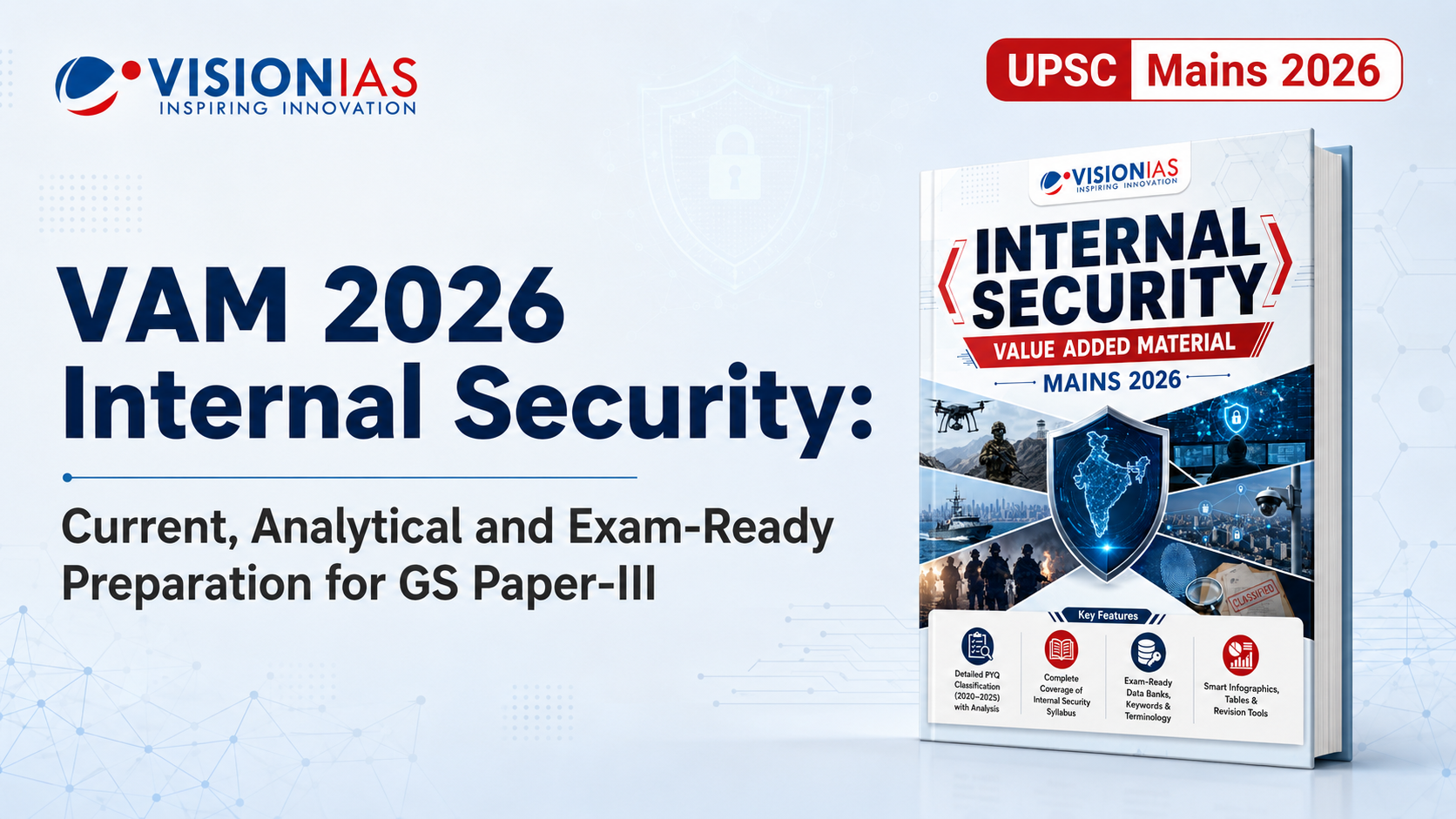











Internal Security is one of the most dynamic and analytical areas of UPSC GS Paper-III. It is not limited to memorising definitions of terrorism, insurgency, cyber security or border management. UPSC expects aspirants to understand how security threats evolve, how they are linked with governance and development, and how India responds through policy, institutions, technology, diplomacy and security forces.
In recent years, India’s internal security landscape has changed rapidly. Issues such as Left-Wing Extremism, cross-border terrorism, cyber warfare, drone-based threats, digital radicalisation, money laundering, organised crime, grey-zone warfare, border management and the role of security agencies have become increasingly interconnected.
This is where VisionIAS Value Added Material (VAM) Internal Security 2026 becomes highly useful for Mains preparation. It is designed as a comprehensive and exam-oriented resource that helps aspirants connect static concepts with recent developments, use relevant data and keywords, and write structured, analytical and high-scoring answers in GS Paper-III.
[Download VAM Internal Security 2026 PDF]
Why Internal Security Requires a Focused Mains Strategy
Internal Security questions in UPSC Mains are rarely one-dimensional. A question on Naxalism may require aspirants to connect development deficits, tribal alienation, governance gaps, land rights, security operations and rehabilitation. A question on cyber security may require linkage with critical infrastructure, digital economy, social media, deepfakes, data protection and national security architecture. Similarly, a question on terrorism may demand understanding of external state actors, non-state proxies, terror financing, radicalisation, border infiltration and diplomatic countermeasures.
Therefore, Internal Security preparation requires:
- Conceptual clarity
- Syllabus-wise coverage
- PYQ-based prioritisation
- Current-affairs integration
- Legal and institutional awareness
- Use of data, examples and keywords
- Analytical answer writing
- Balanced security-development perspective
VisionIAS VAM Internal Security 2026 has been prepared with this exact requirement in mind.
Internal Security in GS Paper-III: Why It Matters
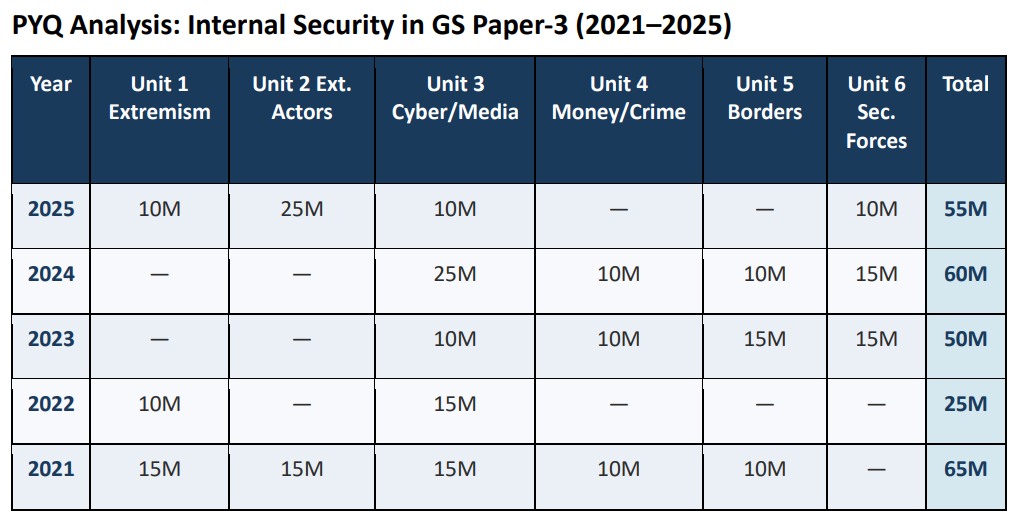
Internal Security has consistently remained an important component of GS Paper-III. The subject usually contributes around 50–65 marks in the paper, making it a high-return area for serious Mains preparation.
The importance of Internal Security has increased because the nature of threats has changed. Traditional concerns such as terrorism, insurgency and border infiltration now overlap with non-traditional threats such as cyber attacks, drone use, fake currency, narcotics, information warfare, social media radicalisation and organised crime.
Aspirants therefore need answers that are not merely descriptive. They must show the ability to analyse the threat matrix and propose practical, constitutional and security-sensitive solutions.
Also, Read blog to know VAM 2025 Reflection in UPSC Mains 2025 GS- 3 paper
What Makes VisionIAS VAM Internal Security 2026 Useful?
1. PYQ-Based and Exam-Oriented Approach
A key strength of the VAM is its detailed PYQ classification and analysis from recent years. This helps aspirants understand which areas are repeatedly tested and how UPSC frames questions.
The PYQ analysis shows that:
- Cyber Security and Communication Networks have appeared consistently in recent years.
- LWE and Extremism remain important and often return in high-weightage questions.
- External state and non-state actors, especially cross-border terrorism, remain central to the syllabus.
- Money laundering and organised crime have gained importance due to terror-financing linkages.
- Border management and maritime security remain recurring themes.
- Security forces, agencies, AFSPA, NIA, CAPFs and police reforms are important for institutional questions.
This allows aspirants to prepare with precision rather than reading Internal Security randomly.
2. Complete Coverage of the Internal Security Syllabus
The VAM covers all major components of the UPSC GS Paper-III Internal Security syllabus. Its six-unit structure includes:
- Linkages between Development and Spread of Extremism
- Role of External State and Non-State Actors in creating challenges to Internal Security
- Cyber Security, Communication Networks and Role of Media
- Money Laundering, Organised Crime and Terrorism
- Security Challenges and their Management in Border Areas
- Various Security Forces and Agencies and their Mandate
This structure helps aspirants revise the syllabus systematically and map each topic with UPSC’s demand.
3. Static + Current Integration
Internal Security is highly dynamic. Static concepts such as terrorism, border management or cyber security cannot be prepared without recent examples.
VAM Internal Security 2026 integrates contemporary developments such as:
- Operation Sindoor
- Pahalgam attack
- Drone-based terrorism
- Hybrid terrorism
- Grey-zone warfare
- Digital radicalisation
- Deepfakes and algorithmic manipulation
- Cyber attacks on critical infrastructure
- FICN and narco-terrorism
- Crime-terror nexus
- Shifting Red Corridor
- Northeast peace agreements
- Border fencing and smart surveillance
- Women in security forces
- Integrated Theatre Commands
This makes the content relevant for Mains 2026 and helps aspirants write updated answers.
4. Answer-Writing Tools
The VAM provides several answer-writing tools such as:
- Key Quotes
- Critical Data Points
- Most Recent Developments
- Keywords for Answer Writing
- Tables and frameworks
- Security doctrines
- Success models
- Way-forward points
For example, keywords such as SAMADHAN Doctrine, Red Corridor to Red Pockets, Tri-Junction Theory, Hybrid Terrorism, Over-Ground Workers, Doval Doctrine, Strategic Restraint to Active Deterrence, Crime-Terror Nexus, Grey-Zone Warfare, CIBMS, Maritime Domain Awareness and Theatre Commands can help aspirants write more precise and exam-ready answers.
How VAM Internal Security Helps in Answer Writing
1. Moving from Descriptive to Analytical Answers
Many aspirants write Internal Security answers by listing threats. However, UPSC rewards answers that analyse causes, linkages, consequences and solutions.
For example, in a question on Left-Wing Extremism, merely writing about Naxal violence is not enough. A strong answer should examine:
- Developmental deprivation
- Resource conflict over Jal, Jangal, Jameen
- Tribal displacement
- Failure of PESA and FRA implementation
- Administrative vacuum
- Maoist parallel governance
- Security response
- Developmental saturation
- Rehabilitation and surrender policy
This helps aspirants write answers that show depth and maturity.
2. Using Data for Credibility
Internal Security answers become stronger when supported by credible data. The VAM provides important data points that can be used in introductions, body arguments and conclusions.
For example:
- Reduction in LWE-affected districts
- Decline in LWE violence and fatalities
- Shrinking Red Corridor
- Northeast insurgency decline
- J&K civilian death trends
- Operation Sindoor-related details
- Bru-Reang Agreement rehabilitation numbers
- Cyber and border-related developments
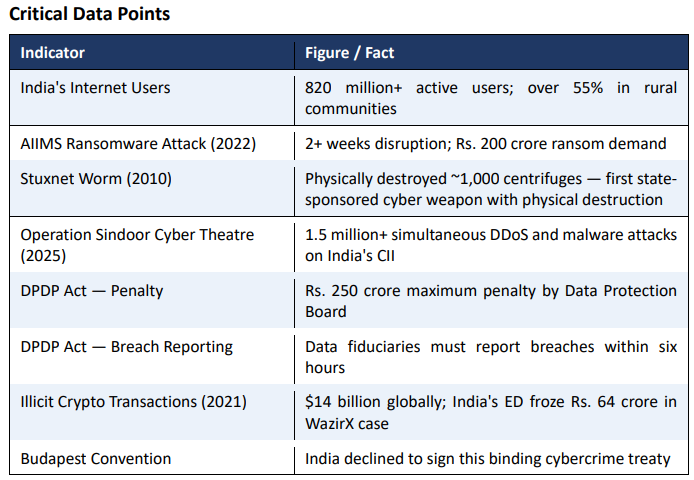
Data makes the answer specific and prevents it from becoming generic.
3. Using Frameworks and Doctrines
A strong Internal Security answer should use frameworks where relevant. VAM Internal Security includes several such tools:
- SAMADHAN Doctrine for LWE
- 3C Connectivity Model
- Clear-Hold-Build approach
- Doval Doctrine
- Kinetic vs Non-Kinetic Warfare
- String of Pearls vs Necklace of Diamonds
- Crime-Terror Continuum
- Disaster-style preparedness for cyber incidents
- Multi-layered security architecture
- Community-based border management
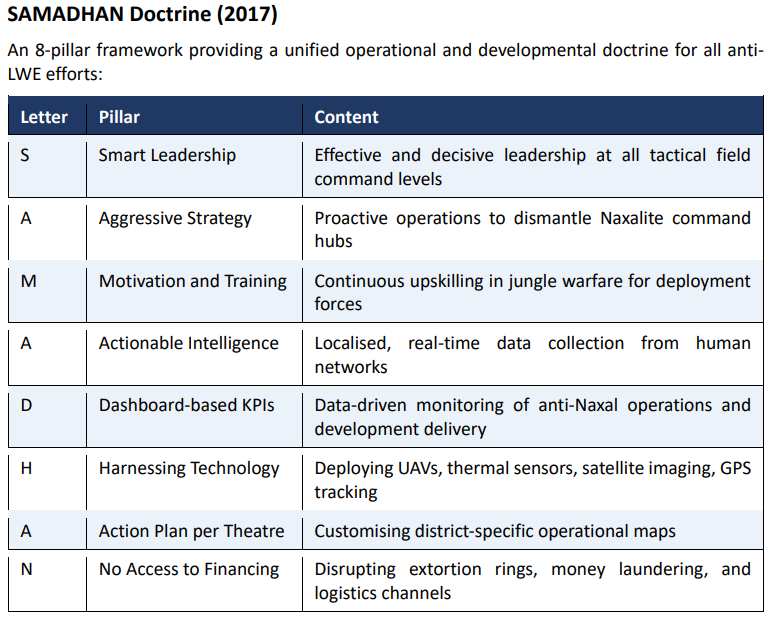
Frameworks help aspirants organise answers better and show policy awareness.
4. Linking Security with Development and Governance
UPSC frequently tests whether aspirants understand the link between internal security and governance. Extremism, insurgency, border insecurity and crime often thrive in spaces where governance is weak.
For instance:
- LWE is linked with tribal alienation, land rights, displacement and weak governance.
- Northeast insurgency is linked with identity anxiety, migration, underdevelopment and border geography.
- J&K insurgency is linked with external sponsorship, radicalisation, hybrid terrorism and local grievances.
- Border areas face not only infiltration but also livelihood, migration, connectivity and community issues.
- Cyber security is linked with digital governance, financial systems and critical infrastructure.
Thus, an answer should not treat security as purely military or policing-driven. It must also discuss development, trust, institutions and community participation.
Key Areas Covered in VAM Internal Security 2026
1. Linkages Between Development and Spread of Extremism
This unit covers extremism, Left-Wing Extremism, North-East insurgency and Jammu & Kashmir insurgency. It explains ideological foundations, historical evolution, root causes, government strategies, success models, emerging challenges and way forward.
Important themes include:
- LWE and developmental deprivation
- SAMADHAN Doctrine
- Red Corridor contraction
- North-East ethnic insurgencies
- AFSPA and peace agreements
- Manipur ethnic violence
- J&K insurgency and hybrid terrorism
- Operation Sindoor and the “new normal” in counter-terror response
2. Role of External State and Non-State Actors
This unit examines how external state and non-state actors create internal security challenges for India. It covers Pakistan-sponsored terrorism, China’s grey-zone coercion, spillover challenges from neighbours, terrorism, transformed asymmetric threats, crime-terror continuum and India’s counter-strategy.
Important themes include:
- Pakistan’s proxy-war strategy
- ISI and terror infrastructure
- Narco-terrorism and FICN
- China’s salami slicing and cyber espionage
- String of Pearls vs Necklace of Diamonds
- Terror financing
- Doval Doctrine
- Proactive defence paradigms
3. Cyber Security, Communication Networks and Role of Media
This unit covers cyber security fundamentals, cyber threat matrix, emerging technology challenges, India’s cyber defensive architecture, role of media and social networking in internal security, fake news, misinformation, radicalisation and regulation.
Important themes include:
- Cyber attacks on critical infrastructure
- Deepfakes and information manipulation
- Social media radicalisation
- Dark web and encrypted communication
- Cyber fraud and financial security
- Media responsibility during security crises
- Regulation of digital platforms
4. Money Laundering, Organised Crime and Terrorism
This unit explains money laundering, its stages, techniques, impact, India’s legal and institutional framework, global AML framework, organised crime, crime-terror nexus and India’s initiatives.
Important themes include:
- Placement, layering and integration
- PMLA framework
- ED and FIU-IND
- FATF framework
- Hawala networks
- Drug trafficking
- Arms smuggling
- FICN
- Organised crime-terror convergence
5. Security Challenges and Border Management
This unit covers India’s border overview, bilateral border challenges, thematic issues, illegal migration, role of communities in border management, maritime security, airspace surveillance and critical border events.
Important themes include:
- India-Pakistan border challenges
- India-China LAC issues
- India-Bangladesh border and illegal migration
- India-Myanmar border and insurgent movement
- India-Nepal and India-Bhutan border dynamics
- Smart fencing and CIBMS
- Maritime security and coastal threats
- Kargil Review Committee
- Pahalgam attack and Operation Sindoor
6. Security Forces and Agencies
This unit covers India’s multi-layered security architecture, National Security Council, intelligence agencies, CBI, NIA, UAPA, enforcement agencies, CAPFs, specialised forces, armed forces in internal security, AFSPA, state police, Prakash Singh case, women in security forces, integrated theatre commands and reforms.
Important themes include:
- NSC and intelligence coordination
- NIA and counter-terror investigation
- UAPA framework
- Roles of BSF, ITBP, SSB, Assam Rifles, CRPF, CISF and NSG
- AFSPA debate
- Police modernisation
- CAPF and police reforms
- Theatre commands and security architecture reforms
How to Use VAM Internal Security 2026 Effectively
Step 1: Start with PYQ Analysis
Begin with the PYQ table and key observations. This will help you understand which units are high priority and how UPSC has distributed marks across topics.
Step 2: Map Each Topic with the Syllabus
Internal Security has a very specific syllabus. Map each unit with syllabus phrases such as extremism, external actors, cyber security, border management, organised crime and security forces.
Step 3: Prepare a Keywords Sheet
Create a one-page keywords sheet. Include terms like:
- SAMADHAN Doctrine
- Red Corridor
- Hybrid terrorism
- OGWs
- Grey-zone warfare
- Narco-terrorism
- FICN
- Crime-terror nexus
- CIBMS
- Maritime Domain Awareness
- AFSPA
- CAPF reforms
- Active deterrence
These keywords can upgrade answer quality quickly.
Step 4: Prepare Data Points for Introductions
Use 8–10 high-utility data points from the VAM, such as LWE reduction, Northeast violence decline, J&K trends, Operation Sindoor details and terror-financing examples.
Step 5: Make Framework-Based Notes
For every major topic, prepare a compact framework:
- Causes
- Manifestations
- Current developments
- Government response
- Challenges
- Way forward
This will help in both 10-marker and 15-marker questions.
Step 6: Link Static with Current Affairs
Every static topic should be linked with current examples. For instance:
- LWE with Red Corridor contraction
- Cyber security with deepfakes and critical infrastructure threats
- Terrorism with Pahalgam and Operation Sindoor
- Border management with drones and smart fencing
- Organised crime with terror financing and narcotics
- Security forces with theatre commands and police reforms
Step 7: Practise Balanced Conclusions
Internal Security answers should not end with only force-based solutions. Use balanced conclusions that combine:
- Security
- Development
- Technology
- Community participation
- Rights-based governance
- Institutional reforms
- International cooperation
Last-Mile Benefits of VAM Internal Security 2026
During the final phase before Mains, aspirants need concise, updated and answer-ready material. VAM Internal Security 2026 helps by providing:
- Complete syllabus coverage
- PYQ classification and analysis
- Current developments for Mains 2026
- Data points and keywords
- Security doctrines and frameworks
- Unit-wise answer tools
- Updated examples such as Operation Sindoor, Pahalgam attack, drone threats, cyber threats and Red Corridor contraction
- Institutional and legal frameworks
- Balanced way-forward points
It allows aspirants to move from scattered preparation to structured, current and exam-ready revision.
Final Word
Internal Security can become a scoring area in GS Paper-III when aspirants prepare it with clarity, structure and current relevance. The subject must not be treated only as policing, terrorism or border management. It must be understood as a complex interface of development, governance, technology, geopolitics, law, institutions and citizen trust.
VisionIAS VAM Internal Security 2026 is designed to support this approach. It helps aspirants revise the entire syllabus in a structured manner, enrich answers with data and keywords, and connect static themes with current developments.
Use it as an answer-enrichment tool. Read the PYQ analysis, prepare keywords, revise security doctrines, learn data points, practise frameworks, and apply the content in Mains-style answers.
When security understanding meets analytical clarity and updated examples, GS Paper-III answers become stronger. Let VAM Internal Security 2026 be your strategic companion for UPSC Mains GS Paper-III.
[Download VAM Internal Security 2026 PDF]
VisionIAS Value added Material (VAM) Reflections in UPSC GS paper 2025
Below are the related links showcasing how VisionIAS VAM (Value added material) were reflected in UPSC GS Papers 2025 and how they proved helpful in enhancing UPSC Mains answer writing.
| GS Paper 1 : Reflections from VAM | GS Paper 2 : Reflections from VAM |
| GS Paper 3 : Reflections from VAM | GS Paper 4 (Ethics) : Reflections from VAM |
FAQs on VisionIAS VAM Internal Security 2026
1. What is VisionIAS VAM Internal Security 2026?
VisionIAS Value Added Material Internal Security 2026 is an exam-oriented resource for UPSC CSE Mains GS Paper-III. It covers the complete Internal Security syllabus, including extremism, terrorism, cyber security, border management, money laundering, organised crime and security agencies.
2. How does this VAM help in answer writing?
It helps aspirants write better answers through PYQ analysis, data points, keywords, security doctrines, current developments, legal frameworks, institutional coverage and structured way-forward points.
3. Is this useful for last-minute revision?
Yes. Its unit-wise structure, PYQ table, keywords, critical data points, recent developments and answer-writing frameworks make it useful for quick revision before Mains.
4. What are the major themes covered in this VAM?
It covers LWE, North-East insurgency, J&K insurgency, external state and non-state actors, terrorism, cyber security, media and social media, money laundering, organised crime, border management, maritime security and security forces.
5. What is the best way to use VAM Internal Security 2026?
Start with PYQ analysis, revise syllabus-wise units, prepare keywords and data points, link static topics with current developments, and practise answer frameworks for 10-marker and 15-marker questions.