Officer's View
Leadership, Technology & Nation-Building : Key Lessons from an Interactive Session with Shri Prabhat Kumar, IRS
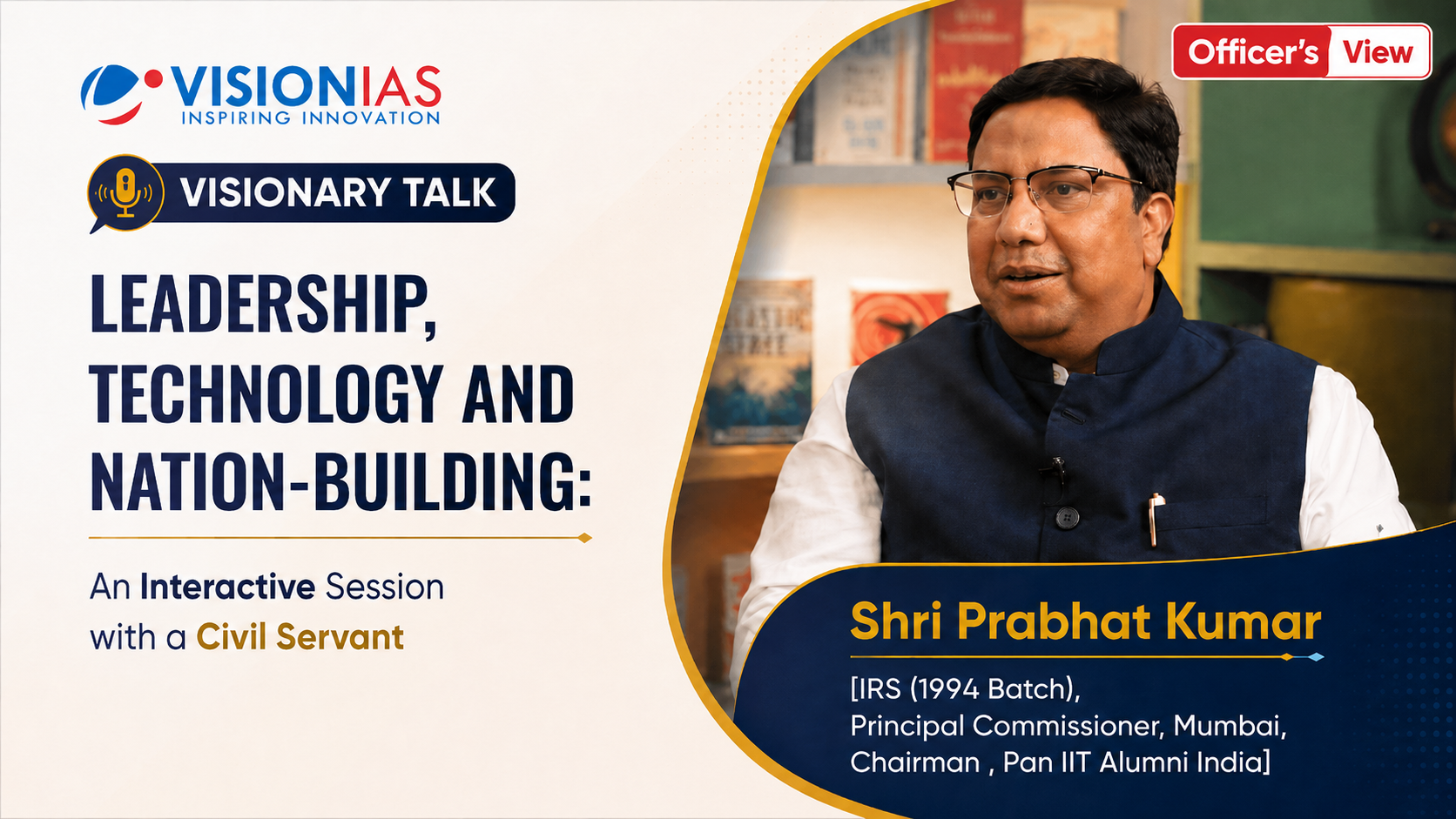




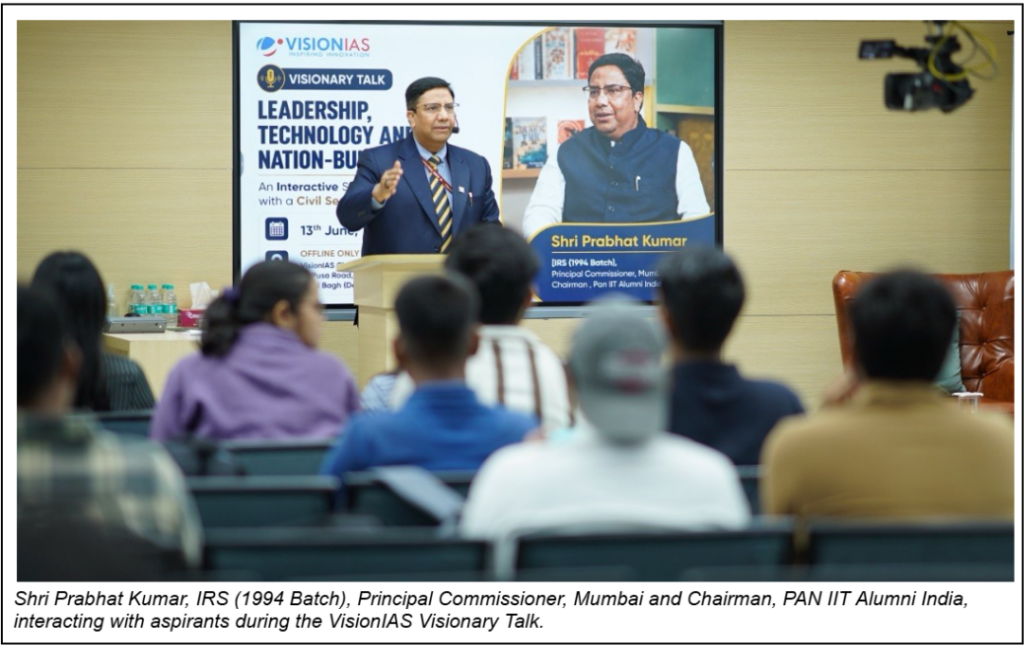
VisionIAS recently hosted a Visionary Talk with Shri Prabhat Kumar, IRS (1994 Batch), Principal Additional Director General at NACIN, Mumbai and Chairman of PAN IIT Alumni India. The interactive session brought together civil services aspirants for an insightful discussion on leadership, technology, governance, and nation-building.
Drawing from his distinguished career in public service, his academic journey at IIT Delhi, and his work with PAN IIT, Shri Prabhat Kumar shared valuable lessons on service orientation, resilience, innovation, and the evolving role of technology in governance.
Key Takeaways from the Visionary Talk
1. One Interaction Can Inspire a Life: The Dumka Story
Before speaking about purpose, leadership, or technology, Shri Prabhat Kumar began with a memory — quiet, personal, and entirely unexpected in its origin.
As a young student in Class VII in Dumka, Jharkhand, he had no vision of what he wanted to become. There was, he recalled, no clarity — no sense of direction, no map of what lay ahead. It was in that state of uncertainty that his school organised a talk by a young woman SDM, fresh from training, at her very first posting.
“I felt a little motivated. I thought she is doing something very right in her career. That discussion motivated me to try something like this in my life — to do whatever best I can.”
He was not describing a dramatic turning point. He was describing something simpler — a conversation, a presence, a sense that someone ahead of him was doing something meaningful. And that was enough.
The reason he shared this story was not to speak about himself. It was to explain why he had come to Vision IAS that morning.
Some interactions generate some positivity somewhere in people’s minds. Some minds may get inspired. If I can motivate even a single soul to do something good in their life, my purpose is served.
For aspirants, this is an important reminder: learning does not happen only through books and classrooms. Sometimes, the right words at the right time can create clarity, confidence, and direction. The chain of inspiration is long and it begins with small moments.
2. The Purpose Behind the Pursuit: Service Orientation Above All Else
Civil services may appear attractive for several reasons — authority, prestige, job security, social recognition, and the opportunity to participate in policy implementation. Shri Prabhat Kumar acknowledged these dimensions, but emphasised that they cannot be the primary reason for entering public service.
The deeper purpose of civil services, he said, lies in service orientation — the clarity of whom one seeks to serve and why. Without this mindset, the pursuit remains incomplete.
You are here not to rule, but to serve.
In a democratic system, the administrative structure exists to implement policies for the people and respond to their needs. A civil servant, therefore, is not merely an office-holder, but an instrument of public service and nation-building.
For aspirants, before preparing for the examination, one must be clear about the purpose behind the pursuit. Civil services demand not just knowledge and effort, but the right attitude — a commitment to serve people and contribute meaningfully to the nation.
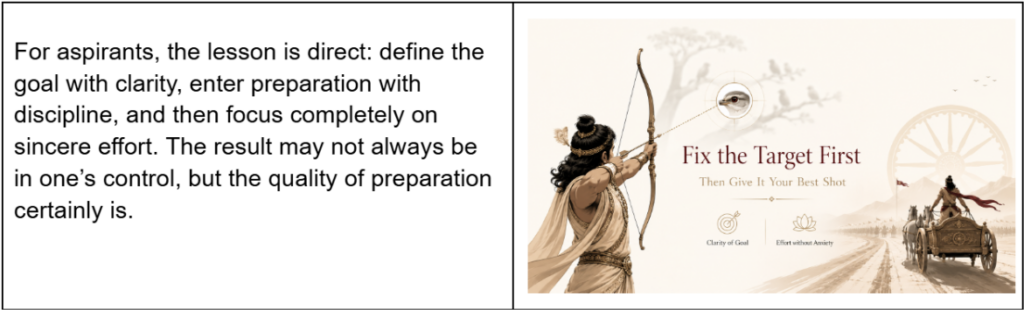
3. Fix the Target First — Then Give It Your Best Shot
Shri Prabhat Kumar drew upon the Mahabharata to underline the importance of clarity of purpose. When Dronacharya asked his students what they saw before them, each described something different — the tree, the branch, or the bird. Arjuna, however, saw only the eye of the bird.
For aspirants, he said, this is the kind of focus required in the civil services examination. Unless the target is clearly defined, the effort may remain scattered. “You have to set your eyes on the target. Until and unless you have your eyes clearly focused, you cannot achieve it.”
He also addressed the apparent tension between this target-oriented approach and the message of the Gita — “कर्मण्येवाधिकारस्ते मा फलेषु कदाचन “ i.e. to perform one’s duty without being attached to the result.
His explanation was simple: before entering the battlefield, the target must be clear; once the battle begins, one must stop worrying about the outcome and give one’s best.
4. The Delta X Principle: Keep Improving Every Day
One of the most practical ideas Shri Prabhat Kumar shared was the principle of “Delta X” — the idea of making a small but positive addition to oneself every day.
He urged aspirants to ask themselves a simple question: what is today’s delta? What positive contribution have I made to myself today? According to him, growth stops the moment a person becomes satisfied with yesterday’s level of effort or achievement.
“What is today’s delta? What positive contribution have I made to myself today?”
For aspirants, this principle is especially relevant. UPSC preparation is not built through one dramatic effort, but through consistent daily improvement — one better answer, one clearer concept, one revised topic, one improved habit.
He explained this through the image of a ten-storey staircase. If one looks at the entire climb from the bottom, it may appear overwhelming. But if one takes one step at a time, the distance covered becomes visible only when one looks back.
The larger lesson is simple: do not wait for motivation to arrive in one big moment. Build progress through small, disciplined increments every day.
As the Sanskrit wisdom reminds us, “उद्यमेन हि सिध्यन्ति कार्याणि न मनोरथैः।” i.e. no meaningful task is accomplished by wishful thinking alone; it requires effort.
5. Technology in Governance: Moving from Reactive to Proactive Systems
Shri Prabhat Kumar spoke at length about how technology is reshaping the role of civil servants. In his view, governance can no longer depend only on human monitoring or delayed response. The future lies in using technology to anticipate, identify, and address problems more effectively.
He explained this through the example of traffic management. A conventional CCTV control room, where officers watch multiple screens and respond after an incident occurs, is largely reactive. A more advanced system would use computer vision and machine learning to detect unusual activity, generate alerts, and activate response teams in real time.
Drawing from his experience in Customs, he also spoke about data-driven passenger profiling. Every passenger or cargo consignment cannot be checked manually. Such an approach would create delays, queues, and inefficiency. Instead, data such as travel frequency, destination, duration of stay, and booking patterns can help identify risk indicators, allowing officers to focus on cases that require closer scrutiny.
“Can you possibly look into each and every cargo, everywhere? The answer lies in the technological solution.”
He also used examples such as gold smuggling and inter-state liquor movement to show that governance challenges often require both analytical thinking and field-level creativity. The task of a civil servant is not merely to enforce rules mechanically, but to understand patterns, identify weak links, and design practical solutions within real-world constraints.
The larger lesson for aspirants is clear: administration today demands more than authority and procedure. It requires technological awareness, data-driven thinking, creativity, and the ability to move from reactive governance to proactive problem-solving.
As he reminded students, every service has its own challenges. Ultimately, it comes down to the individual officer’s ability to understand the problem and find a workable solution.
6. AI and the Re-imagination of Governance
Shri Prabhat Kumar emphasised that artificial intelligence is not a distant possibility; it is already reshaping the way governance systems are imagined and designed.
“AI is coming. The governance model is changing. There will be an entirely new re-imagination of governance structures.”
For future civil servants, this shift is significant. Governance will increasingly require officers who can understand technology, use data responsibly, and think beyond conventional administrative processes. The challenge will not only be to adopt new tools, but to reimagine systems so that they become more efficient, responsive, and citizen-centric.
He explained that the purpose of any systemic change should be to improve efficiency — to reduce clutter, cut noise, and generate better outcomes from available resources. In public administration, this means solving problems in a way that makes the system clearer, faster, and more effective.
Through PAN IIT, he also referred to PARINITI, the PAN IIT AI Think Tank, which seeks to study India’s AI policy landscape, identify benchmarking gaps, and offer grounded recommendations to policymakers.
For aspirants, the lesson is clear: the civil servant of the future must be comfortable with change. Constitutional values, administrative sensitivity, and service orientation will remain central, but they must now be combined with technological awareness and the ability to lead governance transformation.
7. PAN IIT, Legacy, and Nation-Building
Shri Prabhat Kumar spoke about PAN IIT not merely as an alumni platform, but as a vehicle for carrying forward an institutional legacy rooted in nation-building.
He emphasised that institutions such as the IITs were created with a larger national purpose. That purpose, he said, should not be forgotten. Whether one is working in government, building a start-up, creating jobs, working in technology, or solving social problems, the underlying spirit should remain the same — contributing to the nation.
Under his chairmanship, PAN IIT has taken several initiatives, including conferences across cities, the PARINITI AI Think Tank, and efforts towards a venture fund to support early-stage start-ups through capital, mentorship, and patient support.
He also shared that leadership roles do not come automatically. Even his position as Chairman of PAN IIT came through an election, after persuasion, hesitation, and eventual participation.
Life gives nothing for granted. Everywhere, you have to struggle for it.
For aspirants, the lesson is twofold: institutions matter, but so does individual initiative. A legacy becomes meaningful only when individuals take responsibility to carry it forward through leadership, innovation, and service to society.
8. The 4:30 AM Discipline: Turning Purpose into Work
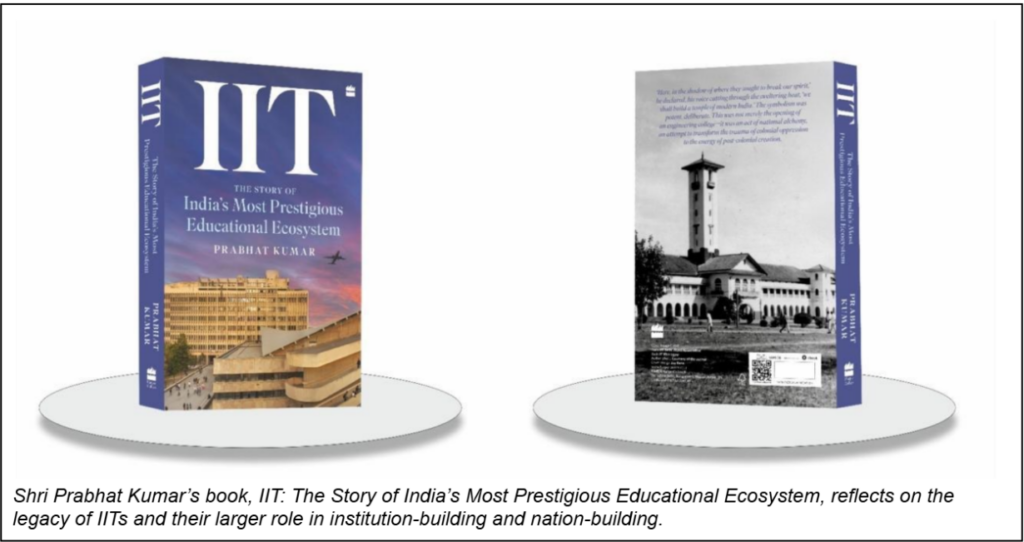
Shri Prabhat Kumar also spoke about the discipline behind writing his book, IIT: The Story of India’s Most Prestigious Educational Ecosystem. He did not present it merely as a book, but as an example of what sustained commitment looks like.
He shared that he would wake up at 4:30 every morning and write for nearly four hours before beginning his official day. This routine continued with consistency and required personal and family sacrifices.
The larger lesson was simple: meaningful work demands discipline. Passion alone is not enough; it must be supported by regular effort, patience, and the willingness to work quietly over time.
For aspirants, this is a powerful reminder. Whether the goal is writing a book, serving the country, or preparing for civil services, success requires a personal sense of purpose. One has to decide how far one wants to go — and then build the discipline to match that ambition.
A Closing Thought: Keep Expanding Your Limits
The session ultimately left aspirants with a simple but powerful reminder: civil services preparation is not only about clearing an examination. It is about building the mindset required for a life of responsibility, service, learning, and continuous growth.
Through his experiences, Shri Prabhat Kumar reminded students that purpose must come before pursuit, resilience must accompany effort, and focus must remain steady despite uncertainty. He also underlined that the future of governance will demand officers who are not only grounded in values, but also open to technology, innovation, and new ways of solving public problems.
His final message was one of limitless possibility.
Where you draw the line — where you say I am happy and satisfied — your growth stops exactly there. This entire sky is yours. Your wings are yours. Your courage is yours. How far you want to fly depends entirely on you.
For every aspirant, this is perhaps the most important takeaway: do not draw the line too early. Keep learning, keep improving, keep serving, and keep expanding the limits of what you believe is possible.