UPSC News
UPSC Mains 2026: Admit Card, Exam Timings, Schedule & Exam Pattern




The Union Public Service Commission (UPSC) has released the e-Admit Card for the Civil Services (Main) Examination 2026. Candidates appearing for the examination can now download their admit cards through the official UPSC portal.
With the examination approaching, candidates should download the e-Admit Card well in advance, verify their examination centre and personal details, and carefully read the instructions mentioned on it.
UPSC Mains Admit Card 2026: Download Link
Candidates can download the Civil Services (Main) Examination 2026 e-Admit Card through the official UPSC portal.
Download UPSC Mains Admit Card 2026
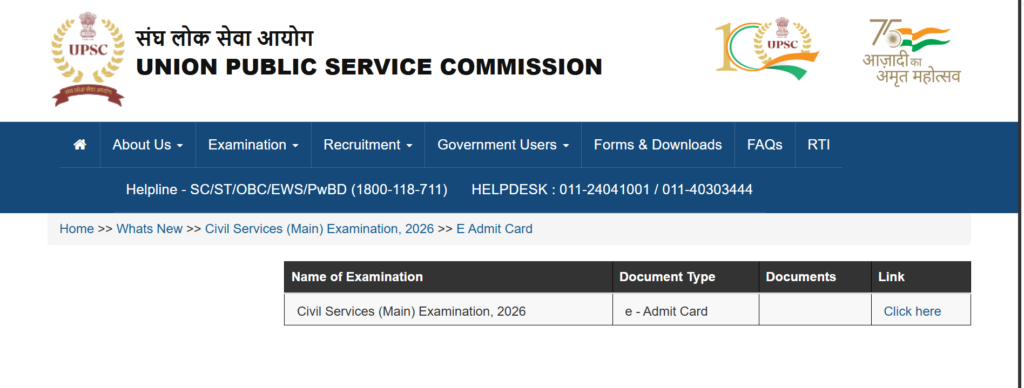
How to Download UPSC Mains Admit Card 2026
Candidates can follow these steps to access their e-Admit Card:
- Visit the official UPSC portal.
- Log in using the required registered credentials.
- Go to the relevant Examination / Admit Card section.
- Select Civil Services (Main) Examination, 2026.
- Click on the e-Admit Card download option.
- Download and save the admit card.
- Take a clear printout for use during the examination.
Candidates are advised not to wait until the last day to download the document.
Details to Check on the UPSC Mains Admit Card
After downloading the admit card, carefully verify:
- Candidate’s name
- Roll Number
- Examination centre and venue
- Examination/session details
- Photograph and other personal particulars
- Reporting and entry instructions
- Documents/items required at the examination centre
- Prohibited items and other examination-day guidelines
In case of any discrepancy, candidates should refer to the official UPSC instructions and contact the Commission through the prescribed channel.
UPSC Mains 2026 Exam Timings
The examination will be conducted in two three-hour sessions on days when both morning and afternoon papers are scheduled.
| Session | Timing | Duration |
| Forenoon Session | 9:00 AM – 12:00 Noon | 3 Hours |
| Afternoon Session | 2:30 PM – 5:30 PM | 3 Hours |
Candidates should carefully distinguish these timings from previous examination schedules and follow the timings mentioned in their 2026 e-Admit Card and official timetable.
UPSC Mains 2026: Complete Paper-Wise Schedule
The written examination is spread across two consecutive weekends. The Essay and General Studies papers are held during the first phase, followed by the qualifying language and Optional papers during the next weekend.
| Date | Day | Forenoon Session: 9:00 AM–12:00 Noon | Afternoon Session: 2:30 PM–5:30 PM |
| 21 August 2026 | Friday | Paper I – Essay | No Paper |
| 22 August 2026 | Saturday | Paper II – General Studies I | Paper III – General Studies II |
| 23 August 2026 | Sunday | Paper IV – General Studies III | Paper V – General Studies IV |
| 29 August 2026 | Saturday | Paper A – Indian Language | Paper B – English |
| 30 August 2026 | Sunday | Paper VI – Optional Subject Paper I | Paper VII – Optional Subject Paper II |
Official UPSC Mains 2026 Timetable Link
The sequence is particularly important for final revision planning. The Essay and four GS papers are completed during the first weekend, while candidates get the intervening period before appearing for the language and Optional papers.
UPSC Mains 2026 Exam Pattern
The Civil Services (Main) Examination consists of a written examination followed by the Personality Test/Interview.
The written examination comprises nine descriptive papers. Of these, two are qualifying in nature, while seven papers contribute to the candidate’s written merit score.
| Paper | Subject | Marks | Nature |
| Paper A | One Indian Language | 300 | Qualifying |
| Paper B | English | 300 | Qualifying |
| Paper I | Essay | 250 | Merit |
| Paper II | General Studies I | 250 | Merit |
| Paper III | General Studies II | 250 | Merit |
| Paper IV | General Studies III | 250 | Merit |
| Paper V | General Studies IV | 250 | Merit |
| Paper VI | Optional Subject – Paper I | 250 | Merit |
| Paper VII | Optional Subject – Paper II | 250 | Merit |
Marks Distribution
The seven merit papers together account for:
- Essay: 250 marks
- General Studies I–IV: 1,000 marks
- Optional Subject Paper I & II: 500 marks
Total Written Merit Marks: 1,750
The Personality Test carries 275 marks, taking the final maximum to 2,025 marks.
The Indian Language and English papers are qualifying in nature and their marks are not added to the final merit score.
What to Do Immediately After Downloading the Admit Card
Once the e-Admit Card has been downloaded, preparation should become increasingly exam-oriented and execution-focused.
1. Verify Your Examination Centre
Check the complete venue carefully. Candidates travelling to another city should finalise accommodation and travel arrangements early.
If possible, familiarise yourself with the route and approximate travel time to the centre beforehand.
2. Read the Admit Card Instructions Carefully
Do not rely solely on instructions followed in previous attempts or shared informally by others.
Check the admit card specifically for:
- Entry and reporting requirements
- Required documents
- Permitted items
- Prohibited items
- Any special instructions issued for the examination
3. Align Practice With Actual Exam Timings
The final few full-length tests can be attempted during the actual examination slots.
This helps condition the mind and body for:
- Sustained three-hour writing
- Morning-to-afternoon recovery
- Food and hydration planning
- Maintaining concentration across consecutive papers
4. Shift From Content Addition to Content Retrieval
Close to the examination, preparation should progressively shift from collecting resources to quickly retrieving and deploying what has already been prepared.
Revise high-utility material such as:
- Constitutional Articles and provisions
- Committee recommendations
- Important reports and indices
- Government initiatives
- Examples and case studies
- Data and statistics
- Maps and diagrams
- Thinkers and quotations
- Optional-specific value addition
The key question now is not simply “How much have I studied?” but “Can I recall and present the right content within the available time?”
Exam-Day Readiness: A Quick Checklist
Before leaving for the examination centre, ensure that you have:
- Printed the UPSC Mains e-Admit Card clearly
- Checked the examination venue and travel route
- Read all instructions printed on the admit card
- Arranged the required identification/documents
- Prepared only permitted stationery and other items
- Planned sufficient travel buffer
- Avoided carrying prohibited items
Candidates should rely on the official UPSC e-Admit Card for the final list of requirements and examination-day instructions.
Conclusion
The release of the UPSC Mains 2026 e-Admit Card marks the transition from preparation to final execution.
Candidates should now ensure that administrative requirements—admit card, examination centre, travel arrangements and exam-day instructions—are fully sorted so that their attention remains on performance.
Academically, the emphasis should move towards revision, recall, answer-writing efficiency, paper completion and maintaining consistency across consecutive papers.
UPSC Mains ultimately tests not only what a candidate knows, but how effectively that knowledge can be organised and presented under strict time constraints.
Best wishes for the UPSC Civil Services (Main) Examination 2026!