Current Affairs
UPSC CSE Prelims 2026: Expected & Unconventional Questions | How VisionIAS Current Affairs Ecosystem Delivered on Both Fronts





UPSC CSE Prelims 2026 was, in many ways, a test of how well a student had prepared and tested their patience. The paper combined questions that rewarded consistent UPSC current affairs coverage with others that required sharper, more analytical reading.
For students following VisionIAS Digital Current Affairs particularly Monthly Magazine, PT365 2026 and News Today, a significant portion of the paper was answerable from material they had already read. That is what smart UPSC preparation looks like in practice: the right resources, followed consistently.
UPSC CSE Prelims 2026: Paper That Tested Preparation Strategies
GS Paper 2026 sent a clear message: UPSC is no longer only testing what you remember, it is testing how well you understand it. Questions were structured around nuanced statements, interlinkages across subjects, and applied understanding of current developments. Aspirants who had followed developments consistently over months navigated this paper with far greater confidence than those who relied on last-minute reading hacks.
If you look at the UPSC CSE Prelims 2026 paper as a whole, the questions broadly split into two types.
- The first kind are what most people call expected questions which includes topics that had been in the news for months, that any regular current affairs reader would have encountered, and that tested direct knowledge. These included questions on the Strait of Hormuz, Sagarmala, Mangroves, Green Hydrogen, etc.
- The second kind is harder to prepare for in isolation as they were unconventional in nature. They seemed out of the box, and only a careful reader of the current events could focus on the minute details such questions focused upon. These tests not just whether you read something, but whether you understood it. Such questions included Black Box, Traditional Names of Rivers, Methodology used in Multidimensional Poverty Index, Gibbons, etc.
Both types appear every year, while the proportion of expected and unconventional questions may vary. The good news is that the same resources that help with one tend to help with the other provided the reading is done with some attention to context, not just facts.
Expected Questions: UPSC Current Affairs Coverage in Action
A large number of questions this year came from areas covered comprehensively in PT365 2026, Monthly Magazine and News Today programme. The subject-wise breakdown below goes through each one.
Environment and Ecology
Q Mangrove Ecosystems & Climate Resilience
| Q. Which of the following best explain(s) the rationale for protecting mangrove ecosystems in the context of climate resilience? 1. Mangroves reduce tidal energy and store freshwater, making them ideal sites for paddy cultivation in saline estuarine belts. 2. Their salt-sensitive roots filter seawater, making mangroves key to converting coastal land into freshwater aquaculture zones. 3. By withstanding tidal surges and offering biomass resources, mangroves function both as natural bio-shields and livelihood bases for rural communities. Select the answer using the code given below: (a) 1 only (b) 1 and 2 (c) 2 and 3 (d) 3 only Answer: (d) |
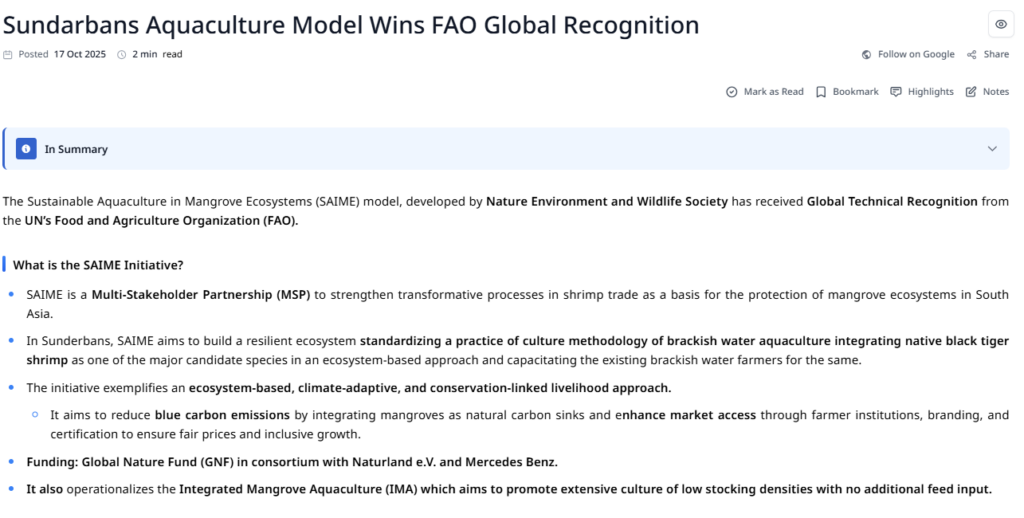
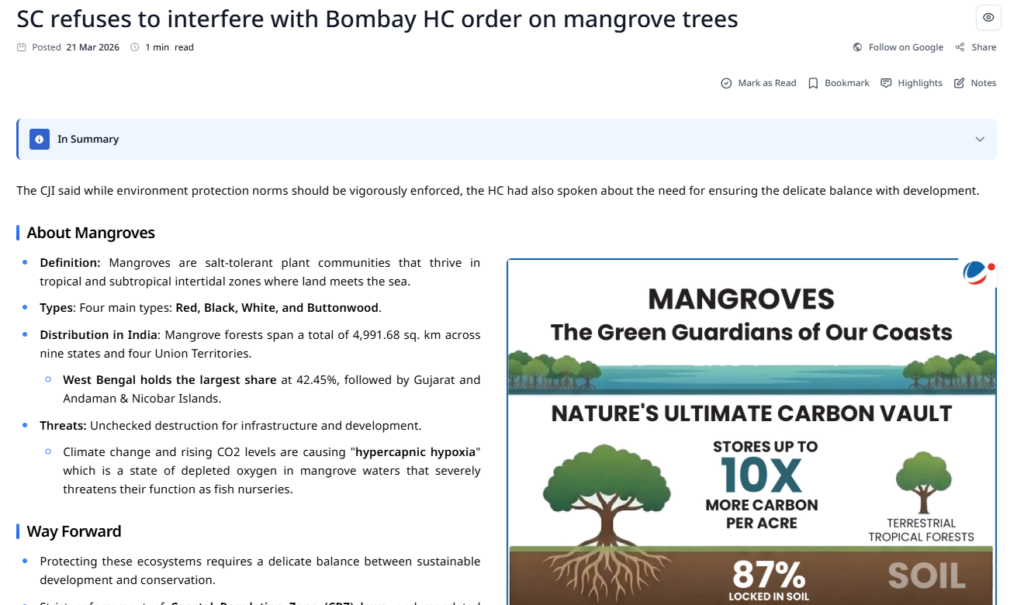
Question on mangrove ecosystems was less about recall and more about understanding. Three statements were placed alongside each other, testing whether students genuinely knew what mangroves do ecologically.
Coverage in PT365 2026 Environment (Sustainable Aquaculture in Mangrove Ecosystems — SAIME) and News Today (21 March 2026) on the Supreme Court’s mangrove order gave students the grounding to identify the correct option.
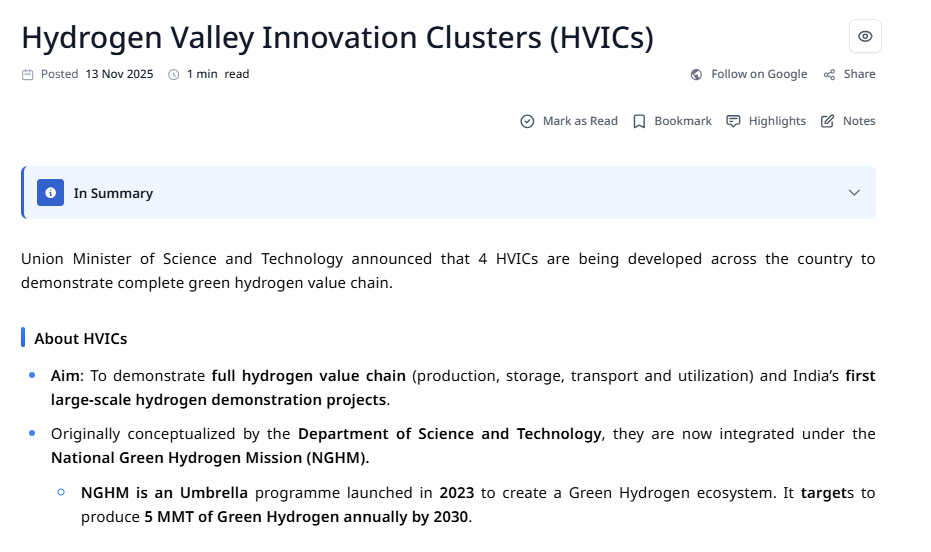
Q Green Hydrogen & National Green Hydrogen Mission
| Q Which of the following statements with regard to Green Hydrogen is/are correct? 1. It is decarbonized hydrogen obtained from natural gas reforming combined with carbon capture and storage (CCS). 2. It is produced using electrolysis of water with electricity generated by renewable energy. 3. National Green Hydrogen Mission of India aims for abatement of nearly 50 MMT of annual greenhouse gas emissions by 2030. Select the answer using the code given below: (a) 1 only (b) 2 and 3 only (c) 2 only (d) 1, 2 and 3 Answer: (b) |
This question required aspirants to distinguish between different types of hydrogen, a conceptual distinction that UPSC CSE Prelims 2026 tested with precision.
The News Today (November 2025) coverage of Hydrogen Valley Innovation Clusters and the PT365 Environment section on the National Green Hydrogen Mission provided the definitional clarity and policy details needed to answer this question correctly.
Economy
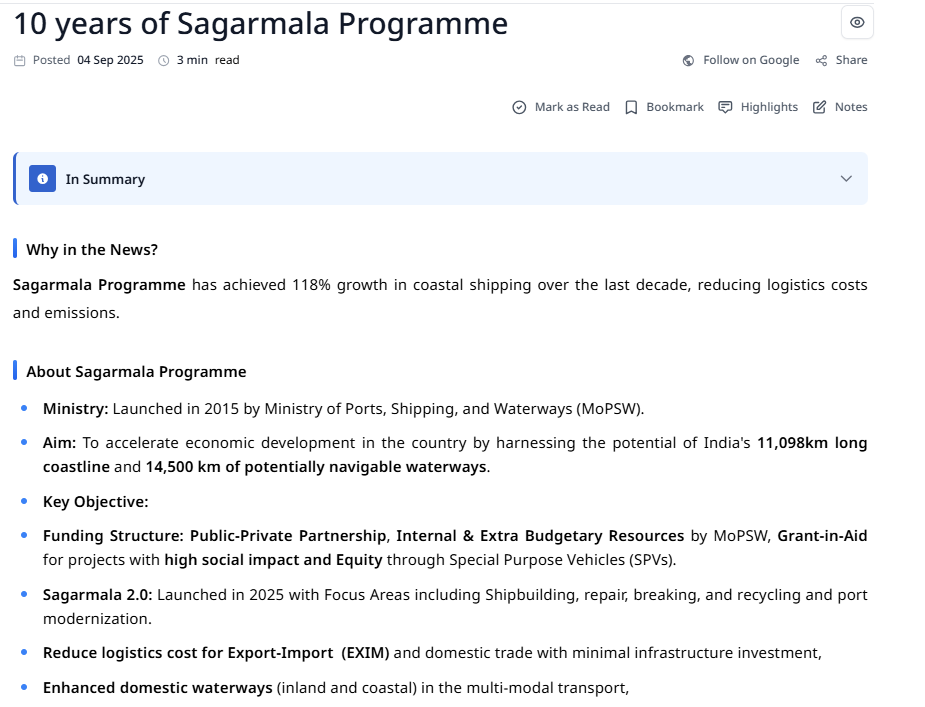
Q Sagarmala
| Q. Consider the following statements with reference to the Sagarmala Programme of the Government of India: I. The Sagarmala Programme seeks to achieve port-led economic growth through cost- effective and sustainable coastal infrastructure. II. The success of the Sagarmala Programme is reflected in significant growth in coastal and inland waterway shipping, along with improved global port rankings. III. Sagarmala 2.0 aims to position India as a global maritime innovation hub aligned with Atmanirbhar Bharat and Viksit Bharat 2047 visions. Which of the following relationships among the above statements is/are correct? 1. Statement II validates the effectiveness of the strategies envisioned in statement I. 2. Statement III extends the objectives of statement I by embedding them into a future- oriented innovation framework. 3. Statement I contradicts statement III by focusing only on traditional infrastructure instead of modern innovation. Select the answer using the code given below: (a) 1 only (b) 1 and 2 (c) 2 and 3 (d) 3 only Answer: (b) |
Rather than asking what Sagarmala is, this question asked students to reason about how three statements about the programme relate to each other — whether Statement II validates Statement I, or whether Statement III contradicts it. This requires understanding the programme’s evolution, not just its existence.
The Monthly Magazine August 2025 piece on Sagarmala’s 10-year anniversary is a good example of the kind of coverage that enables this: it looked at what the programme had done, what it was moving toward with Sagarmala 2.0, and how that connected to India’s broader maritime and economic goals. That context is exactly what a relationship question requires.
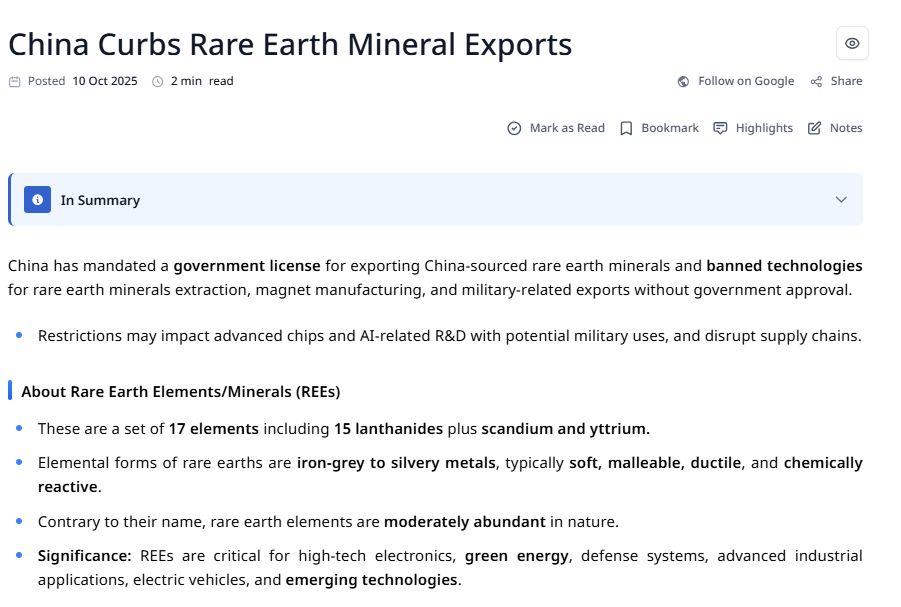
Q Rare Earth Elements & Critical Minerals
| Q. Which of the following statements about Rare Earth Elements (REEs) and Critical Minerals is/are correct? 1. Modern technological innovations including Artificial Intelligence, robotics and space exploration extensively utilise Rare Earth Elements (REEs). 2. China has the highest share in mining of REEs followed by India. 3. The Government of India launched the National Critical Mineral Mission (NCMM) in 2025 to establish a robust framework for self-reliance in the critical mineral sector. 4. Rare Earth Elements are a set of 13 metallic elements. Select the answer using the code given below: (a) 1 and 3 only (b) 3 only (c) 1, 3 and 4 (d) 1, 2 and 4 Answer: (a) |
Rare Earth Elements became a major geopolitical flashpoint in 2025 when China imposed export curbs, a development that UPSC used as the basis for a conceptually layered question.
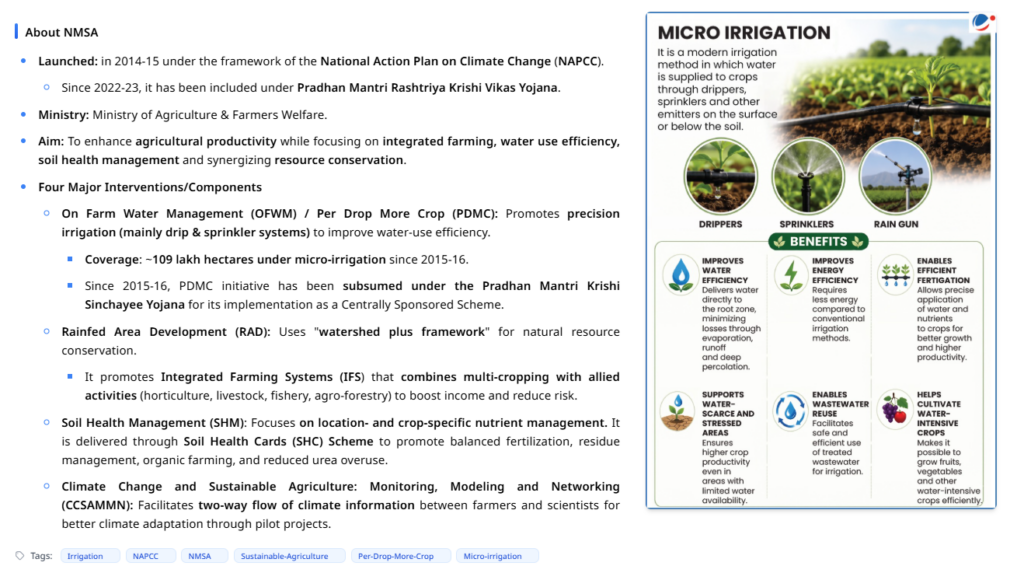
Q Rainfed Area Development
| Q. Which among the following is/are the objective(s) of the Rainfed Area Development (RAD) initiative under the National Mission for Sustainable Agriculture (NMSA)? 1. Encouraging monoculture in rainfed areas 2. Increasing rice cultivation in irrigated regions 3. Enhancing productivity and minimising climatic risks through Integrated Farming Systems (IFS) Select the answer using the code given below: (a) 1 only (b) 1 and 2 (c) 2 and 3 (d) 3 only Answer: (d) |
Question on Rainfed Area Development under the National Mission for Sustainable Agriculture tested knowledge of Integrated Farming Systems as a mechanism for productivity and climate risk reduction. This appeared in News Today (11 May 2026) in the context of micro-irrigation targets.
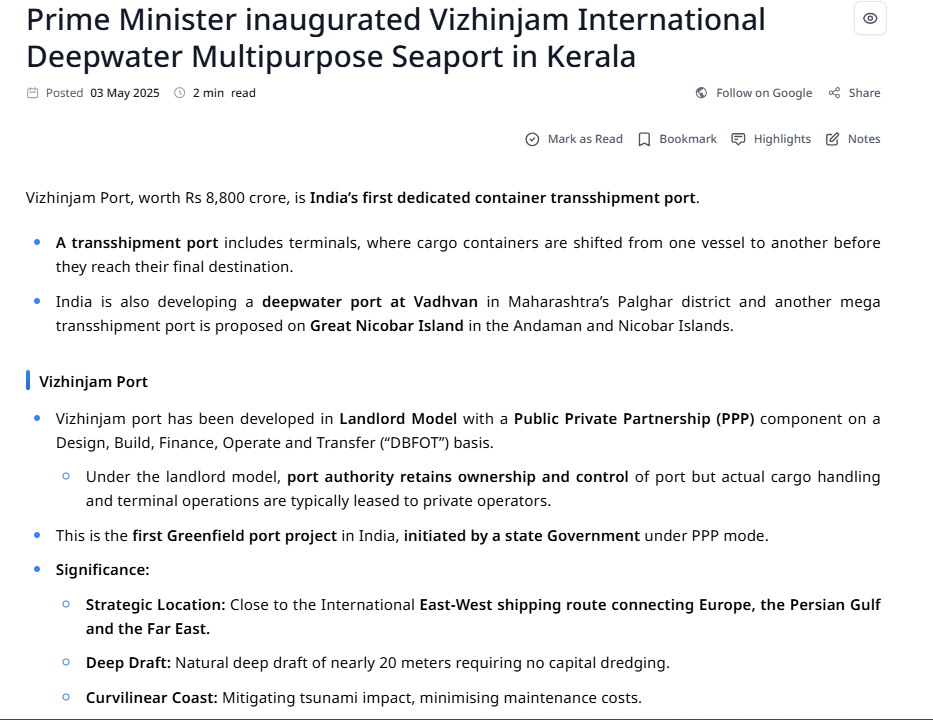
Q Vizhinjam International Seaport
| Q. In what way(s) does the Vizhinjam International Seaport represent a structural shift in India’s maritime trade and logistics policy? 1. By functioning exclusively as a domestic cargo hub to reduce reliance on coastal shipping and eliminate the need for foreign collaborations. 2. By focusing primarily on passenger cruise tourism and heritage shipping to increase Kerala’s profile as a maritime heritage destination. 3. By leveraging its natural deep draft and strategic location to reduce dependence on foreign trans-shipment ports, enhance revenue retention, and reposition India in regional maritime trade. Select the answer using the code given below: (a) 1 only (b) 1 and 2 (c) 2 and 3 (d) 3 only Answer: (d) |
This question was not asked when Vizhinjam was inaugurated or where it is located. It asked which statement correctly described its role as a structural shift in India’s maritime trade policy.
Vizhinjam, inaugurated by the Prime Minister in May 2025, represents a structural shift in India’s maritime trade policy and UPSC tested aspirants’ understanding of why it matters, not just what it is. The question asked aspirants to identify which statement correctly captured the significance of the seaport.
PT365 2026 Economy (Article 9.1.5) covered Vizhinjam’s significance in terms of its natural deep draft, reduction of dependence on foreign trans-shipment ports, and revenue implications.
International Relations
Q INTERPOL
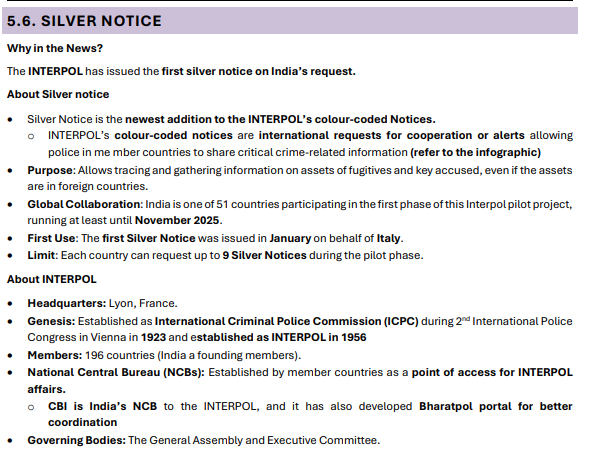
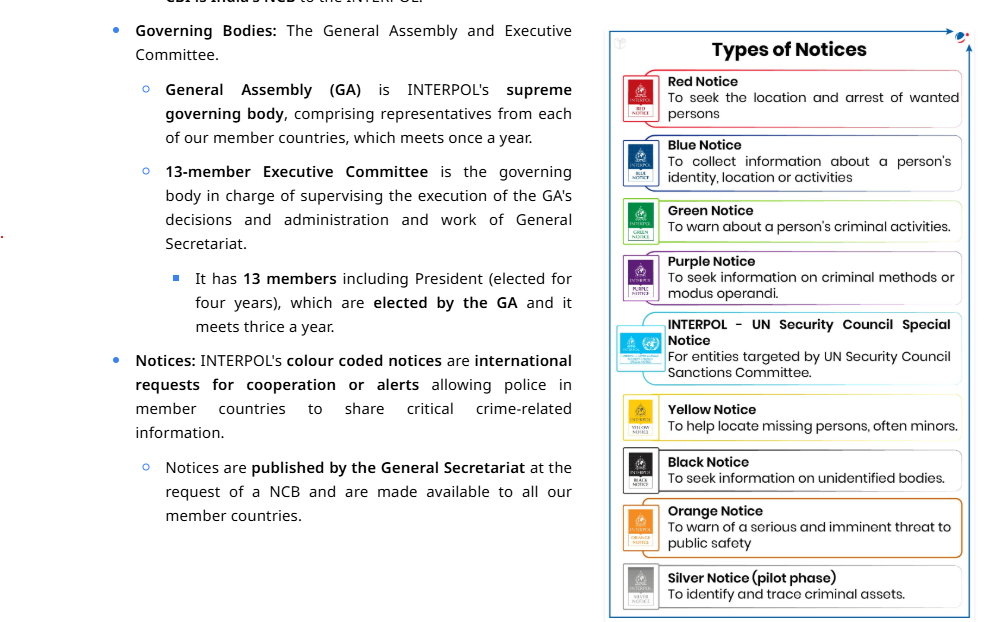
| Q. Match List I with List II and select the answer using the code given below the Lists: List I (INTERPOL Notice) — List II (Description) A. Silver Notice — 1. To seek information on unidentified bodies B. Blue Notice — 2. To collect additional information about a person’s identity, location, or activities in relation to a criminal investigation C. Black Notice — 3. To provide warning about a person’s criminal activities, where the person is considered to be a possible threat to public safety D. Green Notice — 4. To identify and trace criminal assets Code: A B C D (a) 3 1 2 4 (b) 3 2 1 4 (c) 4 2 1 3 (d) 4 1 2 3 Answer: (c) |
Question was a matching question on INTERPOL notices. Silver, Blue, Black, and Green notices each had a specific description, and students had to match them correctly. PT365 2026 International Relations (Article 5.6) and Monthly Current Affairs (June 2025, Article 4.2.1) covered the Silver Notice context and the broader framework.
Q Genome India Project
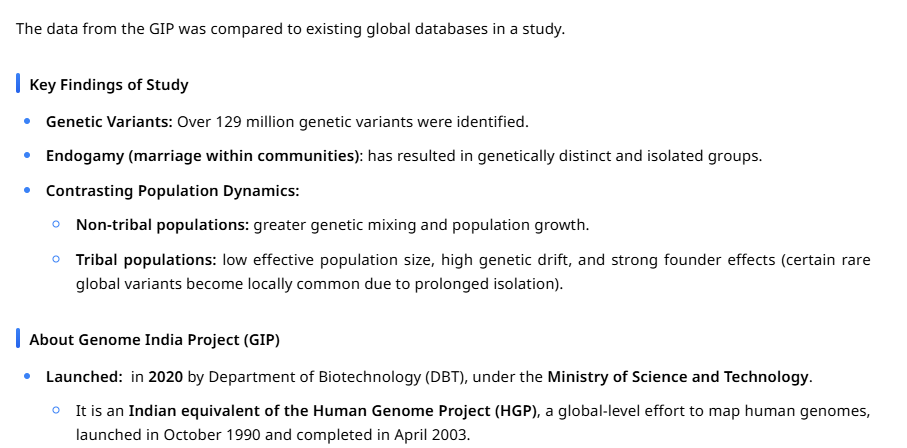
| Q. Which of the following statements with regard to Genome India Project is/are correct? 1. It is a part of the Human Genome Project. 2. The project is funded by the Department of Biotechnology (DBT), Government of India. 3. Its primary aim is to build a catalogue of genetic diversity of the Indian population. Select the answer using the code given below: (a) 1 only (b) 2 and 3 only (c) 1 and 2 only (d) 1, 2 and 3 Answer: (b) |
Question on the GenomeIndia Project — its independence from the Human Genome Project, its DBT funding, and its aim to catalogue India’s genetic diversity — was covered in News Today (20 April 2026) and Monthly Current Affairs (April 2026, Article 7.4.1).
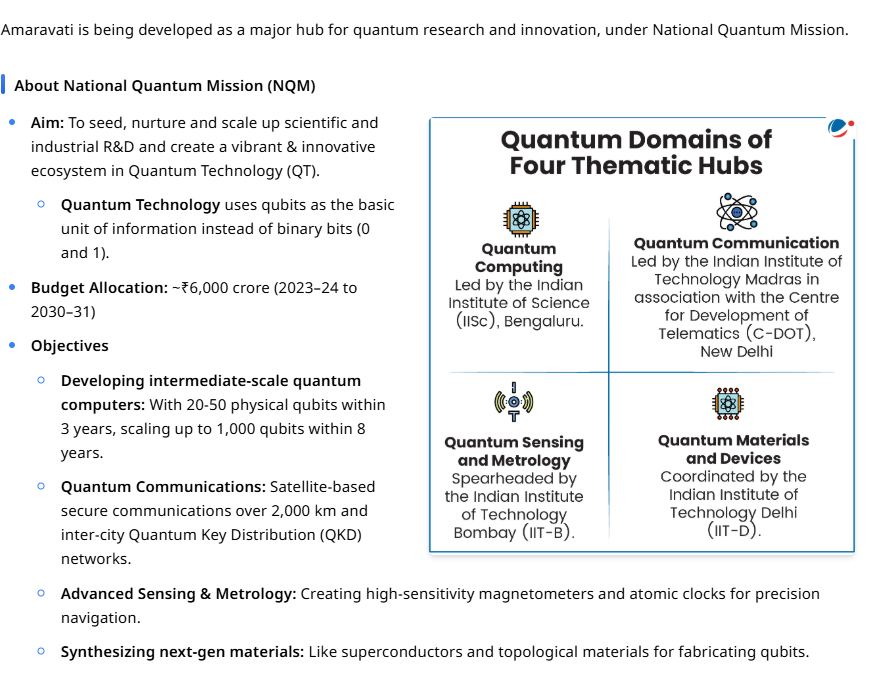
Q National Quantum Mission
| Q. Which of the following statements with regard to the National Quantum Mission (NQM) is/are correct? 1. It aims at developing intermediate-scale quantum computers with 50–1000 physical qubits. 2. Its implementation includes setting up of four Thematic Hubs (T-Hubs) in academic and national R&D institutes across India. Select the answer using the code given below: (a) 1 only (b) 2 only (c) Both 1 and 2 (d) Neither 1 nor 2 Answer: (c) |
Both statements in this question are correct and both were covered across multiple VisionIAS Current Affairs resources.
The NQM’s target of 50–1000 physical qubits and the four Thematic Hubs (in quantum computing, communication, sensing and metrology, and materials) were explained in News Today (February 2026) following the foundation ceremony of Amaravati Quantum Valley, the Monthly Magazine (August 2025) under R&D Schemes, and PT365 Science & Technology.
Three separate coverage points for one topic is precisely what ensures that aspirants who engage with the ecosystem rather than any single resource encounter the material enough times to retain it confidently.
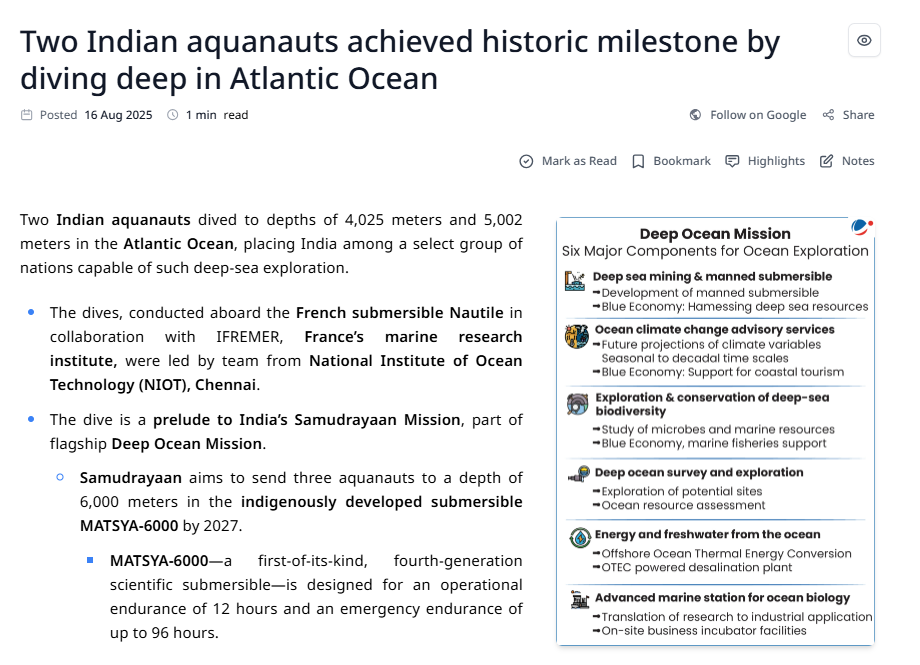
Q Deep Ocean Mission
| Q. Which of the following statements with regard to India’s Deep Ocean Mission is/are correct? 1. It was launched by the Ministry of Ports, Shipping and Waterways, Government of India. 2. Matsya-6000 has been designed to carry 3 people for deep sea exploration. 3. Samudrayaan is a project under this mission. Select the answer using the code given below: (a) 1 only (b) 2 and 3 only (c) 1 and 2 only (d) 1, 2 and 3 Answer: (b) |
Question on India’s Deep Ocean Mission which the ministry launched, the capacity of Matsya-6000, and the Samudrayaan project was covered in PT365 2026 SnT (Article 8.7) and related News Today pieces.
Unconventional Questions: Where VisionIAS Enabled Smart Preparation Made the Difference
A portion of UPSC CSE Prelims 2026 was made up of questions that couldn’t be answered by recall alone. They were unconventional, unorthodox and not on the expected lines.
However, with the understanding of how relevant a topic is for UPSC, VisionIAS had that covered for aspirants as well. The key is not to treat them as a different category of question requiring different resources. It is to read the same VisionIAS Current Affairs more attentively, with an eye on how things connect.
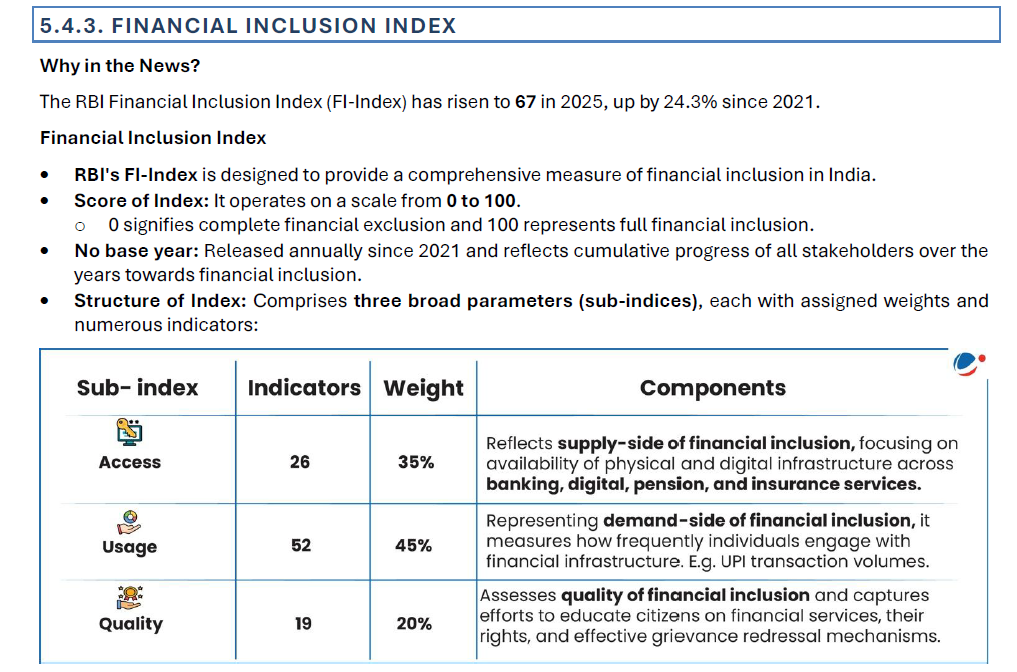
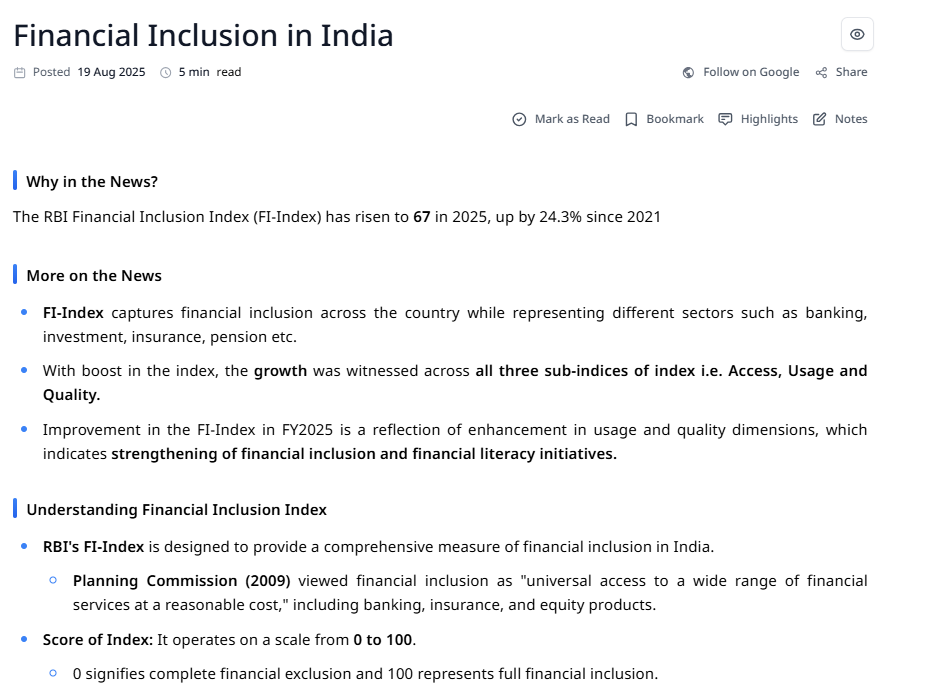
Q Financial Inclusion Index
| Q. Which one of the following correctly represents the three key sub-indices of the Financial Inclusion Index (FI-Index) of the Reserve Bank of India (RBI)? (a) Credit access, Insurance depth, and Pension coverage (b) Banking access, GDP contribution, and Financial literacy (c) Access, Usage, and Quality (d) Access, Affordability, and Transparency Answer: (c) |
This was a straightforward factual question but only for aspirants who had specifically covered the RBI’s Financial Inclusion Index. This was covered across three VisionIAS Current Affairs sources: News Today (July 2025), the Monthly Magazine (July 2025) under Financial Inclusion in India, and PT365 Economy under Financial Inclusion.
The multiple-source coverage meant that even aspirants who missed one resource would have encountered this topic in another, reinforcing the value of the ecosystem approach over dependence on a single material.
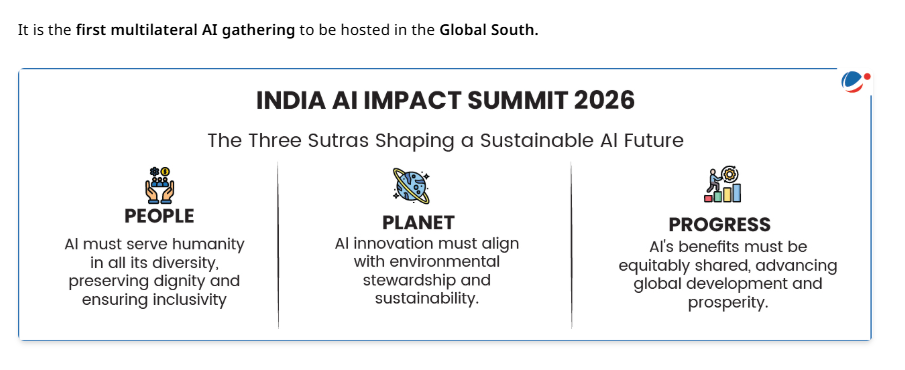
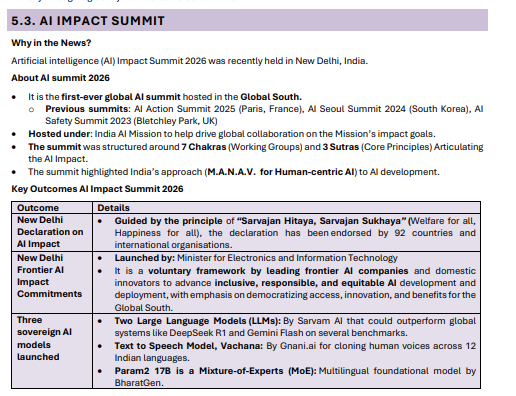
Q AI Impact Summit 2026
| Q. Consider the following statements with respect to the AI Impact Summit, 2026 held in New Delhi: 1. The Summit’s intellectual framework was based on three foundational Sutras: People, Planning, and Progress. 2. The Preamble of the Summit stresses Democratising AI Resources, which acknowledges the Charter for Democratic Diffusion of AI as a binding framework to support locally relevant innovation and strengthen resilient AI ecosystems while respecting national laws. 3. The New Delhi Declaration on AI Impact was structured around seven Access Chakras (Pillars), which included Access for Social Empowerment, AI for Science, and Secure and Trusted AI. Which of the statements given above is/are correct? (a) 1, 2 and 3 (b) 1 and 2 only (c) 2 and 3 only (d) 3 only Answer: (d) |
Question on the AI Impact Summit 2026 was a three-statement question on the Summit’s Sutras, Declaration structure, and the Charter for Democratic Diffusion of AI. PT365 2026 Updated 2 (Article 5.3), Monthly Current Affairs (February 2026), and News Today (17 February 2026) covered all three statements.
Q Moidams
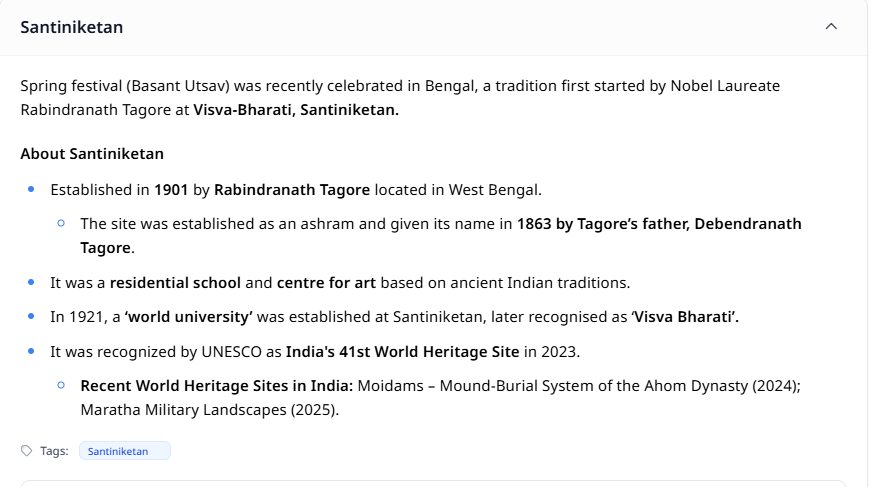
| Q. Which one of the following statements with regard to the Moidams, built by the Tai-Ahom kingdom and inscribed as a World Heritage Site by UNESCO, is/are correct? 1. They acted as army fortresses. 2. They were recreation centres of the Royals and Nobles. 3. They were burial grounds of the Royals and Nobles. 4. They were battle drill centres of the Royals and Nobles. Select the answer using the code given below: (a) 1 only (b) 1 and 3 (c) 3 only (d) 2 and 4 Answer: (c) |
Question on Moidams, the Tai-Ahom burial grounds inscribed as a UNESCO World Heritage Site was covered in News Today (9 March 2026). The question asked what Moidams were. Students who had read it knew these were royal and noble burial grounds not fortresses or recreation centres, as two of the options misleadingly suggested.
Q Western Hoolock Gibbons
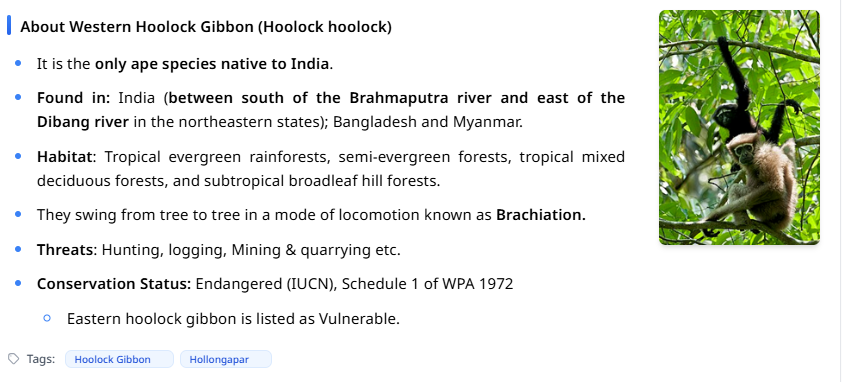
| Q. With respect to the Western Hoolock Gibbons, which of the following statements is/are correct? 1. A Sanctuary in North-east India is home to this ape species listed as Endangered in the International Union for Conservation of Nature (IUCN) Red List. 2. They have specialized brachiation and can easily swing between trees. 3. They possess a strong and heavy build like gorillas, yet are remarkably agile tree climbers. Select the answer using the code given below: (a) 1 only (b) 1 and 2 (c) 2 and 3 (d) 3 only Answer: (b) |
The Western Hoolock Gibbon was covered in News Today (May 2026), which explained its status as an Endangered species under the IUCN Red List, its habitat in North-east India, and its distinctive brachiation, the arm-swinging locomotion that is a defining biological trait.
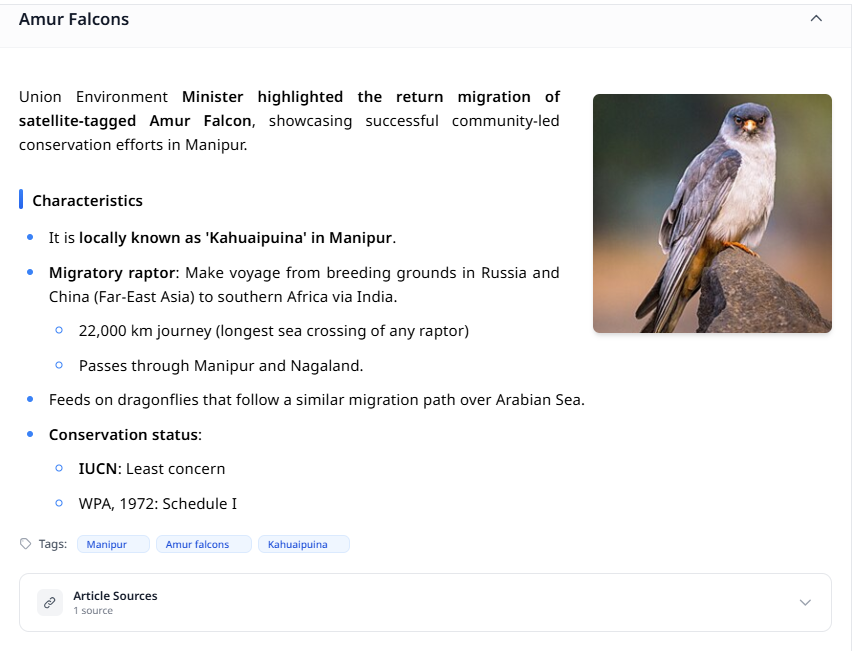
Q Amur Falcons
| Q. Which of the following statements with regard to the arrival of Amur Falcons at Doyang Lake in Nagaland each year from Mongolia is/are correct? 1. It showcases how sustained local conservation efforts can contribute to the arrival and protection of international migratory birds. 2. It reflects the global success of advanced tracking technologies that guide migratory birds back to their stopover sites. 3. It confirms that Amur Falcons have adapted to permanent residency in India due to favourable habitat changes. Select the answer using the code given below: (a) 1 only (b) 1 and 2 (c) 2 and 3 (d) 3 only Answer: (a) |
Question on Amur Falcons at Doyang Lake, Nagaland was covered in News Today (18 May 2026) — Also In News. The question asked what the annual migration illustrates, which required reasoning slightly beyond just knowing the birds arrive there. Regular DCA readers had both the fact and the context.
Q Boong
| Q. Consider the following statements with regard to the film ‘Boong’: 1. The film has recently won the British Academy of Film and Television Arts (BAFTA) Award in the Children’s and Family Film category. 2. The film is directed by Lakshmipriya Devi. 3. This is the first Indian film to win a BAFTA award in the Children’s and Family Film category. Which of the statements given above is/are correct? (a) 1, 2 and 3 (b) 2 and 3 only (c) 1 and 2 only (d) 3 only Answer: (a) |
Question on the film ‘Boong’ winning a BAFTA in the Children’s and Family Film category and being the first Indian film to do so was in News Today (23 February 2026)
Q India’s Climate Response: Understanding Relationships Between Statements
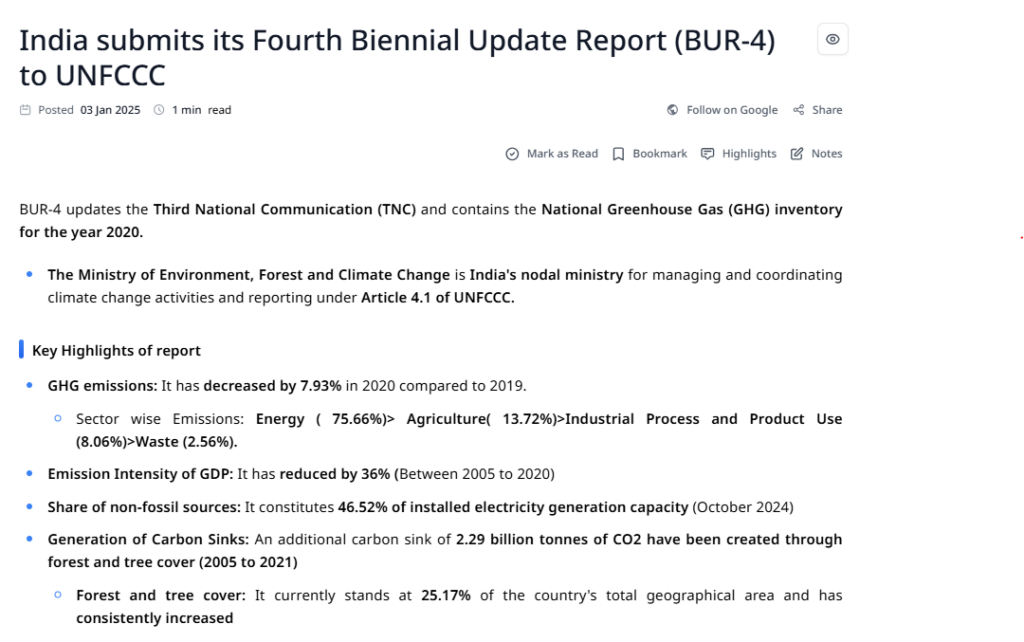
| Q. Consider the following statements with reference to India’s response to climate change: I. India’s Long-Term Low Emission Development Strategy (LT-LEDS) is a crucial tool for achieving net-zero emissions by 2070. II. India’s 4th Biennial Update Report (BUR-4) submitted in December, 2024 recorded around 8% decrease in Greenhouse gas emissions in 2020 over 2019. III. Climate-resilient development necessarily depends on quick and short-term achievement of emission reduction targets. Which of the following relationships among the above statements is/are correct? 1. Statement I is empirically supported by statement II. 2. Statement III contradicts the approach implicit in statement I. 3. Statement I and statement III together establish the premise of long-term sustainability. Select the answer using the code given below: (a) 1 only (b) 1 and 2 (c) 2 and 3 (d) 3 only Answer: (b) |
This question gave three statements: one on India’s LT-LEDS strategy, one on BUR-4 data showing an 8% decrease in GHG emissions in 2020, and one claiming that climate-resilient development depends on quick, short-term emission cuts.
Students were then asked which relationships between the statements were correct.
Statement III was the trap, it directly contradicted the LT-LEDS approach, which is by definition long-term. A student who had only read that India submitted BUR-4 would struggle here.
But a student who had read News Today (3 January 2025) on India’s BUR-4 submission and PT365 2026 Economy (Article 2.2.2) with some thought about what these strategies actually mean would have seen through it.
Ten Legacy Years of the VisionIAS PT365
This year marks a decade since VisionIAS began building PT365 with UPSC Prelims in mind. Over that period, the structure of the exam has shifted and questions have become more application-based, more multi-layered, and increasingly drawn from topics that a student might easily overlook if their reading is not systematic.
PT365 2026 is not a summary of the year’s news. It is a curated, syllabus-mapped resource that identifies which developments have examination relevance and presents them with enough depth that a student can answer both direct and analytical questions from the same material. The monthly magazine adds thematic context, helping students see how individual news items connect to larger trends. And the News Today initiative ensures that nothing significant slips through in real time.
The performance of VisionIAS Current Affairs Ecosystem in Prelims 2026 with verifiable coverage across environment, economy, science and technology, international relations, and polity is a reflection of this ongoing legacy.
The questions on Moidams, DHRUV64, Sagarmala, the AI Impact Summit, GenomeIndia, Madhav Tiger Reserve, and many others all had coverage trails in VisionIAS Digital Current Affairs. That consistency does not happen by accident.
Reflections from VisionIAS Current Affairs Ecosystem
For detailed reflections of UPSC Prelims 2026 questions from PT 365, monthly magazines and New today, click on the following link.
Reflections from VisionIAS Current Affaies Ecosystem
VisionIAS Digital Current Affairs: One Stop Solution for Prelims, Mains and Interview
VisionIAS Digital Current Affairs solves one of the most persistent problems in UPSC Prelims preparation: information overload. Rather than asking aspirants to track multiple newspapers and scattered online sources, VisionIAS Digital Current Affairs delivers curated, exam-relevant coverage converting newspaper reading into structured preparation.
The focus is always on exam relevance over information volume: what UPSC is likely to ask, explained in the context it needs to be understood.
How Digital Current Affairs Reinforces the Learning Loop
VisionIAS Digital Current Affairs follows a closed-loop preparation cycle. Each day, aspirants read curated current affairs and understand them in their exam context, not just as news, but as UPSC-relevant concepts. They then practice through Daily Practice Questions that build the active recall instinct that UPSC CSE Prelims 2026 demanded. Monthly compilations support Revision of broader themes, and PT365 anchors final consolidation.
The result is a confident Recall on exam day, not anxious guessing.
This loop:
Read → Understand → Practice → Revise → Recall
is what converts current affairs engagement into examination performance.
“Current affairs preparation becomes effective not when students read more sources, but when they consistently engage with the right material. VisionIAS Digital Current Affairs is built on exactly that principle.”
Conclusion
UPSC CSE Prelims 2026 combined questions that rewarded consistent reading with questions that required careful reading. The VisionIAS Current Affairs ecosystem consisting PT365 2026, the Monthly Magazine, and the News Today covered both. That coverage was not uniform across every single question in the paper, and it never is. But across the questions that were within scope, the coverage was detailed, timely, and useful.
For aspirants preparing for the next cycle, UPSC current affairs coverage remains the single most important variable in Prelims performance. The resources are on the VisionIAS Digital Current Affairs. PT365 2026 and the archive of Daily Current Affairs and Monthly Magazines are available for revision.