Current Affairs
Supreme Court Proposes Ban on AI Verdicts: Draft Rules Define Limits of AI in Courts
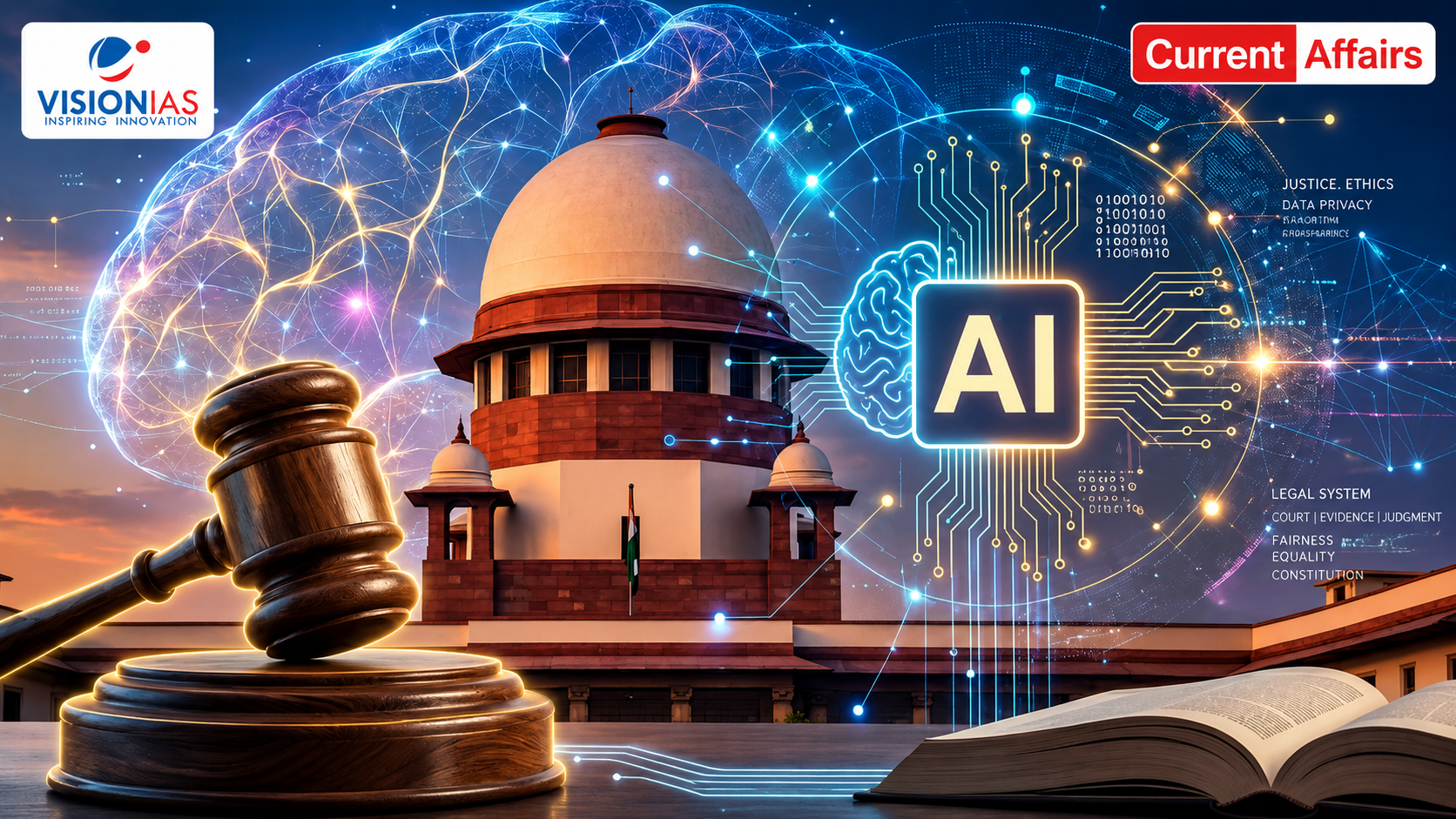














The Supreme Court’s AI Committee released a draft “Regulations for Use of Artificial Intelligence (AI) in Courts, 2026”, proposing a complete ban on the use of AI for deciding judicial outcomes.
India’s Supreme Court has taken a step in defining the boundaries of Artificial Intelligence (AI) in the judiciary. On June 4, 2026, the Supreme Court AI Committee published the preliminary draft of the ‘Regulations for Use of Artificial Intelligence (AI) in Courts, 2026’, a comprehensive framework that proposes a complete ban on AI-based judicial decision-making, including bail determinations, risk scoring, and verdict delivery.
The draft regulations make one principle crystal clear: AI must always remain strictly subservient to human judgment and judicial authority. Every final decision on matters of law, fact, or justice must vest exclusively with a duly appointed judicial officer.
Supreme Court AI Committee
The Supreme Court AI Committee, chaired by Justice P. S. Narasimha was constituted to guide the responsible integration of artificial intelligence across Indian courts. The draft applies to all judicial, adjudicatory, and administrative functions of the Supreme Court, High Courts, other courts, tribunals, and statutory commissions performing adjudicatory roles in India.
Guiding Principles: Fairness, Privacy, and Human Primacy
The draft lays down clear guiding principles for any AI system deployed in courts:
- Human Primacy: AI must remain strictly subservient to human judgment and judicial authority at all times.
- Non-Discrimination: No AI system shall perpetuate, amplify, or introduce bias on grounds of race, religion, caste, sex, gender, disability, language, or economic status.
- Data Privacy: All systems will be subject to the Digital Personal Data Protection Act, 2023. No personal data shall be used to train or test AI without prior approval.
- Transparency and Explainability: AI systems must be explainable and auditable, especially when affecting personal liberty.
- Digital Inclusion: AI tools must be accessible and should not widen existing digital divides.
- Judicial Accountability: Judicial officers remain entirely accountable for all decisions, regardless of AI assistance.
Key Prohibitions: What AI Cannot Do in Courts
The most significant aspect of the draft is its list of absolute bans on AI use. The draft proposes that AI shall be completely prohibited from the following judicial functions:
1. Deciding Verdicts or Adjudicating Cases
No AI system shall perform the function of adjudication or sentencing in any matter. Any output of an AI system related to adjudicative or sentencing questions shall be treated as advisory only and will be subject to independent judicial evaluation.
2. Risk Scoring and Bail Eligibility
The draft explicitly prohibits using AI for risk scoring for any purpose in court processes, including:
- Assessment of flight risk
- Prediction of recidivism (repeat offending)
- Evaluation of bail eligibility
- Determination of the credibility of parties or witnesses
This is a critical safeguard against algorithmic bias entering the bail and sentencing process, a concern that has already triggered major controversies in jurisdictions like the United States, where tools like COMPAS have been widely criticised for racial bias.
3. Opaque and Unexplainable AI Systems
No undisclosed, opaque, or unexplainable AI system shall be used in any court process that may materially affect the lawful rights or personal liberty of any party. This provision upholds the principles of transparency and explainability fundamental requirements for fairness in judicial processes.
4. Surveillance of Court Stakeholders
AI shall not be used for the surveillance or continuous monitoring of judicial officers, advocates, litigants, or any other person within or in connection with court premises or court processes, except as specifically authorised by applicable law.
Permitted Uses: Where AI Can Assist
While the draft enforces a complete ban on AI-based judicial decision-making, it recognises a wide range of legitimate, assistive uses of AI in the judiciary. Permissible applications include:
- Case management, cause list preparation, and hearing scheduling
- Transcription of court proceedings using Automatic Speech Recognition (ASR)
- Translation of judgments into multiple Indian languages
- Legal research assistance and document analysis
- Administrative functions: case filing assistance, defect scrutiny, record management
- Conversational AI assistants (chatbots) for litigants to understand procedures
- Accessibility services for persons with disabilities or language barriers
- Anonymisation of court records
In all these permitted uses, AI functions solely in an assistive capacity. The draft mandates that AI shall never supplant the independent exercise of judicial authority by a duly appointed judicial officer.
Proposed Regulatory Architecture
To operationalise these regulations, the draft proposes a three-tier governance structure:
1. Apex Body at the Supreme Court
A permanent, full-time apex body will be established at the Supreme Court to regulate and promote innovation, integration, governance, oversight, standard-setting and policy development on AI in the judiciary. Its composition will include two Supreme Court judges, two High Court Chief Justices, two High Court judges, a cybersecurity expert, a finance expert, advocates with expertise in technology law, a Ministry of Electronics and IT representative, and an AI professor from the National Judicial Academy, Bhopal.
2. AI Committees at Every High Court
An AI committee at the Supreme Court and every High Court will oversee, regulate, and facilitate the responsible adoption and governance of AI within each jurisdiction, in accordance with standards set by the apex body.
3. Compliance and Audit Mechanisms
The draft prescribes pre-deployment impact assessments and annual internal audits for all AI tools used in courts. Additionally, lawyers and litigants will be required to explicitly disclose any use of AI in preparing court documents.
AI Adoption in the Indian Judiciary
India has already been deploying AI tools in courts over the past few years. The draft regulations will govern and standardise their use. Some current AI tools in Indian courts are:
- SUVAS: Multilingual Justice
The SUVAS (Supreme Court Vidhik Anuvaad Software) translates Supreme Court judgments into 18 Indian languages using AI, significantly improving access to justice for non-English-speaking citizens.
- SUPACE: Legal Research
The SUPACE (Supreme Court Portal for Assistance in Court Efficiency) helps judges by identifying legal precedents and clarifying case facts. It processes information and puts it at the disposal of the judge but the decision always remains with the judge.
- LegRAA and ASR-SHRUTI
The LegRAA (Legal Research Analysis Assistant) analyses documents and extracts relevant legal references. ASR-SHRUTI converts judges’ speech into text for drafting orders and judgments, while AI-based ASR tools provide near real-time transcription of court proceedings.
Conclusion
The ‘Regulations for Use of Artificial Intelligence (AI) in Courts, 2026’ mark a watershed moment in India’s approach to technology in the justice system. The draft strikes a careful balance embracing AI’s potential to improve efficiency, access, and administrative ease, while enforcing a complete ban on AI-based judicial decision-making that could compromise fairness, personal liberty, and the integrity of the judicial process.
Master Digital Age Governance & Technology Trends with VisionIAS Comprehensive Current Affairs →
Supreme Court Publishes Draft Regulations on AI Use in Judiciary FAQs
1. What specific judicial functions has the Supreme Court of India proposed to permanently ban AI from performing under the 2026 draft regulations?
Ans. AI is banned from verdicts, sentencing, bail eligibility, risk scoring, recidivism prediction, witness credibility assessment, and surveillance of court stakeholders.
2. What are the guiding principles governing AI systems in Indian courts under the 2026 draft regulations?
Ans. Human Primacy, Non-Discrimination, Data Privacy, Transparency and Explainability, Digital Inclusion, and Judicial Accountability.
3. Under what conditions can an AI system’s output be considered in adjudicative or sentencing matters in Indian courts?
Ans. Only as advisory input, subject to complete independent judicial evaluation by a duly appointed judicial officer.
4. What transparency requirements must AI systems meet before being deployed in Indian courts under the 2026 draft?
Ans. Every AI system must be explainable, auditable, and fully disclosed, particularly when its use could materially affect a party’s personal liberty or legal rights.
5. What is SUPACE’s role in Indian courts?
Ans. It identifies legal precedents and clarifies case facts for judges, while all final decisions remain exclusively with the judge.