Current Affairs
India Records Major Gains in Maternal, Child Health and Nutrition in NFHS-6
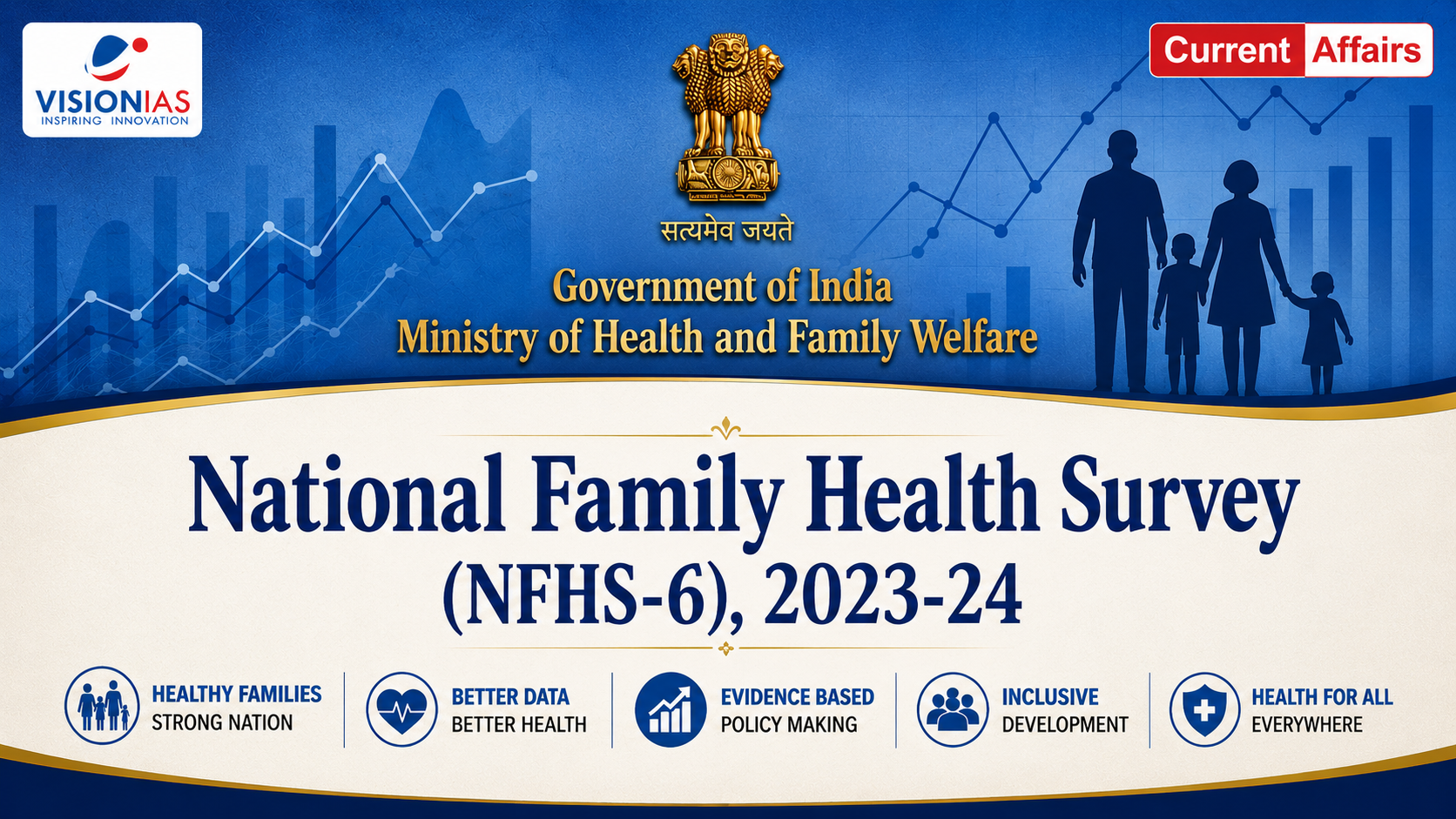













The National Family Health Survey-6 (2023–24) reported major improvements in maternal and child health, with institutional deliveries reaching 90.6% and antenatal care coverage 95.9%.
The National Family Health Survey (NFHS-6), released on 29 May 2026 by the Ministry of Health and Family Welfare (MoHFW), provides data on India’s health and social development for 2023-24. Conducted with the International Institute for Population Sciences (IIPS), Mumbai, the survey covered 6.79 lakh households across 715 districts and provides evidence on population, health, nutrition, and family welfare indicators.
The survey tracks progress from NFHS-5 (2019-21) to NFHS-6 (2023-24) across maternal health, child nutrition, immunisation, and financial protection in healthcare. For UPSC aspirants, NFHS-6 is relevant for GS Paper 2 (Health, Governance) and GS Paper 3 (Social Development).
What is the National Family Health Survey (NFHS)?
The National Family Health Survey is a multi-round survey conducted across India. It collects state- and district-level data on fertility, infant and child mortality, maternal and child health, nutrition, and the status of women and men. NFHS-6 covers the period 2023-24, and its findings are compared against NFHS-5 to measure change. The survey is used by the government to design, monitor, and evaluate health and nutrition programmes at the national and district levels.
Maternal Health: Key Findings
NFHS-6 shows progress across maternal health indicators.
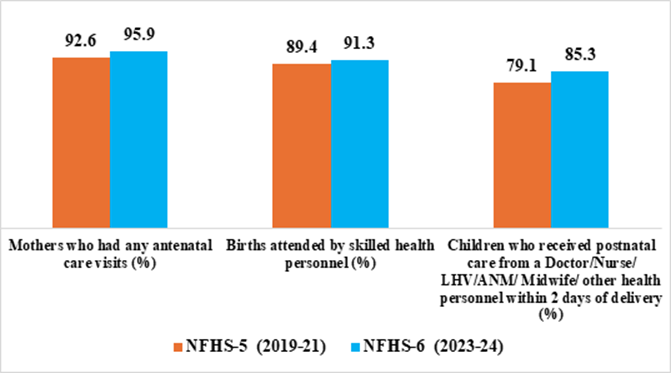
Institutional deliveries increased from 88.6% to 90.6%, while births attended by skilled health personnel improved from 89.4% to 91.3%.
Postnatal care for newborns within two days of delivery improved from 79.1% to 85.3%.
Antenatal Care (ANC) Coverage
Antenatal care (ANC) coverage has improved across all indicators:
- Overall ANC coverage increased from 92.6% to 95.9%.
- Mothers receiving ANC in the first trimester rose from 70.0% to 76.2%.
- Mothers receiving at least four ANC visits increased from 58.5% to 65.2%.
- Iron folic acid supplements consumed for 100 or more days during pregnancy increased from 44.1% to 54.9%.
Government Schemes Supporting Maternal Health
The progress in maternal health is supported by the following schemes:
- Janani Suraksha Yojana (JSY): Cash incentives for institutional deliveries among low-income mothers.
- Janani Shishu Suraksha Karyakram (JSSK): Free services for pregnant women and sick newborns in public health institutions.
- Pradhan Mantri Surakshit Matritva Abhiyan (PMSMA): Assured antenatal care on fixed days.
- SUMAN (Surakshit Matritva Aashwasan): Zero-tolerance policy for denial of healthcare to mothers and newborns.
- Pradhan Mantri Matru Vandana Yojana (PMMVY 2.0): Direct benefit transfer for nutritional support to pregnant women.
Family Planning
NFHS-6 indicates continued progress in family planning and reproductive health. India’s Total Fertility Rate (TFR) remains at 2.0, reflecting sustained population stabilisation. The Contraceptive Prevalence Rate (CPR) increased from 66.7% to 69.1%, indicating improved access to and uptake of family planning services.
These trends highlight a greater focus on the health and well-being of mothers and children and demonstrate the effectiveness of national family planning initiatives, particularly Mission Parivar Vikas, in expanding access to reproductive healthcare services.
Child Immunisation: Key Findings
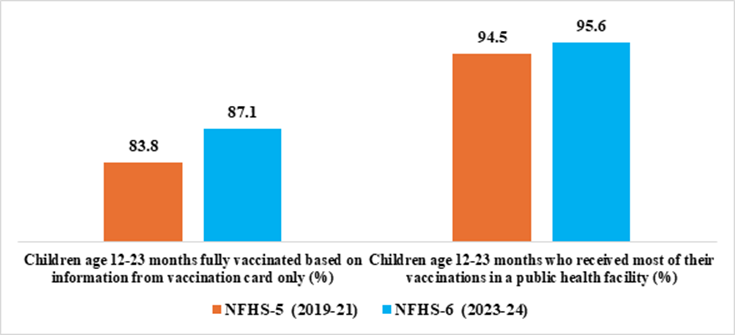
Full vaccination coverage among children aged 12-23 months (based on vaccination cards) increased from 83.8% to 87.1% under the Universal Immunisation Programme (UIP). The data also shows that 95.6% of children received vaccinations through public health facilities, reflecting community trust in the public healthcare system.
Other notable changes in immunisation coverage:
- Any vaccine received by children aged 12-23 months remains above 96%.
- Rotavirus vaccination coverage increased from 36.4% to 85.4%.
- The second dose of the measles-containing vaccine increased from 58.6% to 71.8%.
- Acute Respiratory Infection (ARI) prevalence among children declined from 2.8% to 1.9%.
- Severe diarrhoea prevalence declined to 0.5%.
These gains are supported by last-mile delivery by frontline health workers, improved cold-chain infrastructure, and the digital tracking system U-WIN, which digitises immunisation records.
Child Nutrition: Key Findings
Stunting (low height-for-age) among children under five years declined from 35.5% to 29.3%, a reduction of 17%. Severe wasting (low weight-for-height) declined from 7.7% to 5.2%, a reduction of 32%. These are measurable improvements in long-term nutritional outcomes.
Other nutrition indicators from NFHS-6:
- Underweight prevalence in children under five declined from 32.1% to 31.8%.
- Children aged 6-8 months receiving solid or semi-solid food along with breastmilk increased from 45.9% to 59.5%.
- Breastfeeding within one hour of birth increased from 41.8% to 50.1%.
- 95.6% of children under six months were exclusively breastfed during the survey period.
These improvements are driven by POSHAN Abhiyaan, Saksham Anganwadi, and POSHAN 2.0, supported by Nutrition Rehabilitation Centres (NRCs), Mother’s Absolute Affection (MAA), and interventions under the National Health Mission (NHM).
Health Insurance and Financial Protection
Household-level health insurance coverage increased from 41.0% to 60.2%. The Ayushman Bharat (PM-JAY) scheme has played a central role in expanding access to healthcare for low-income and vulnerable populations. This expansion moves India closer to Universal Health Coverage (UHC), a core Sustainable Development Goal target.
Women’s Empowerment and Financial Inclusion
NFHS-6 records improvements in women’s empowerment indicators, which have a direct bearing on maternal and child health outcomes.
- Women who had used the internet rose from 33.3% to 64.3%.
- Women operating their own bank accounts increased from 78.6% to 89.0%.
- Women using a mobile phone independently rose from 53.9% to 63.6%.
- Hygienic menstrual protection among women aged 15-24 years increased from 77.6% to 79.2%, supported by the Menstrual Hygiene Scheme (MHS) and the Pradhan Mantri Bhartiya Janaushadhi Pariyojana.
Access to digital services and financial resources enables women to seek healthcare independently and make decisions on nutrition and child health. These indicators are therefore connected to broader gains in maternal health and child nutrition.
Challenges That Remain
NFHS-6 also flags health challenges that require continued attention. Rising Non-Communicable Diseases (NCDs) including diabetes, hypertension, and lifestyle-related conditions are creating a dual burden of rising overweight/obesity alongside undernutrition. Key gaps include:
- Underweight prevalence in under-five children has seen only a marginal improvement, from 32.1% to 31.8%.
- Overweight and obesity among adults is rising, alongside undernutrition.
- Sustained improvement in child nutrition requires community-level behavioural change, not just infrastructure.
Conclusion
NFHS-6 shows that India has made progress in maternal health, child nutrition, immunisation, and healthcare access. Institutional deliveries have reached 90.6%, stunting has declined from 35.5% to 29.3%, and health insurance coverage has risen from 41% to 60.2%. These gains reflect the impact of sustained policy implementation.
At the same time, the survey points to areas that need attention, including rising NCDs, the dual burden of undernutrition and obesity, and the need for behavioural change at the community level. For India to meet its SDG targets by 2030, the focus must continue on last-mile service delivery, convergence across ministries, and inclusive access to healthcare.
Master Digital Age Governance & Technology Trends with VisionIAS Comprehensive Current Affairs →
NFHS-6 FAQs
1. What is the purpose of the National Family Health Survey (NFHS)?
Ans: It collects state- and district-level data to help the government design, monitor, and evaluate health and nutrition programmes.
2. How does women’s financial inclusion impact maternal and child health outcomes?
Ans: Access to bank accounts and mobile phones enables women to seek healthcare independently and make informed nutrition decisions.
3. What is the institutional delivery rate in India as per NFHS-6?
Ans: 90.6%
4. Which government scheme ensures zero tolerance for denial of healthcare to mothers and newborns?
Ans: SUMAN (Surakshit Matritva Aashwasan)
5. What dual burden does NFHS-6 highlight in India’s nutrition landscape?
Ans: The coexistence of undernutrition and rising obesity and overweight among adults.