Current Affairs
10 Years of PMSMA- A Decade of Care for Safe Motherhood in India
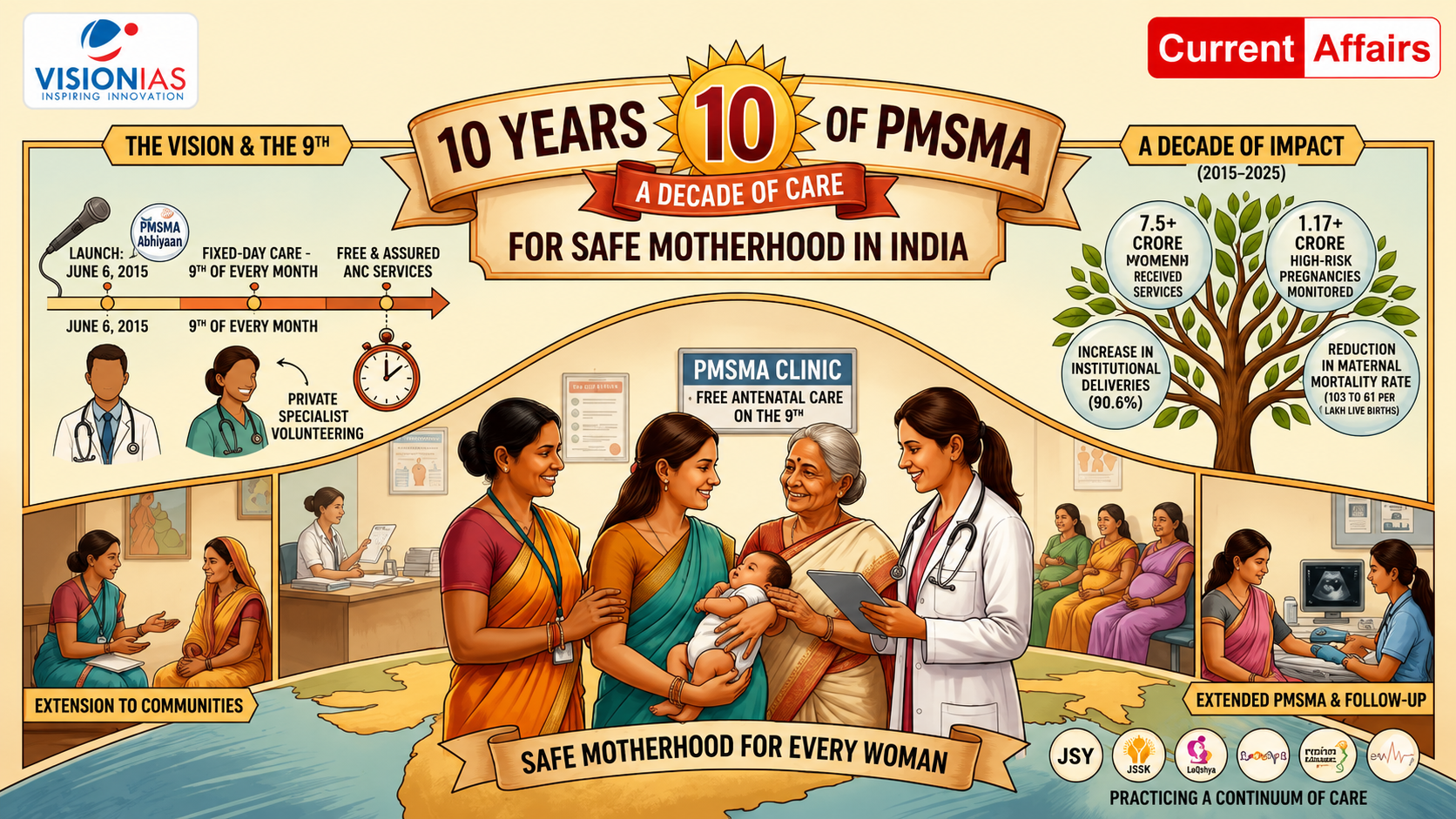







The Ministry of Health and Family Welfare has launched the nationwide “10 Years of PMSMA – A Decade of Care” campaign to mark 10 years of the Pradhan Mantri Surakshit Matritva Abhiyan (PMSMA).
India’s maternal healthcare story has undergone a quiet but powerful transformation over the past decade. On 9 June 2026, the Union Health Minister launched the nationwide “10 Years of PMSMA- A Decade of Care” campaign in New Delhi to mark ten years of the Pradhan Mantri Surakshit Matritva Abhiyan (PMSMA). The celebration included the release of a special ₹75 Commemorative Coin and a ₹5 Postal Stamp, symbols of a programme that has quietly redefined what quality antenatal care means for millions of Indian women.
In those ten years, PMSMA has delivered free, comprehensive antenatal care to more than 7.5 crore pregnant women, making it one of the most far-reaching maternal health interventions in the country’s history.
What Is PMSMA and Why Was It Launched?
The Indian Prime Minister launched the Pradhan Mantri Surakshit Matritva Abhiyan on 9 June 2016 under the Ministry of Health and Family Welfare through the National Health Mission (NHM). The core idea was straightforward but urgent: every pregnant woman in India deserved at least one comprehensive, free antenatal check-up conducted by a qualified specialist, not just a basic health worker during her second or third trimester.
Before PMSMA, outreach through Village Health and Nutrition Days (VHNDs) extended coverage but fell short on clinical depth. Rural facilities lacked obstetricians, diagnostic equipment, and the capacity to identify high-risk pregnancies early enough to act.
PMSMA filled that gap by establishing dedicated monthly clinics on the 9th of every month at government health facilities across India, anchored within the broader RMNCH+A (Reproductive, Maternal, Newborn, Child, and Adolescent Health) strategy.
Nine Assured Free Services: What Every Pregnant Woman Receives
A key focus of the “10 Years of PMSMA- A Decade of Care” campaign is spreading awareness about the nine assured free antenatal services that every eligible pregnant woman can access under the scheme.
These services cover the full spectrum of clinical and preventive care:
- Clinical examinations: weight monitoring, blood pressure recording, and abdominal palpation by a trained medical officer or specialist.
- Laboratory investigations: hemoglobin estimation, urine albumin, urine sugar, and blood tests for infections such as HIV, syphilis (VDRL), and malaria.
- Ultrasonography (USG): at least one obstetric ultrasound scan during the second trimester to assess fetal development and detect anomalies.
- Essential medicines: Iron Folic Acid (IFA) tablets, calcium supplements, folic acid, and Tetanus-Diphtheria Toxoid (Td) injections.
- Nutritional and birth planning counselling ensures women understand danger signs, dietary needs, and institutional delivery planning.
Women in their second or third trimester (beyond 12 weeks of gestation) are eligible to walk into any designated government facility on the 9th of any month with their Mother and Child Protection (MCP) card and receive all services free of charge.
At the end of each visit, a colour-coded sticker is placed on the MCP card, Green for normal pregnancies requiring routine monitoring, and Red for high-risk cases requiring specialist follow-up and referral to a First Referral Unit (FRU).
“Pledge for 9” Initiative and Private Sector Volunteering
One of PMSMA’s most distinctive features is its public-private partnership model. Under the “Pledge for 9” campaign, private obstetricians, gynaecologists, radiologists, and physicians volunteer their services at government clinics on the 9th of every month entirely without fees.
Voluntary registrations are managed through the PMSMA portal (pmsma.nhp.gov.in), a toll-free helpline (1800-180-1104), SMS, or the PMSMA mobile app. Professional organisations like the Federation of Obstetric and Gynaecological Societies of India (FOGSI) and the Indian Medical Association (IMA) actively mobilise their members for this effort.
Outstanding volunteers are recognised through the “IPledgeFor9” Achievers Awards — honouring doctors who serve high volumes of patients or volunteer in remote, underserved areas.
This model directly addresses one of the most persistent gaps in rural maternal healthcare: the shortage of specialist doctors at government facilities.
Extended PMSMA (e-PMSMA): Strengthening High-Risk Follow-Up
Launched in January 2022, the Extended PMSMA (e-PMSMA) strategy transformed the programme from a single-day screening event into a continuous, digitally monitored surveillance system.
When a woman is flagged as high-risk, her details are entered into the e-PMSMA portal and the ANMOL (ANM Online) register, generating automated SMS alerts for both the woman and her ASHA worker. Facilities can hold up to four additional PMSMA sessions per month, and each mother is tracked from early gestation through the 45th day postpartum.
To support this follow-up, the programme provides:
- ₹100 per visit to the beneficiary (for up to 3 follow-up sessions) to cover travel costs.
- ₹100 per high-risk case to ASHA workers for mobilising up to three follow-up check-ups.
- ₹500 to ASHA workers upon a verified healthy outcome for both mother and baby on Day 45 after delivery.
The e-PMSMA framework also expanded the clinical definition of high-risk pregnancies from 10 to 25 specific categories, including severe anaemia, gestational diabetes, hypothyroidism, teenage pregnancy, HIV, and tuberculosis — ensuring no vulnerable case is missed.
PMSMA’s Place in India’s Maternal Health Ecosystem
Pradhan Mantri Surakshit Matritva Abhiyan does not work in isolation. It functions as a diagnostic hub within a wider network of complementary maternal health programmes:
- Janani Suraksha Yojana (JSY) promotes institutional deliveries and has benefited over 11.96 crore women.
- Janani Shishu Suraksha Karyakram (JSSK) guarantees free diagnostics, medicines, and referral transport; has supported over 18.05 crore beneficiaries.
- Pradhan Mantri Matru Vandana Yojana (PMMVY) provides a ₹5,000 cash benefit for the first child, conditional on attending antenatal check-ups, which drives PMSMA attendance.
- SUMAN (Surakshit Matritva Aashwasan) assures dignified, zero-cost care at over 99,290 certified facilities.
- LaQshya Initiative improves quality of care in labour rooms and maternity operation theatres.
- POSHAN Abhiyaan coordinates with PMSMA to enrol severely malnourished or anaemic pregnant women in targeted nutritional support.
Conclusion
The “10 Years of PMSMA- A Decade of Care” campaign is more than a milestone celebration. It is a reminder that Pradhan Mantri Surakshit Matritva Abhiyan represents one of the most significant investments India has made in the lives of its mothers and newborns reaching over 7.5 crore women with free, specialist-led antenatal care in a single decade.
As India moves towards its 2030 SDG commitments, the programme’s continued expansion deeper into underserved districts, with stronger diagnostics, smarter digital tracking, and more inclusive community engagement will determine how many more maternal deaths can be prevented.
Master Digital Age Governance & Technology Trends with VisionIAS Comprehensive Current Affairs →
Pradhan Mantri Surakshit Matritva Abhiyan (PMSMA) FAQs
1. When was PMSMA launched?
Ans. 9 June 2016.
2. How many pregnant women has PMSMA benefited so far?
Ans. Over 7.5 crore.
3. What is the minimum gestational age to be eligible for PMSMA services?
Ans. Beyond 12 weeks (second or third trimester).
4. How many free antenatal services does PMSMA guarantee to every pregnant woman?
Ans. Nine assured free services.
5. What is Extended PMSMA (e-PMSMA) and when was it launched?
Ans. Launched in January 2022, e-PMSMA is a digital surveillance system that tracks high-risk pregnancies from early gestation through 45 days postpartum.