Officer's View
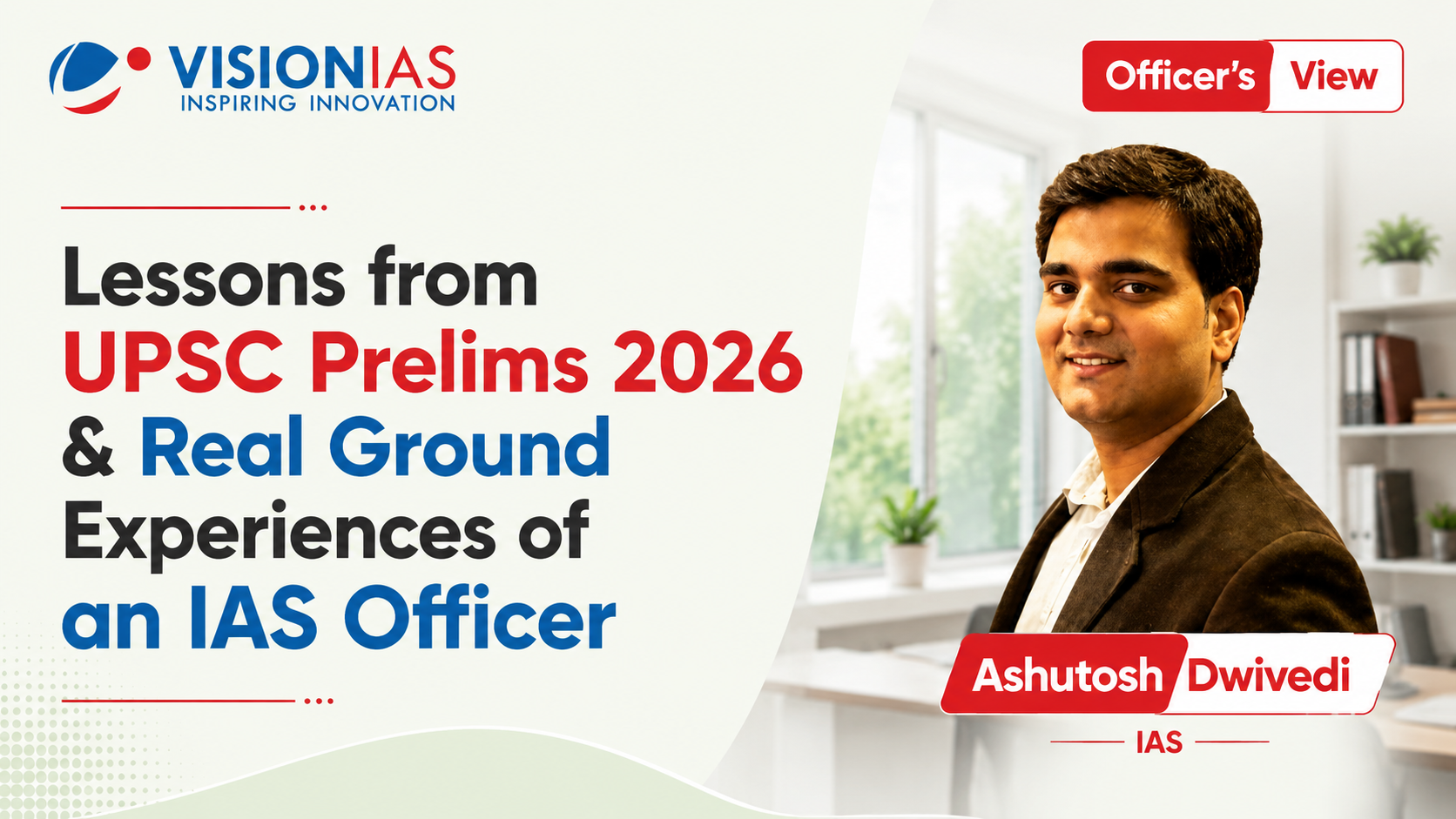
Lessons from UPSC Prelims 2026 & Real Ground Experiences of an IAS Officer













The UPSC Prelims 2026 is over, and the paper has left many aspirants shaken. Questions felt unfamiliar, patterns seemed to shift, and across coaching circles and online forums, one word kept coming up — tough. But tough for whom, and in what way?
Before you spiral into self-doubt or start reworking your entire strategy, it is worth pausing to hear from someone who has sat on both sides of this journey — as an aspirant, and now as a serving IAS officer navigating real ground realities every single day.
Recently, Shri Ashutosh Dwivedi, IAS, (Batch 2018) conducted an open session at Vision IAS, New Delhi, shortly after UPSC Prelims 2026. What followed was one of the most candid, ground-level discussions on what this paper actually means, what the service actually demands, and how the two are more connected than most people realise. The following are the key lessons from that session.
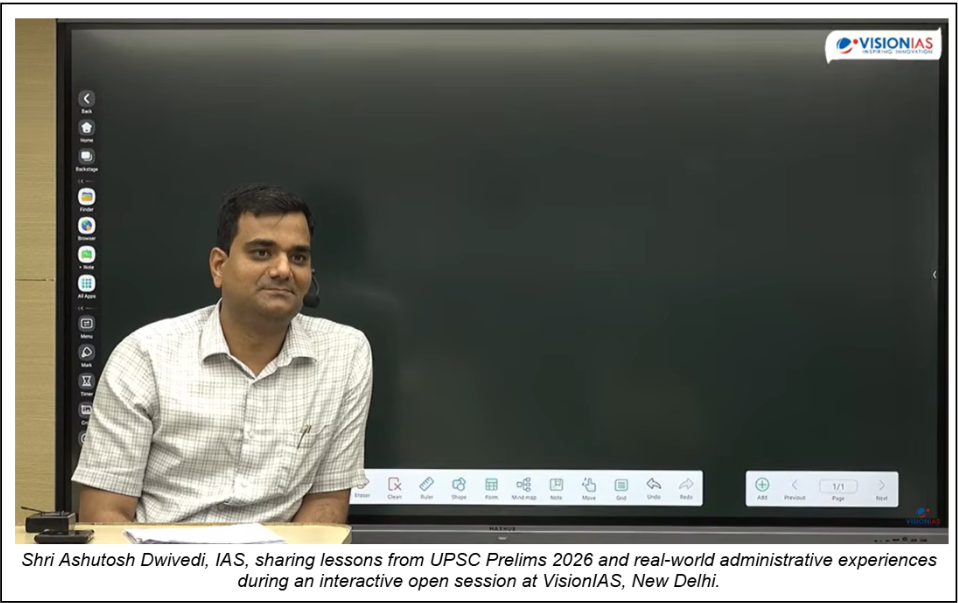
[Watch: Lessons from UPSC Prelims 2026 by Shri Ashutosh Dwivedi, IAS]
Key Lessons from Shri Ashutosh Dwivedi, IAS
On UPSC Prelims 2026 Paper
UPSC Finally Made Prelims Look Like the Civil Service
The paper was difficult— no doubt. Anyone who says otherwise is not being honest. But here is the more important question: why was it tough? Shri Ashutosh Dwivedi, IAS made it clear that for the first time, UPSC Prelims felt aligned with what the civil service actually demands. The interview has always tested you in unpredictable, real-world conditions. Mains shifted after 2013 to test integrated thinking rather than isolated recall. This year, Prelims joined that trajectory.
In the actual service — especially as an IAS or IPS officer — every single day is different. Every situation is new. There is no fixed pattern on which you can base your decisions. So why would UPSC design an exam on a fixed, predictable pattern? They are selecting people for a life of uncertainty. The exam, naturally, had to reflect that.
‘You cannot predict how you will react to a situation. And you cannot assume that because you succeeded with one approach before, the same approach will work again. You have to read the situation fresh every single time.’ – Shri Ashutosh Dwivedi, IAS
On UPSC Exam Strategy and Preparation
The 20-Question Rule: Stop Fighting Battles You Can’t Win
Shri Ashutosh Dwivedi, IAS on solving upsc exam paper observed that, out of 100 questions, roughly 14–20 were the kind of purely factual, rote-memory questions — where the answer is either in your head or it isn’t. Things like which corps of the CRPF is headquartered where, or obscure numismatic details nobody outside specialists knows. Let’s be generous and call it 20.
The mistake many people make is this: they see those 14–20 questions they cannot answer, panic, and that panic bleeds into the remaining 80 where they actually could succeed. The unknown 20 don’t hurt you. Your reaction to the unknown 20 hurts you.
Let’s do some exam mathematics. Out of those 80 questions, suppose you get 20 wrong because of reasoning errors. That’s 60 correct answers. At 2 marks each, that’s 120. Subtract one-third negative for wrong ones: roughly 7 marks gone. Net score: 113. The cutoff? Somewhere around 75–80. The math works — if you let the unknowable 20 go and attack the knowable 80 with full composure.
‘Those 20 questions that you can’t answer — don’t let them contaminate the 80 you can. Stay present. Each question is its own world’. – Shri Ashutosh Dwivedi, IAS
Intelligent Guessing Is Not Guessing. It’s a Skill You Build.
This is something he stressed strongly. Intelligent guessing is not randomly marking answers , it is using what you know to eliminate what is clearly wrong, and then deducing from what remains.
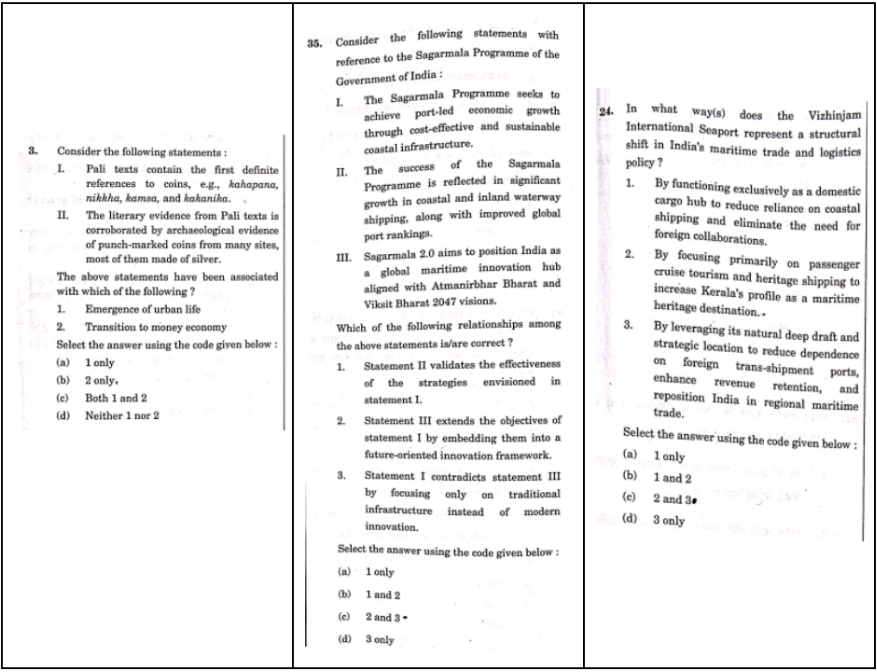
He walked through specific questions from this paper to demonstrate.
- It was about Pali texts, coins, and what they indicate. Most people who haven’t specifically read about Pali texts and numismatics would panic and skip it. But here’s the thing: the question itself provides the inference path. The text contains definite references to coins → Literary evidence for Pali texts corroborated by archaeological evidence of punchmarked coins, most made of silver. That tells you two things: (1) urbanization was emerging, and (2) there was a transition to a money economy. You don’t need to have studied Pali at all. You need to be able to read, deduce, and stay calm.
- Similarly with the Sagarmala question: Statement 1 described Sagarmala. Statement 3 said “Statement 1 contradicts Statement 3 by focusing only on traditional infrastructure instead of modern innovation.” Basic reasoning: Sagarmala and Sagarmala 2.0 are sequential programmes. 2.0 extends 1.0. They cannot contradict each other. Statement 3 eliminated itself. You didn’t need to know a single detail about Sagarmala’s actual content.
- In the “Vidhijism Port” question, Option 1 said the port functions “exclusively as a domestic cargo hub.” The port’s own name had “International” in it — eliminated. Option 2 linked it to “passenger cruise tourism.” The question’s context said “logistics.” Logistics ≠ passenger tourism — eliminated. Two options gone. Only one can remain. You just needed to read carefully and stay logical, not memorise port data..
This skill cannot be improvised in the exam hall. It must be built through 50 to 100 mock tests, done under real exam conditions, timed strictly, with post-test analysis of where your guessing strategy is net-positive and where it is not.
Newspaper Reading Builds Context, Not Just Information
Over the past four years, Shri Ashutosh Dwivedi (IAS) observed a clear and worrying trend: aspirants have largely replaced newspaper reading with YouTube summaries, one-page PDFs, and Telegram cheat sheets. It feels efficient.
But here is what you are losing, and this is the hidden reason UPSC rewards newspaper readers:
- when you read a full newspaper over weeks and months, you don’t just collect facts. You absorb the evolution of an issue. An issue develops — one article, then a response, then a policy, then a counter-argument, then an outcome. When you have followed that arc, any question on that issue — even about a seemingly minor character in the story — surfaces from your memory like a scene from a film you watched closely.
- There is a second reason, equally important, that people overlook: reading a full newspaper every day builds your reading speed and deduction speed. This year’s paper had questions where the question itself contained the answer but only if you could read quickly, extract information, and deduce under time pressure. If your daily reading habit is watching a 7-minute summary video, your brain has not been trained for rapid written comprehension. When you are in the exam hall staring at three dense statements, the skill gap shows up instantly.
| How Shri Ashutosh Dwivedi (IAS) actually read the newspaper during preparation Five minutes first — scan and tick only the articles relevant to your syllabus, knowing which GS paper and which sub-topic each article serves. Then read those articles, and make notes — not long paragraphs, but bullet points on half a page. He maintained six thin files: GS 1, 2, 3, 4, Sociology (his optional), and a daily miscellaneous file. Each clipping went into the right folder. Before the exam, you revise your notes. You cannot revise 1,200 newspaper clippings; you can revise organised bullet-point notes sorted by topic. One more thing: never underline or mark a book on the first read. Everything feels important when your knowledge base is thin. Underline only on revision passes, when your preparation has matured enough that you can genuinely distinguish important from obvious. |
On Mindset and Temperament
Treat Each Question as Its Own World
One of the most direct and practically useful points from the session: a bad question does not predict a bad next question. This seems obvious, but it is one of the most common ways aspirants collapse mid-paper.
In the civil service, every situation is fresh. A district collector cannot carry the emotional residue of a difficult meeting into the next one — the next person deserves a clean assessment.
The same principle applies in the exam hall. If Question 37 was unfamiliar, that tells you nothing about Question 38. Reset completely. Your only job, at any given moment, is the question in front of you.
The Exam Is Training You for the Job
This is one of the most important lessons from the entire session. Shri Ashutosh Dwivedi, IAS described real situations from his service: deciding when to personally intervene in a law-and-order situation versus sending the SDM and DSP first; reading a room of agitated people and judging whether to wait or act; writing a dissenting note in a committee when two other members are compromised.
None of these situations come with a manual. There is no senior who can tell you in advance what to do — because the situation has not happened yet. You derive judgment from your own knowledge, your own reading of people and contexts, your own ethical clarity.
The exam is selecting precisely for that capacity. The aspirant who stayed calm during this paper, read questions carefully, applied logic, and moved forward — that person demonstrated exactly the temperament the service needs.
On Integrity and Professional Conduct
Integrity in the Service Is Non-Negotiable — And It Is Also Practical
Asked about ethical dilemmas and what happens when others around you are compromised, he replied that Integrity is not a philosophical position for him — it is a professional operating principle. People trust your decisions, even when those decisions go against them, because they know your decisions are made on principle, not on caste, religion, or personal interest. That trust is what allows you to function effectively.
On committees where others may be compromised, you write your dissenting note. You document. You escalate when possible. You may not always fix the outcome but you remain clean, and that record matters over a career. He was also clear that justifying compromise by saying “everyone does it” is the beginning of a very particular kind of professional failure.
On What UPSC Preparation Ultimately Does to You
The Process Itself Builds the Civil Servant
He further observed that almost everyone who enters UPSC preparation has mixed motivations — status, power, money, a vague sense of wanting to do something meaningful. But almost everyone who gets selected — through the years of reading about this country, its people, its failures, its possibilities — arrives at a genuine desire to contribute. The process does that.
You do not need to separately cultivate a “sense of service.” Reading deeply about India, its governance, its social realities, its economics, its history — that is Bharat Darshan in text form. The actual Bharat Darshan during training completes the rest. Trust the process. It is designed to produce exactly what the country needs.
Closing note
Treat the exam the way you will eventually treat your work. Not as a test of your identity, but as a problem in front of you that deserves your full, composed attention. When you are in the exam hall — your target is not IAS. Your target is this question, right now. Solve it with everything you have. Move to the next one with a clean slate.
The paper was tough. The cutoff will reflect that. Everyone faced the same difficulty. The ones who stay calm, eliminate intelligently, and keep moving — they will be fine. They always are.
A couplet he wrote during his own years of preparation:
“ कितने रोड़े लगाएगा ज़ालिम मेरी मंज़िल के रस्तों पर , हमने पत्थर से सीढ़ी बनाने का हुनर सीखा है, तेरे वारों का माकूल असर होना नहीं मुमकिन , मेरा हर ज़ख्म पुरज़ोर मजबूती का तरीका है “
“No matter how many obstacles are placed in my path, I have learned to turn stones into steps. No setback can truly weaken me, For every wound has become a source of greater strength.”