Current Affairs
Iran-US War: Risks to India’s Energy Security
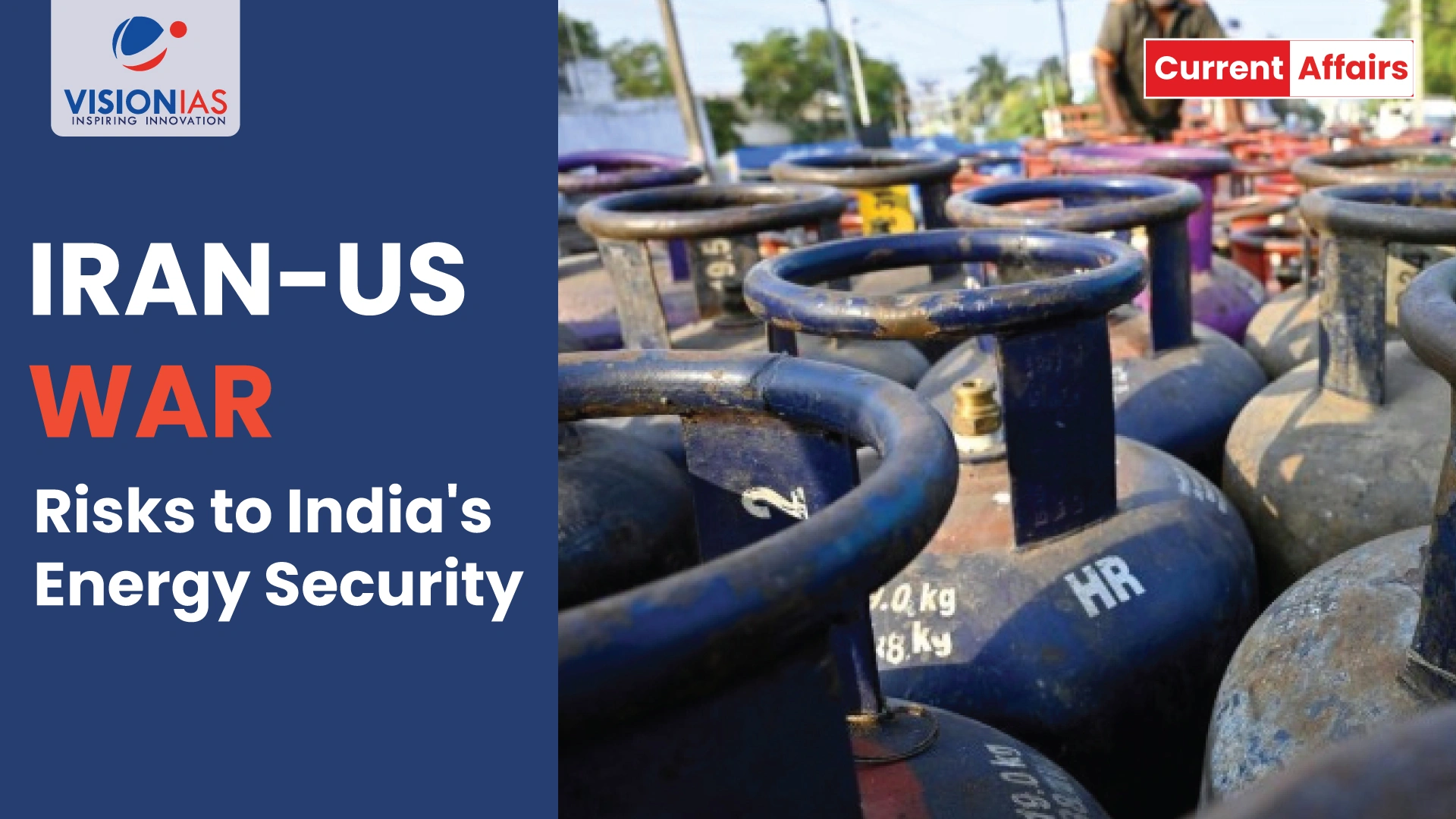












The US–Iran war has disrupted oil supplies in the region, leading to rising prices and emergency interventions that may place financial pressure on Indian oil marketing companies.
The Iran-US war, which began on February 28, 2026, has disrupted energy supply chains across West Asia. For India, which sources nearly 91% of its Liquefied Petroleum Gas (LPG) from the Gulf region, the conflict has brought its LPG import dependence into focus.
Within days of the conflict, domestic LPG prices were raised by Rs 60 per cylinder, Brent crude rose above $120 a barrel, and the Strait of Hormuz, through which a large share of India’s cooking gas travels, was closed to commercial shipping. In response, the government invoked the Essential Commodities Act and redirected domestic refinery output to prioritise household consumers.
Background: India’s LPG Import Dependence
India is the world’s second-largest importer of LPG. The country produces around 40% of its LPG requirement domestically. The remaining 60% is imported, with the Gulf region accounting for the bulk of those imports. This LPG import dependence has grown over the past decade, in large part due to government programmes that expanded access to clean cooking fuel.
Between 2015 and July 2025, the number of active domestic LPG consumers rose from 148.6 million to 330.5 million, an increase of over 120%. The Pradhan Mantri Ujjwala Yojana, launched in 2016 when LPG household coverage stood at 62%, has since expanded coverage to nearly 100%. As LPG adoption increased, imports rose from 16.48 MMT in 2020-21 to over 18 million metric tonnes (MMT) in 2025-26.
Who Supplies India’s LPG?
India’s LPG imports are concentrated in a few West Asian countries. In 2025:
- Qatar accounted for approximately 34% of India’s LPG imports, making it the largest supplier.
- UAE supplied nearly 26% of imports.
- Kuwait contributed around 8.3%.
- Saudi Arabia was a major supplier in earlier years, accounting for 11% in 2020.
Most of these suppliers export through the Strait of Hormuz, a waterway between Iran and Oman through which approximately 20% of the world’s daily oil and LNG trade passes. The closure of this route since March 1, 2026, has directly affected India’s energy security.
Sectoral Impact: Hospitality, Industry, and Households
The West Asia energy crisis has affected India’s hospitality sector. In Bengaluru, hotel associations reported that only 10% of establishments received their gas supplies on March 10. In Mumbai, commercial LPG refill delays ranged from two to eight days.
The National Restaurant Association of India (NRAI) stated that 75% of the food service industry depends on LPG and that a prolonged shortage could cost the economy between Rs 1,200 and Rs 1,300 crore per day. Hospitals, educational institutions, and LPG-based crematoriums in some cities have also been affected.
India’s LNG imports have also been disrupted. India imported 27 MMT of LNG in 2024-25, the highest on record, with 50% sourced from Qatar. LNG is used in fertiliser plants, power generation, and city gas networks. The supply disruption has implications for both agricultural input costs and urban energy availability.
Government Response: Supply Reallocation and Rationing
Maximising Domestic LPG Output
On March 9, the Ministry of Petroleum and Natural Gas directed all domestic oil refining companies to maximise LPG recovery and supply the entire output to IOCL, HPCL, and BPCL. Refiners were barred from diverting propane or butane streams to petrochemical production. This resulted in a 10% increase in domestic LPG output within the first week.
Invocation of the Essential Commodities Act
On March 10, the government invoked the Essential Commodities Act of 1955, notifying the Natural Gas (Supply Regulation) Order, 2026. The order established a four-tier priority system for gas allocation:
- Tier 1: Full requirements for domestic PNG, CNG for transport, and LPG production.
- Tier 2: Fertiliser plants at 70% of their requirements.
- Tier 3: Manufacturing consumers on the national gas grid, capped at 80%.
- Tier 4: Industrial and commercial CGD consumers, capped at 80%.
To reduce hoarding, the minimum waiting period for domestic LPG refills was increased from 21 days to 25 days.
Supply Diversification: Exploring Alternatives to Gulf Imports
The Iran-US war has prompted India to explore alternative energy supply sources to reduce its concentration of imports from the Gulf. Steps taken include:
- Russia: On March 5, the US Treasury Department issued a 30-day waiver allowing Indian refiners to purchase Russian crude oil already at sea. Russian crude (Urals), which previously traded at a discount to Brent, has moved to a premium as demand for non-Hormuz crude has increased.
- Canada: A Strategic Energy Partnership signed in early March includes a $2.6 billion uranium supply agreement with Cameco. The two countries are also working on India’s first long-term LPG supply arrangement with Canada.
- Australia: Australia has offered additional gas supplies to help India offset the 60 mmscmd of gas it normally sources from Qatar.
- United States: India is increasing LPG intake from the US Gulf Coast to 2.2 million tonnes per year.
Maritime Security: Role of the Indian Navy
Over 38 Indian-flagged vessels are reported stranded in the Persian Gulf and Gulf of Oman, with nearly 20,000 Indian seafarers in the conflict zone. The physical security of energy shipments has become a concern for the Ministry of Defence.
Under Operation Sankalp, the Indian Navy has been placed on standby to provide escorts for merchant tankers carrying LPG and crude oil. A decision on full-scale naval deployment is expected by mid-March, as private insurers have suspended coverage for vessels in the region. An attack on the tanker Skylight on March 1, which killed two Indian crew members, has added to the urgency of the decision.
Conclusion
The Iran-US war has brought India’s energy security concerns to the foreground. The crisis has highlighted three areas that require policy attention: the absence of strategic LPG reserves, a concentration of import sources in a single region, and the vulnerability of maritime trade routes that the supply chain depends on.
In the near term, domestic production increases, demand rationing, and emergency supply arrangements are being used to manage the situation. Over the medium and long term, India will need to build strategic LPG reserves, establish naval protocols for energy-related shipping, and conclude supply agreements with partners outside the Gulf region.
Master Digital Age Governance & Technology Trends with VisionIAS Comprehensive Current Affairs →
Iran-US war FAQs
1. What percentage of India’s LPG is imported from the Gulf region?
Ans. Approximately 60%.
2. Which country is India’s largest LPG supplier?
Ans. Qatar, at roughly 34% of imports.
3. Which waterway closure most directly threatened India’s LPG supply?
Ans. Strait of Hormuz, closed since March 1, 2026.
4. What law did India invoke to manage domestic gas supply during the crisis?
Ans. Essential Commodities Act of 1955.
5. What naval operation has India activated to protect energy shipments?
Ans. Operation Sankalp.