Current Affairs
US Issues 30-Day Waiver Allowing India to Purchase Russian Oil
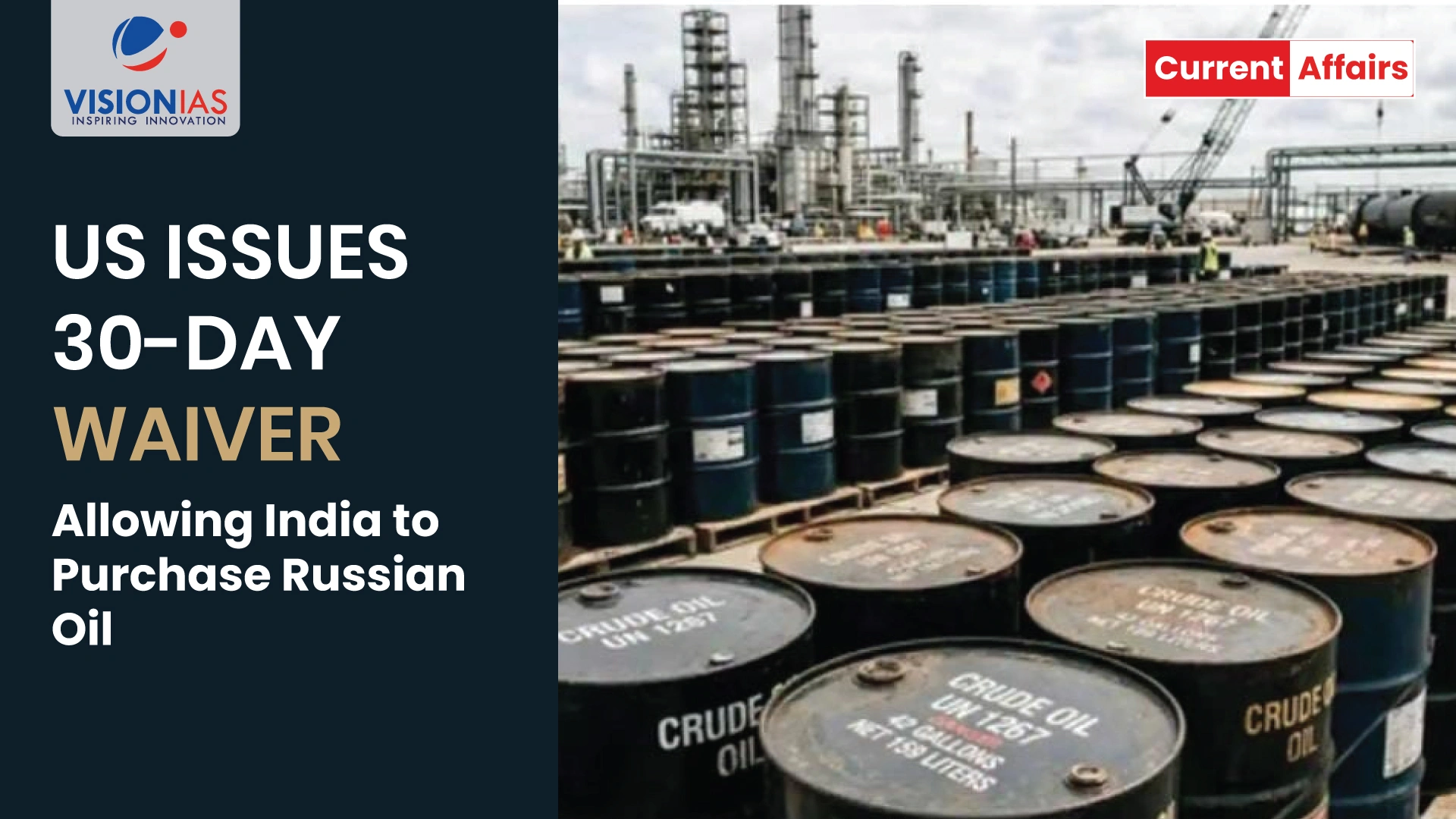


















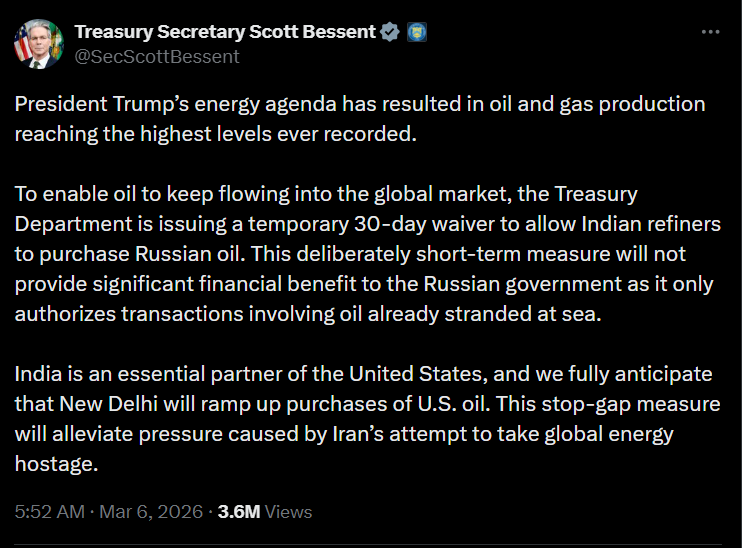
The US Treasury Department on March 6, 2026 issued a “temporary 30-day waiver to allow Indian refiners to purchase Russian oil” amid ongoing West Asia conflict.
The United States Treasury Department issued a 30-day waiver on March 6, 2026, allowing Indian refiners to purchase Russian crude oil that is currently stranded at sea. The move, announced by U.S. Treasury Secretary Scott Bessent, comes amid escalating conflict in West Asia that has severely disrupted global oil supply chains.
Concerns over potential disruptions in shipping through the Strait of Hormuz, a key route for global oil trade have increased volatility in oil supply and prices. For India, the world’s third-largest oil importer, nearly 40-50% of the crude oil imports pass through the Strait of Hormuz, which makes maintaining stable supply chains a key economic priority.
U.S. Waiver: Scope and Conditions
In response to these market pressures, the U.S. Treasury authorised a temporary exemption from sanctions to allow Indian companies to receive Russian oil cargoes that were already in transit.
The waiver applies for 30 days, from March 5 to April 4, 2026, and includes specific conditions. The shipments must have been loaded on vessels before March 5, 2026, and the cargo must be delivered to ports located in India. The purchasing company must also be registered under Indian law.
The U.S. Treasury clarified that the waiver covers cargo that had already been loaded and therefore would not generate significant new revenue for the Russian government. Officials described the measure as a limited step aimed at addressing supply disruptions in global energy markets.
West Asian Conflict and Oil Supply Concerns
West Asia conflicts have raised concerns about the security of oil shipments passing through the Strait of Hormuz. The strait connects the Persian Gulf with the Arabian Sea and carries around 20 percent of global oil shipments each day.
At the beginning of the conflict, Iran claimed it had strategically blocked the Strait of Hormuz following strikes by the United States and Israel, warning that vessels attempting to pass could be targeted by its naval forces. The Islamic Revolutionary Guard Corps initially signalled that ships would not be allowed to pass through the waterway, highlighting the use of the strait as a tool of strategic pressure during the escalating conflict.
Iran later clarified that the restrictions were selective rather than universal. Iran subsequently stated that restrictions in the strait would primarily apply to vessels associated with the United States, Israel, Europe and their Western allies.
Additionally, according to Iran’s Consul General in Mumbai, Iran would not obstruct commercial shipping in the Strait of Hormuz, but vessels suspected of using commercial cover for hostile activities could be targeted. This statement followed an incident in which an Iranian warship, IRIS Dena, was reportedly sunk off the coast of Sri Lanka by a US submarine without prior warning.
Strategic Implications of the Russian Oil Waiver
The waiver allowing India to continue purchasing Russian oil reflects a pragmatic use of sanctions diplomacy by the United States. Brent crude prices have risen from about $66 in early February to around $84 in early March. By enabling India to absorb Russian oil already in the market, Washington aims to stabilise supply and limit price spikes.
The decision also recognises India’s dependence on the Middle East for nearly 40-50 percent of its crude and about 60 percent of its LNG imports. Continued access to Russian crude therefore helps cushion supply disruptions linked to tensions around the Strait of Hormuz, while also aligning with broader India–US trade discussions on increasing American energy exports.
This also has financial implications. As a major energy importer, India is highly sensitive to oil price fluctuations. Every $10/barrel rise potentially widens its current account deficit by 50 basis points. The recent waiver offers timely relief, helping contain the import bill amid surging crude prices.
India’s Energy Strategy: Russian Oil and the India-US trade Context
India’s imports of Russian crude rose sharply after the Russia–Ukraine conflict as Western sanctions pushed Moscow to offer discounted oil to Asian buyers. At its peak, Russian oil accounted for more than 40 percent of India’s crude imports. However, its share declined to below 20 percent by January 2026, due to diversification efforts and pressure from the United States over India’s continued purchases of Russian oil.
The US administration had imposed a 25 percent base tariff on certain Indian exports and an additional 25 percent “punitive” tariff linked specifically to India’s Russian oil purchases. This effectively raised tariffs on some Indian goods to nearly 50 percent in 2025.
February 6 Executive Order eliminated the 25% “punitive” tariffs that had been imposed specifically over India’s purchases of Russian oil. This rollback was contingent on India’s commitment to “stop directly or indirectly importing Russian Federation oil” and its representation that it would increase purchases of US energy products.
Amid rising tensions in West Asia and concerns over supply disruptions, Indian refiners including Indian Oil Corporation, Bharat Petroleum, and Hindustan Petroleum have again turned to Russian crude to ensure stable supplies. The Indian government continues to pursue a strategy of diversification and “de-risking,” maintaining its strategic partnership with Russia while simultaneously expanding economic and technological cooperation with the United States.
India’s Efforts to Diversify Energy Supplies
India has accelerated efforts to diversify its energy sources amid the West Asian crisis. It is expanding procurement beyond traditional suppliers, with Australia and Canada offering additional gas supplies and new contracts signed with the United States and the UAE. India imports about 195 MMSCMD of natural gas, of which around 60 MMSCMD comes from QatarEnergy, making Qatar a key supplier.
However, supply risks have increased after QatarEnergy declared force majeure on March 4 following strikes on its energy infrastructure. In response, India has intensified consultations with the International Energy Agency and the Organization of the Petroleum Exporting Countries to secure crude and LPG supplies, while also working with the United States to arrange insurance for ships navigating the Strait of Hormuz.
India currently holds about 100 million barrels of crude in reserves and cargoes in transit, enough to meet roughly 40–45 days of demand even if flows through the Strait of Hormuz are disrupted.
Conclusion
The U.S. decision to grant a 30-day waiver allowing Indian refiners to purchase Russian crude oil reflects the complex interaction between sanctions policy, geopolitical tensions and global energy markets. The exemption provides temporary flexibility for shipments that were already in transit while broader restrictions on Russian oil remain in place.
For India, the development highlights the importance of diversified energy partnerships and stable maritime trade routes. As geopolitical developments continue to influence global oil supply chains, maintaining reliable access to energy resources and significant expansion of strategic petroleum reserves will remain key considerations for economic and strategic policy.
Master Digital Age Governance & Technology Trends with VisionIAS Comprehensive Current Affairs →
US issued 30-days waiver for India to Purchase Russian Oil FAQs
1. What is the latest waiver issued by the US Treasury Department on March 6, 2026 regarding Indian oil purchases?
Ans. The US issued a 30-day waiver allowing Indian refiners to buy Russian crude oil, currently stranded at sea.
2: Which countries offered gas supplies to India amid the West Asian conflict?
Ans. Australia and Canada.
3. What percentage of global oil shipments pass through the Strait of Hormuz daily?
Ans. Around 20 percent.
4: Which countries did Iran block from using the Strait of Hormuz?
Ans. The US, Israel, Europe, and other Western allies.
5. What condition must oil shipments meet to qualify under the US waiver?
Ans. Vessels must have been loaded before March 5, 2026, and cargo delivered to Indian ports.