Current Affairs
US-Israel Attack on Iran: Causes, Consequences and the Strait of Hormuz Crisis
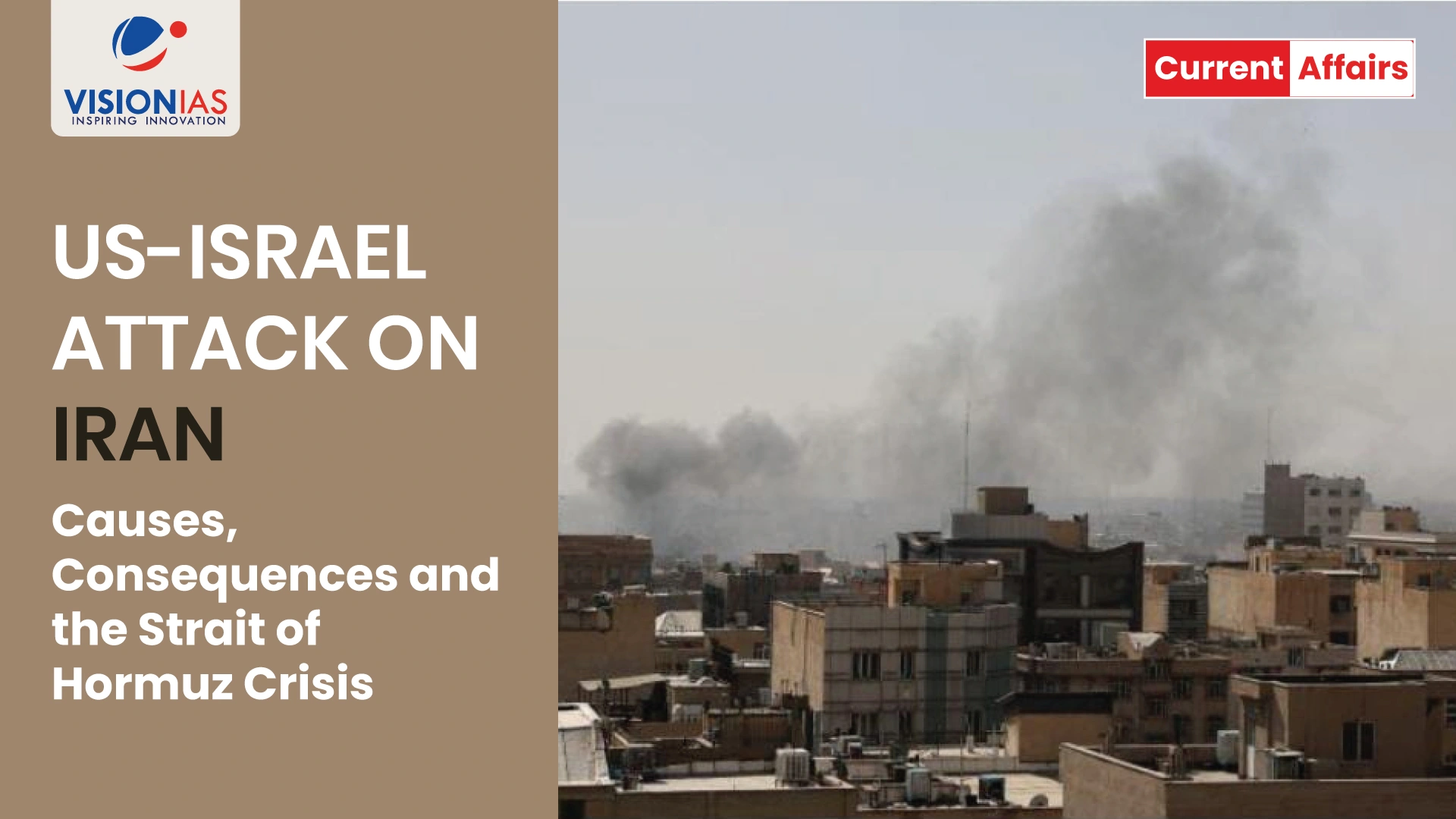


















Following the U.S.–Israel attack on Iran, joint airstrikes killed Iran’s Supreme Leader Ayatollah Ali Khamenei, thereby sharply escalating tensions across the region.
On February 28, 2026, the United States and Israel launched a joint military operation against Iran. Framed as a pre-emptive strike against Tehran’s nuclear and missile programmes, the US-Israel attack on Iran has escalated into a regional crisis. On March 1, 2026, Iran’s Supreme Leader Ayatollah Ali Khamenei was killed in follow-up strikes, alongside other senior officials.
Iran retaliated by attacking the US fleet in West Asia and announcing closure of the Strait of Hormuz, through which nearly one-fifth of global crude oil flows. This has raised concerns about supply disruptions and oil price increases across global energy markets.
Why Did the US and Israel Attack Iran?
The US-Israel attack on Iran was built around four objectives stated by U.S. President Donald Trump:
- Halting Iran’s Nuclear Programme: US President Trump claimed Iran was rebuilding its nuclear capabilities after strikes in June 2025. The IAEA had flagged Iran’s uranium enrichment as a matter of “serious concern.” Iran maintains its nuclear program is exclusively for peaceful, civilian purposes under the Non-Proliferation Treaty (NPT).
- Containing Iran’s Missile Programme: The U.S. cited Iran’s development of long-range missiles capable of reaching Europe, U.S. bases overseas, and the American mainland.
- Eliminating Proxy Threats: US President Trump pointed to Iran’s support for militant groups, including Hamas, whose October 7, 2023 attack on Israel widened the regional conflict.
- Regime Change: US President Trump called on Iranians to “take over your government,” indicating that the operation’s aims extended beyond military targets.
Iran’s Retaliation and the Strait of Hormuz
Following coordinated military strikes by the United States and Israel on Iranian strategic and nuclear-linked facilities, Iran launched a calibrated but geographically widespread retaliation across West Asia. The response involved ballistic missile and armed drone attacks targeting Israeli territory as well as U.S. military installations and logistical facilities across the region.
Reported targets included bases and defence infrastructure located in Bahrain, Iraq, Jordan, Kuwait, Oman, Qatar, Saudi Arabia, and the United Arab Emirates, signalling Iran’s intent to expand the theatre of confrontation beyond direct bilateral engagement.
Alongside military retaliation, Iran announced the closure of the Strait of Hormuz, dramatically escalating the crisis from a regional security confrontation to a matter of global economic concern. The move transformed the conflict into an energy security emergency, drawing immediate attention from major oil-importing economies, global shipping companies, and international financial markets.
What Is the Strait of Hormuz?
The Strait of Hormuz is one of the world’s most strategically significant maritime chokepoints. Located between Iran to the north and Oman and the United Arab Emirates to the south, the narrow waterway connects the Persian Gulf with the Gulf of Oman and ultimately the Arabian Sea, providing the only sea passage for energy exports from major Gulf producers to global markets.
According to estimates by the International Energy Agency (IEA), nearly one-fourth of globally traded crude oil and a substantial share of liquefied natural gas (LNG) shipments transit through the Strait of Hormuz daily. Energy exports from Saudi Arabia, the United Arab Emirates, Kuwait, Qatar, Iraq, and Iran depend heavily on uninterrupted access to this route.
Economic and Energy Implications of Closure
The announcement of closure even before complete physical enforcement triggers immediate disruptions across global supply chains and financial markets. A shutdown or restriction of maritime movement through the Strait typically results in:
- Significant delays in crude oil and LNG shipments reaching Asia, Europe, and North America
- Reduction in tanker traffic due to heightened security risks
- Sharp increases in marine insurance premiums and freight costs
- Diversion or suspension of commercial shipping operations
- Speculative trading pressures pushing global crude oil prices upward
Energy markets react rapidly to perceived supply risks rather than actual shortages. As a result, oil prices often surge within hours of escalation announcements, contributing to volatility in currency markets and stock exchanges worldwide. Import-dependent economies, particularly in Asia including India, China, Japan, and South Korea face immediate exposure through higher import bills and inflationary pressures.
India’s Exposure to West Asia Crisis
India’s exposure to this conflict is direct. Approximately half of India’s crude oil and 54 percent of its LNG imports passed through the Strait of Hormuz in FY2025. Nearly 50 percent of India’s crude oil imports, amounting to around 2.6 million barrels per day, transit through the Strait, significantly heightening India’s vulnerability to supply disruptions. A prolonged closure would raise India’s energy import bill, reduce margins for oil marketing companies, and push up domestic fuel prices.
As per reports, every 1 dollar increase in global crude prices is estimated to add nearly 2 billion dollars to India’s annual import bill, increasing inflationary and fiscal pressures. Trade routes are also affected. Rerouting ships via the Cape of Good Hope adds an estimated 15 to 20 days to transit times, increasing costs for Indian exporters. India currently possesses Strategic Petroleum Reserves, commercial crude stocks sufficient for roughly 10 to 15 days, along with an additional 7 to 10 days of refined fuel inventories, providing only limited short-term cushioning against prolonged disruption.
Approximately 10 million Indians live and work across Gulf nations. Airport closures in Dubai, Abu Dhabi, and Doha have left thousands of travellers stranded. India’s Ministry of External Affairs called on all parties to exercise restraint and pursue dialogue. Indian missions in the region were placed on alert.
Global Reactions: Who Is Supporting Whom?
The US-Israel attack on Iran has divided the international community. The United States has committed to continuing strikes “until all objectives are achieved.”
Iran’s strikes have targeted U.S. military infrastructure across multiple countries in the region. The killing of Supreme Leader Ayatollah Ali Khamenei has placed Iran’s Revolutionary Guards at the centre of any decision on future escalation. Their response will shape how this conflict develops in the coming weeks. The escalation has also raised serious concerns over potential human rights violations, including civilian casualties, damage to critical infrastructure, and risks to non-combatants under international humanitarian law.
While countries such as the United Kingdom, France, and Germany have called for restraint and de-escalation, Russia and China have condemned the strikes as violations of sovereignty, whereas several Western allies have expressed support for Israel’s security concerns and the U.S. position.
Conclusion
The US-Israel attack on Iran and the resulting Strait of Hormuz closure have raised concerns across energy markets, trade routes, and diplomatic channels. The killing of Supreme Leader Khamenei has removed a central figure in Iran’s political structure, and the direction of Iran’s response will determine how the situation develops.
For India, the conflict touches energy security, diaspora welfare, and trade costs. The government’s call for restraint reflects its interest in stability in a region central to its economic interests.
Master Digital Age Governance & Technology Trends with VisionIAS Comprehensive Current Affairs →
US-Israel Attack on Iran FAQs
1. Why did the US and Israel attack Iran?
Ans. To halt Iran’s nuclear programme, contain its missile capabilities, eliminate proxy threats, and pursue regime change.
2. How did Iran retaliate against the US-Israel attack?
Ans. Iran launched ballistic missile and drone strikes on Israeli territory and U.S. military bases across West Asia.
3. Which countries were targeted by Iran’s retaliatory strikes?
Ans. Bahrain, Iraq, Jordan, Kuwait, Oman, Qatar, Saudi Arabia, and the UAE.
4. What is the Strait of Hormuz?
Ans. A critical maritime chokepoint connecting the Persian Gulf to the Arabian Sea, through which a significant share of global energy exports pass.
5. What international body flagged Iran’s uranium enrichment before the strikes?
Ans. The International Atomic Energy Agency (IAEA).