Current Affairs
India AI Impact Summit 2026 and New Delhi Declaration: India’s Leap into the Global AI Order
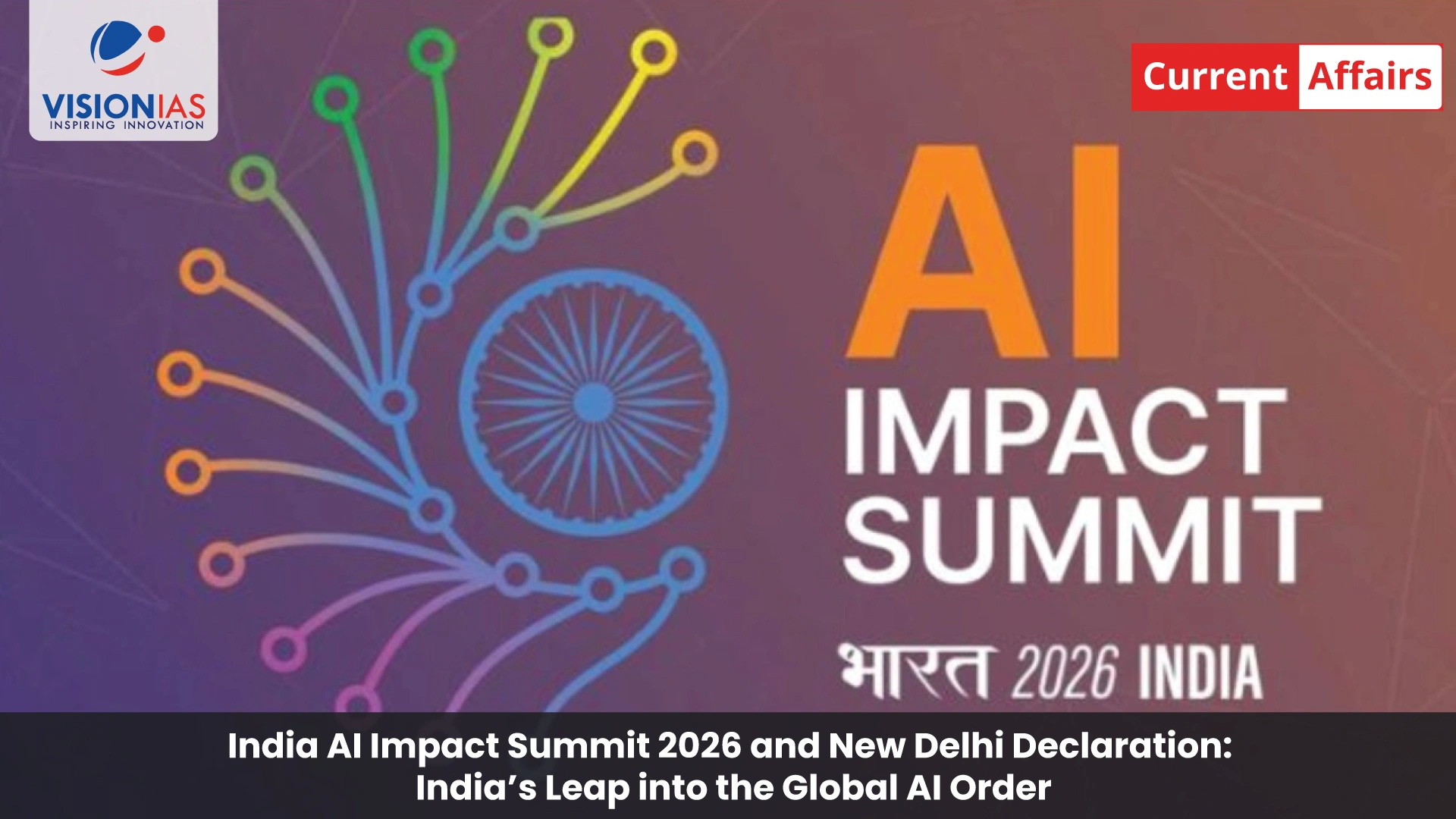








The AI Impact Summit 2026 attracted lakhs of visitors, with high-profile AI executives and heads of state visiting New Delhi.
The India AI Impact Summit 2026, held from February 16–21 at Bharat Mandapam in New Delhi, marked a defining milestone in India’s rise as a global Artificial Intelligence power. Structured around 3 core Sutras and 7 Chakras (pillars) of action, the Summit brought together over 20 Heads of Government, representatives from 118 countries, more than 100 global AI CEOs and CXOs, and over five lakh participants, emerging as one of the largest AI gatherings in history.
At its core, the Summit advanced India’s vision of responsible, sovereign, and inclusive AI, one that serves not only advanced economies but also the Global South. One of the significant outcomes in this regard was India’s formal entry into the Pax Silica Initiative, signalling a decisive geopolitical and technological shift.
Background: From AI Safety to AI Strategy
To understand the significance of the 2026 Summit, it is important to trace the evolution of global AI diplomacy. There is no international organisation at present that convenes AI Summits; participating countries have generally passed the baton for the following year’s summit.The AI summit series began in 2023 at Bletchley Park in the United Kingdom, where discussions were primarily centred on AI safety and existential risks.
The baton then passed to Seoul in 2024 and Paris in February 2025, where the Prime Minister of India co-chaired the summit alongside French President Emmanuel Macron. India positioned itself as a bridge-builder: balancing innovation with responsibility, growth with governance, a middle path especially relevant for emerging economies.
Goals and Priorities: Framing India’s AI Vision
Building on this global transition, India structured the Summit around a clearly articulated set of priorities. India structured the Summit around four integrated priorities: democratising AI to prevent concentration of capabilities; Global South inclusion, particularly for under-represented languages in Large Language Models (LLMs); safe and trusted AI through ethical governance frameworks; and sovereign capacity building encompassing indigenous LLMs, data centres, semiconductor ecosystems, and compute infrastructure.
Working groups on human capital, social empowerment, resilience, and economic development reflected this vision.
New Delhi Declaration: Norm-Setting with Flexibility
A landmark diplomatic outcome of the Summit was the adoption of the New Delhi Declaration on AI Impact on 19 February 2026, endorsed by 89 countries and international organisations. Inspired by the principle of “Sarvajan Hitaya, Sarvajan Sukhaya” (Welfare for all, Happiness for all) and “Vasudhaiva Kutumbakam” (the world is one family), the Declaration affirmed that AI’s benefits must be equitably shared across humanity.
Key Global Platforms and Mechanisms under the New Delhi Declaration on AI:
- Charter for the Democratic Diffusion of AI: Promotes affordable and equitable access to foundational AI resources across countries.
- Global AI Impact Commons: A platform to scale, share, and replicate AI use cases globally.
- Trusted AI Commons: A repository of tools, benchmarks, and best practices to support secure and reliable AI development.
- International Network of AI for Science Institutions: A framework to accelerate AI-driven scientific research through global collaboration.
- AI for Social Empowerment Platform: Facilitates equitable knowledge exchange and socially relevant AI applications.
- AI Workforce Development Playbook and Reskilling Principles: Provides guidance for preparing nations and workers for an AI-driven economy.
- Guiding Principles on Resilient and Efficient AI: Focuses on promoting energy-efficient and sustainable AI infrastructure.
Crucially, all commitments are voluntary and non-binding, ensuring wider participation especially from developing nations.
Other Key Outcomes of AI Impact Summit 2026
The success of the Summit can be assessed across three dimensions such as participation, investment, and technological capability.
Record Participation and Global Engagement
In terms of scale, the Summit surpassed previous benchmarks. With over five lakh participants across multiple countries, it demonstrated unprecedented global engagement. The strong youth participation, including over 2.5 lakh students contributing to ethical AI discussions, symbolised India’s attempt to embed AI awareness at the grassroots level.
This large-scale engagement strengthened India’s credibility as a convenor of global technology diplomacy.
Investment Commitments: Signalling Economic Confidence
The Summit translated diplomatic momentum into tangible economic commitments. Approximately $250 billion in infrastructure investment pledges and $20 billion in deep-tech venture funding were announced.
Major domestic conglomerates such as Reliance Industries and Adani Group committed massive investments in AI infrastructure. Global technology leaders also deepened their presence. Google highlighted its substantial investments in Indian data centres and connectivity infrastructure. OpenAI partnered with Tata Group for large-scale data centre capacity, while Anthropic signed a strategic agreement with Infosys.
Taken together, these commitments signalled that India is not only a market for AI applications but also an emerging hub for AI infrastructure and frontier innovation.
Sarvam AI: From Consumption to Creation
One of the most valuable outcomes was the launch of indigenous LLMs by Sarvam AI. Developed with support under the IndiaAI Mission, these open-source models represented India’s shift from being a consumer of global AI systems to becoming a creator of foundational models.
This move strengthened India’s claim to technological sovereignty and demonstrated how frugal innovation can coexist with cutting-edge AI development.
India and the Pax Silica Initiative
While the Summit focused heavily on governance and inclusion, one of its strategic outcomes lay in geopolitics. India formally joined the Pax Silica Initiative, a U.S.-led framework aimed at securing supply chains for semiconductors, silicon, advanced computing hardware, and critical minerals.
This move must be understood in the broader context of technological decoupling, supply chain vulnerabilities, and semiconductor geopolitics. By entering Pax Silica, India aligned itself more closely with trusted technology coalitions seeking to reduce overdependence on concentrated manufacturing hubs.
The signing also included a Joint Statement on the India-U.S. AI Opportunity Partnership. This bilateral framework envisions pro-innovation regulatory cooperation, enhanced access to advanced compute, joint R&D, and next-generation data centre collaboration.
Conclusion
In essence, the India AI Impact Summit 2026 was not merely a diplomatic gathering; it was a strategic assertion. Through large-scale participation, unprecedented investment commitments, indigenous technological breakthroughs, the New Delhi Declaration, and entry into the Pax Silica Initiative, India signalled its intent to shape the future of Artificial Intelligence.
Master Digital Age Governance & Technology Trends with VisionIAS Comprehensive Current Affairs →
India AI Impact Summit 2026 FAQs
1. How many countries were represented at the India AI Impact Summit 2026?
Ans. 118 countries.
2. What is the Pax Silica Initiative?
Ans. A U.S.-led framework to secure supply chains for semiconductors, advanced computing hardware, and critical minerals.
3. How much infrastructure investment was pledged at the India AI Impact Summit 2026?
Ans. Approximately $250 billion.
4. What was the New Delhi Declaration on AI?
Ans. A non-binding declaration adopted by 89 countries emphasising equitable AI diffusion, trusted AI frameworks, scientific collaboration, and workforce reskilling.
5. What bilateral framework did India and the U.S. announce at the Summit?
Ans. The India-U.S. AI Opportunity Partnership.