Abhyaas
Final Call Before UPSC Prelims: Validate Your Strategy with Abhyaas










As the UPSC Preliminary Examination approaches, the nature of preparation undergoes a subtle but critical shift. The months of studying, revising, and practicing gradually converge into a single, defining question—is the strategy truly working?
At this stage, most aspirants are no longer concerned with how much of the syllabus has been covered. The focus instead turns toward clarity, confidence, and control over performance.
Yet, despite this progress, uncertainty often persists.
An aspirant may feel well-prepared while studying, but remain unsure about how that preparation will translate in the actual exam. Decisions such as how many questions to attempt, how to balance accuracy with risk, or how to manage time across the paper often remain untested in realistic conditions.
This creates a gap—not in knowledge, but in validated readiness.
Why UPSC Preparation Strategy Validation Becomes Essential
Preparation strategies are built over time through study plans, test experiences, and personal insights. However, unless these strategies are tested in conditions similar to the actual examination, their effectiveness remains uncertain.
- The Difference Between Assumed and Tested Strategy: A strategy that appears effective during preparation may not hold under time pressure or uncertainty.
- The Risk of Unverified Decisions: Attempt strategy, question selection, and time management require validation through experience, not assumption.
- The Illusion of Readiness: Familiarity with content often creates a sense of confidence that may not accurately reflect exam performance.
- The Need for Objective Feedback: Without measurable outcomes, it becomes difficult to identify whether the approach needs refinement.
Thus, the final phase of preparation is less about learning new content and more about testing the reliability of one’s approach.
What Does It Mean to Validate a UPSC Prelims Strategy?
Strategy validation is not limited to scoring well in tests. It involves understanding whether one’s approach is consistent, adaptable, and reliable across different conditions.
- Stability of Attempt Pattern: A consistent range of attempts indicates clarity in decision-making.
- Balance Between Accuracy and Risk: An effective strategy ensures that increased attempts do not lead to disproportionate negative marking.
- Time Distribution Across Questions: The ability to manage time without rushing or overthinking reflects strategic maturity.
- Performance Across Difficulty Levels: A validated strategy performs reasonably well across both easy and difficult papers.
- Reduction in Unforced Errors: Mistakes due to misreading, haste, or confusion decrease as strategy becomes refined.
Validation, therefore, is about predictability of performance, not just isolated outcomes.
Why Conventional Prelims Practice Often Falls Short
While regular mock tests and practice questions are essential, they do not always replicate the conditions required for true validation.
- Lack of Uniform Testing Conditions: Online or flexible tests may not create the same discipline and pressure as the actual exam environment.
- Limited Competitive Context: Without large-scale participation, it is difficult to assess where one stands among serious aspirants.
- Incomplete Simulation of Exam Behaviour: Factors such as OMR marking, physical test environment, and peer competition influence performance but are often missing in routine practice.
As a result, many aspirants enter the actual exam with a strategy that is partially tested but not fully validated.
Abhyaas: A Structured Platform for Strategy Validation
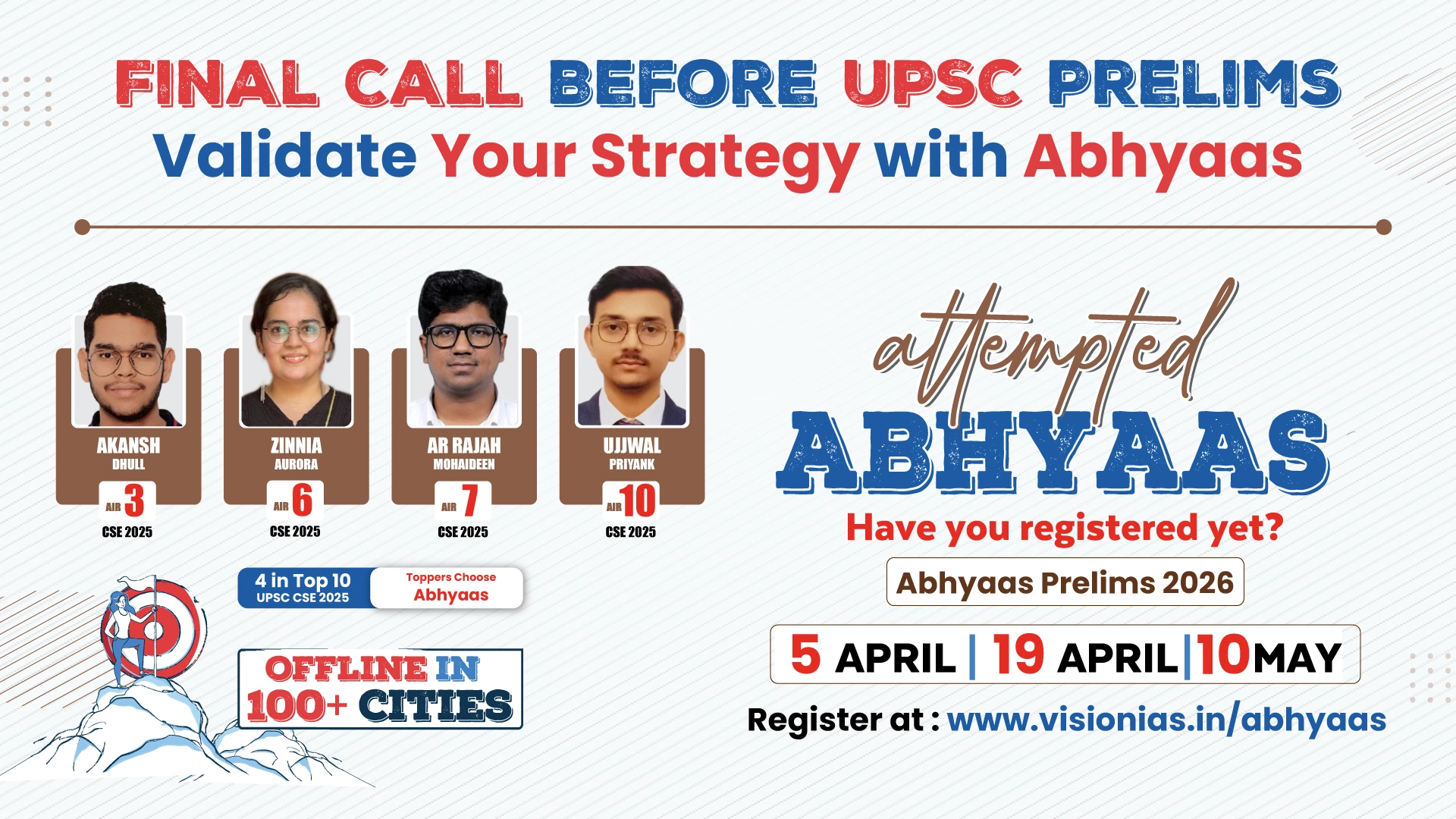
In this context, the All India Abhyaas Prelims (GS + CSAT) Mock Test Series 2026 provides a structured environment where aspirants can validate their preparation strategy under conditions closely aligned with the actual UPSC Preliminary Examination.
Conducted across 100+ cities, Abhyaas follows an offline OMR-based format, offering full-length General Studies and CSAT papers designed to reflect the nature and standard of the exam.
For UPSC Prelims 2026, the All India Abhyaas tests are scheduled on: 5 April, 19 April, and 10 May 2026
This multi-stage structure enables aspirants to not only test their strategy once, but to refine and revalidate it across successive attempts.
Register : Abhyaas Prelims 2026

Learning from the Approach of Successful Candidates
If one reflects on the preparation journeys of several UPSC toppers across recent years who have engaged with structured prelims simulations such as Abhyaas, a consistent pattern becomes visible.
UPSC Toppers like Shubham Kumar (AIR 1, CSE 2020), Ankita Agarwal (AIR 2, CSE 2021), Ishita Kishore (AIR 1, CSE 2022), Aditya Srivastava (AIR 1, CSE 2023), Shakti Dubey (AIR 1, CSE 2024), or Akansh Dhull (AIR 3, CSE 2025) among others, reflect an approach where preparation extends beyond content coverage to include systematic validation of performance strategies.
Their journeys highlight the importance of testing, feedback, and iterative refinement in the final stages of preparation.
Key Aspects that Enable Strategy Validation Through Abhyaas
- Realistic Examination Environment: Abhyaas recreates the structure, discipline, and pressure of the actual exam, enabling authentic performance testing.
- UPSC-Aligned Question Design: The nature of questions allows aspirants to test conceptual clarity and decision-making in varied contexts.
- All India Benchmarking: Large-scale participation provides a meaningful comparison, helping aspirants understand their relative standing.
- Structured Performance Analysis: Detailed insights into attempts, accuracy, and errors support targeted improvement.
- Iterative Testing Framework: Multiple rounds allow aspirants to refine strategy and observe whether improvements are consistent.
- Expert-Led Discussions: Post-test explanations enhance understanding and improve question-solving approaches.
- Personalized Mentoring Support: Focused guidance helps aspirants align their strategy with exam demands.
Conclusion
The final phase before UPSC Prelims is not about doing more, but about ensuring that what has been done is effective.
Preparation, no matter how extensive, remains incomplete without validation. It is only through structured testing under realistic conditions that an aspirant can truly understand their readiness.
Platforms such as Abhyaas provide this opportunity—enabling aspirants to test, refine, and confirm their strategy before the actual examination.
Because ultimately, success in UPSC Prelims depends not just on preparation, but on the confidence that comes from knowing that one’s strategy has been tested, validated, and made reliable.
Watch VisionIAS Faculties Tips on Abhyaas Prelims 2026