UPSC News
UPSC 2026 Notification is Out : Key Dates, Eligibility and What Aspirants Should Do Next







The UPSC 2026 notification has been officially released by the Union Public Service Commission on 4th February 2026 , marking the formal beginning of the UPSC 2026 examination cycle.
For lakhs of aspirants across the country, this is not merely a procedural update—it is the moment when preparation must move from intention to disciplined execution. At this stage, clarity about new changes, form filling process, UPSC eligibility, UPSC criteria, and UPSC qualification becomes as important as the study plan itself, because these conditions decide who is even entitled to remain in the competition.
Must Read, UPSC Notification 2026 Explained: New Changes, Form Filling Process, and Mistakes to Avoid
Download UPSC Notification 2026 PDF (English/Hindi)
[Download Official UPSC CSE 2026 Notification PDF – English]
[Download Official UPSC CSE 2026 Notification PDF- Hindi]
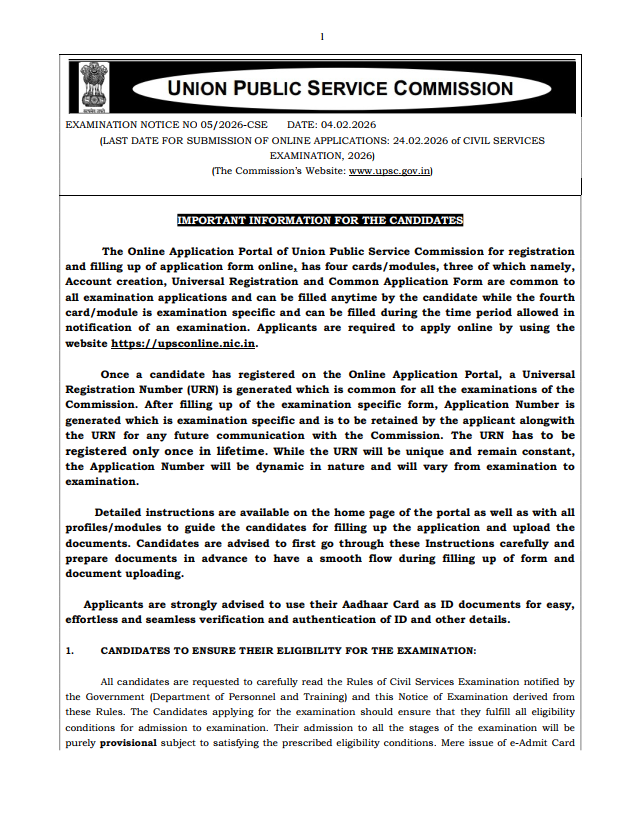
For serious aspirants, this document defines the non-negotiable boundaries within which the entire UPSC CSE 2026 journey will unfold. The first practical step for every aspirant is to understand the key dates and structure preparation around the major milestones of the year.
Key UPSC 2026 Notification Dates: Application Window and Exam Schedule
Here are the most important dates from the official UPSC CSE 2026 calendar that every aspirant must mark:
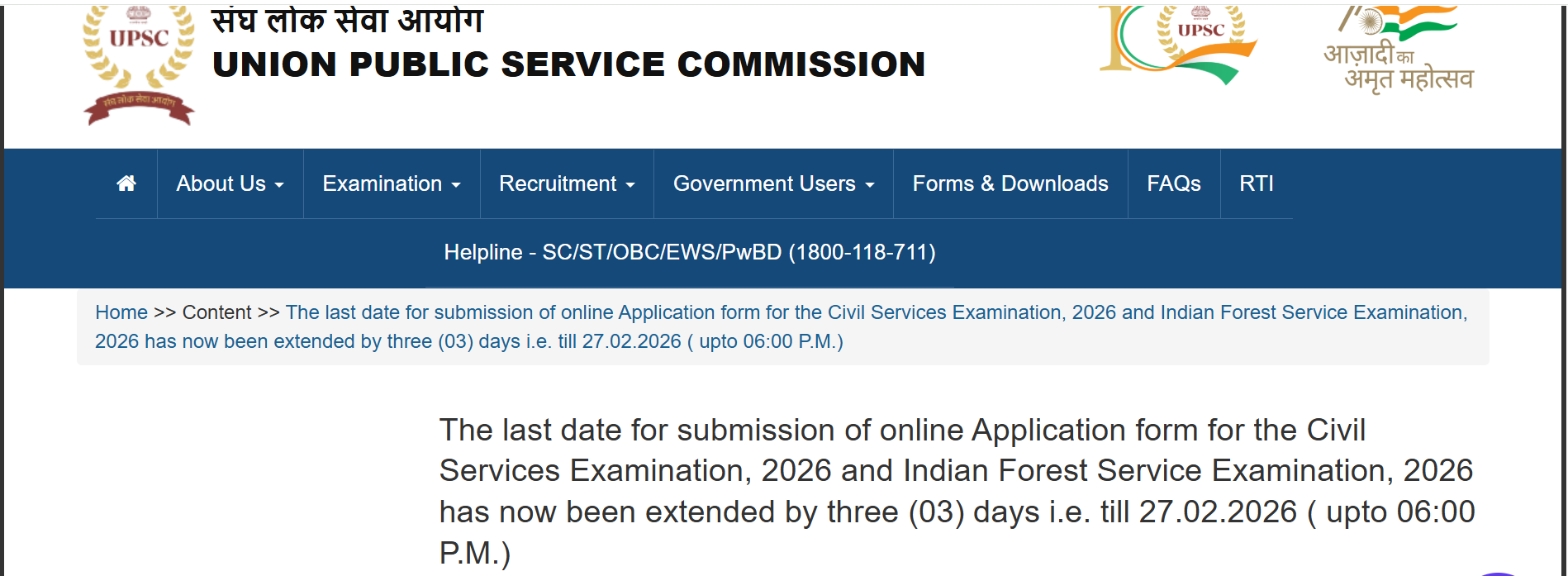
Imp Note: The last date for submission of online Application form for the Civil Services Examination, 2026 and Indian Forest Service Examination, 2026 has now been extended by three (03) days i.e. till 27.02.2026 ( upto 06:00 P.M.)
[Download UPSC Exam Calendar 2026 – Official PDF]
These dates should be treated as anchors for planning revision cycles, test series, and answer-writing practice. In the UPSC 2026 journey, time management is not an accessory skill—it is a core competence.
UPSC Vacancy 2026 Details (As Mentioned in the UPSC Notification)
The number of vacancies to be filled through the CSE 2026 is expected to be approximately 933 which include 33 vacancies reserved for Persons with Benchmark Disability Category. These vacancies are spread across various services such as IAS, IPS, IFS, Indian Revenue Services, Indian Audit and Accounts Services, and more.
*Note: The final vacancy count may change after confirmation from the Cadre Controlling Authorities and reservation is applied as per Central Government guidelines (SC/ST/OBC/EWS/PwBD).
Understanding UPSC Eligibility for UPSC CSE 2026
One of the most critical sections of the UPSC notification is the part that defines UPSC eligibility and UPSC criteria. Every year, candidates lose their candidature not because of poor preparation, but because of misunderstanding or ignoring these rules.
Nationality Criteria (As per UPSC CSE Notification 2026)
(1) For the Indian Administrative Service, the Indian Foreign Service and the Indian Police Service, a candidate must be a citizen of India.
(2) For other services, a candidate must be either:—
(a) a citizen of India, or
(b) a subject of Nepal, or
(c) a subject of Bhutan, or
(d) a Tibetan refugee who came over to India before 1st January, 1962 with the intention of permanently settling in India, or
(e) a person of Indian origin who has migrated from Pakistan, Burma, Sri Lanka, East African countries of Kenya, Uganda, the United Republic of Tanzania, Zambia, Malawi, Zaire, Ethiopia and Vietnam with the intention of permanently settling in India.
Provided that a candidate belonging to categories (b), (c), (d) and (e) shall be a person in whose favour a certificate of eligibility has been issued by the Government of India.
A candidate in whose case a certificate of eligibility is necessary, may be admitted to the examination but the offer of appointment may be given only after the necessary eligibility certificate has been issued to him/her by the Government of India.
Educational Qualification for UPSC CSE 2026
The minimum UPSC qualification required for UPSC CSE 2026 is:
- A Bachelor’s degree from a recognised university or institution.
- Candidates who are in the final year of their graduation may apply provisionally, subject to producing proof of passing before the interview stage.
It is important to understand that the UPSC qualification requirement is not about the subject you studied, but about having completed a recognised degree.
Age Limit and Number of Attempts (As per UPSC Notification 2026)
The UPSC eligibility rules specify age limits and maximum attempts, which vary by category.
Minimum age: 21 years, Maximum age: 32 years as of 1st August 2026 i.e., the candidate must have been born not earlier than 2nd August, 1994 and not later than 1st August, 2005. Valid proof is required for claiming age or attempting relaxation.
Note: Ex-Servicemen & J&K Domicile: Additional age relaxations as per category.
Every aspirant must cross-check their age, category status, and remaining attempts carefully under the UPSC criteria defined for UPSC 2026.
New Change in UPSC Notification 2026: Restrictions on Applying for examination (As per Official Notification)
The UPSC CSE 2026 notification introduces a very important clarification regarding who can apply, who cannot apply, and under what conditions a serving/allocated officer can reappear.


This section is crucial for candidates who are already allocated a service through earlier Civil Services examinations. As per the notification issued by the Union Public Service Commission, the following rules apply:
1. Absolute Restriction – Cannot Apply for CSE 2026
- A candidate already appointed to IAS or IFS from an earlier CSE cannot appear in CSE-2026 at all.
- Even if such an appointment happens after Prelims 2026, the candidate will not be allowed to write Mains or be considered for service from CSE-2026.
2. Special Rule for IPS Officers
- A candidate already appointed to IPS from an earlier CSE can apply and appear in CSE-2026.
- However, they cannot opt for IPS again while filling service preferences.
3. One-Time Improvement Rule
One-Time Improvement attempt linked to training Exemption. If a candidate is allocated IPS or any Group ‘A’ Central Service through CSE-2026:
- UPSC allows one improvement attempt in CSE-2027.
- This is allowed using a one-time training exemption.
- This is a one-time facility only.
4. If a CSE-2026 Selectee Neither Joins Training Nor Takes Exemption
- The 2026 service allocation stands cancelled.
5. If Candidate Appears in CSE-2027 After Taking Exemption
- If a better service is obtained in 2027 → candidate must choose between 2026 and 2027.
- The other service automatically gets cancelled.
6. If Candidate Appears in CSE-2027 but Does Not Get Any Service
- Candidate is allowed to go back and join the 2026 allocated service.
7. If Candidate Does Not Join Training of the Finally Chosen Service (2026/2027)
- Both allocations get cancelled.
8. Restriction After Using This One Improvement Attempt
- After availing this one improvement attempt (CSE-2027), the candidate cannot appear in CSE-2028 onwards unless he/she resigns from service.
9. Candidates Already in Any Service from CSE-2025 or Earlier
- They are allowed one chance to appear in either CSE-2026 or CSE-2027 without resigning.
- If they wish to appear beyond that, resignation becomes mandatory.
10. If Such Candidate Wants to Appear in CSE-2028 or Later
- Must resign first from the currently allocated service.
Why This Change Is Important
This clarification ensures that multiple service allocations, training exemptions, and repeated attempts are regulated strictly. Aspirants currently in service or training must evaluate their decision to reappear in UPSC CSE 2026 carefully in light of these restrictions.
How to Fill UPSC CSE 2026 Application Form (Step-by-Step Guide)
The UPSC CSE 2026 notification clearly specifies that candidates must apply only through the official online portal. Understanding the application workflow in advance helps avoid last-minute errors that often lead to rejection or cancellation of candidature.
As per the official notice, the UPSC online application system is structured into four distinct modules/cards, each serving a specific purpose.
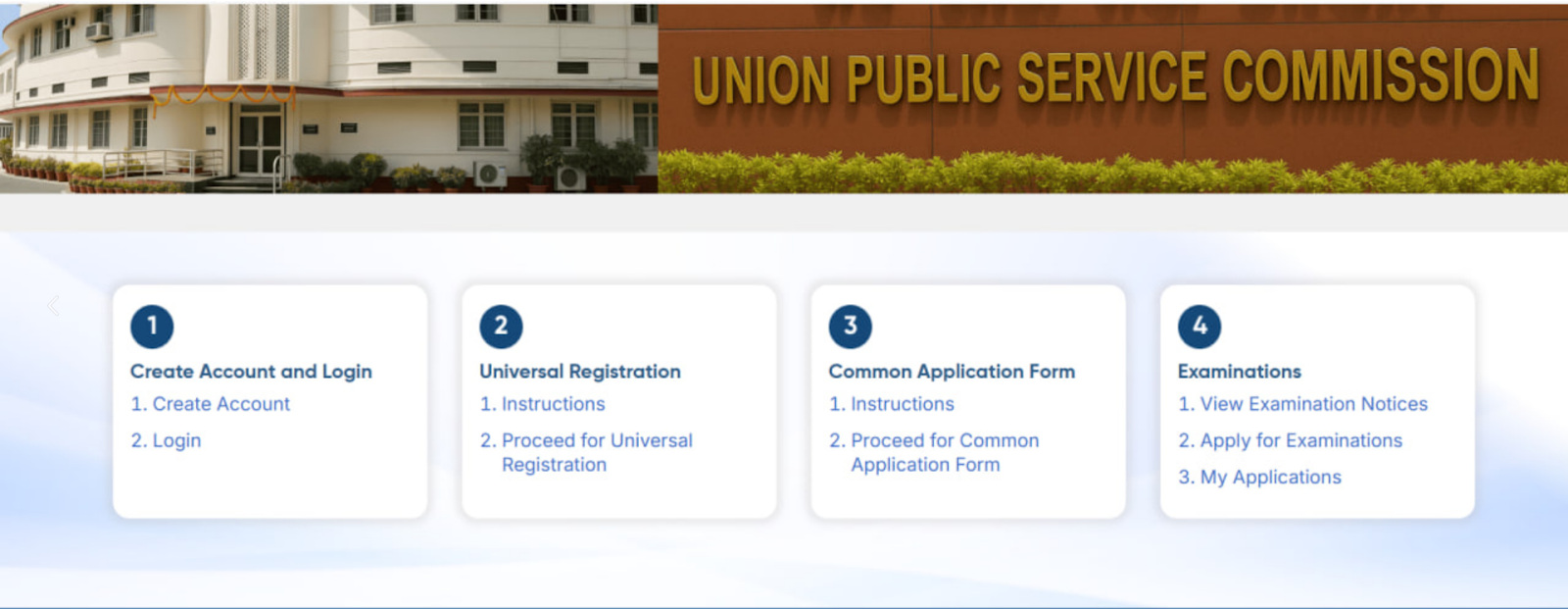
Step 1: Account Creation on UPSC Online Portal
Candidates must first visit the official application portal: https://upsconline.nic.in
The application process begins with Account Creation, where candidates register using a valid and active email ID and mobile number. All future communication from UPSC, including admit card updates, is routed through the registered credentials.
Step 2: Universal Registration Number (URN) Generation
After account creation, candidates must complete the Universal Registration (UR) module.
- On successful completion, a Universal Registration Number (URN) is generated.
- The URN is permanent and remains valid for all future UPSC examinations.
- Candidates need to create the URN only once in their lifetime.
The URN stores core personal details such as:
- Name, date of birth, and identity details
- Photo ID information (Aadhaar recommended by UPSC for seamless verification)
- Contact and address details
Any future UPSC application will reuse this URN.
Step 3: Filling the Common Application Form (CAF)
The next stage is the Common Application Form (CAF), which is also common across UPSC examinations.
Key requirements in the CAF include:
- Live photo capture along with uploading a recent photograph
- Uploading signature (signed three times on plain white paper using black ink)
- Educational qualification details
- Category details (SC/ST/OBC/EWS/PwBD, if applicable)
UPSC clearly states that uploaded photographs, live photos, and signatures must be clear and as per instructions, failing which candidature may be cancelled
Step 4: Examination Specific Module – UPSC CSE 2026
The fourth and final card is the Examination Specific Module, which is available only during the application window mentioned in the UPSC CSE 2026 notification.
In this module, candidates must:
- Select Civil Services Examination 2026
- Choose examination centre preferences
- Select optional subject, medium of examination, and compulsory Indian language
- Pay the examination fee (if applicable)
- Submit the final application form
Once submitted:
- An Application Number is generated (exam-specific and different from URN)
- No withdrawal or correction is permitted after final submission
Both URN and Application Number must be preserved for all future communication with UPSC.
Structure of UPSC CSE 2026 Examination: Prelims, Mains and Interview
The UPSC 2026 will follow the three-stage structure that tests different dimensions of a candidate’s suitability for the civil services.
1. Preliminary Examination
This is an objective-type screening stage consisting of:
- General Studies Paper I
- CSAT (General Studies Paper II)
This stage filters candidates for the Mains examination and is qualifying in nature.
2. Main Examination
The Mains examination is descriptive and includes:
- Essay paper
- Four General Studies papers
- Two Optional subject papers
- Two qualifying language papers
This stage tests depth of understanding, analytical ability, and clarity of expression.
3. Personality Test (Interview)
Candidates who qualify the Mains are called for the interview. The final merit list is prepared based on the marks obtained in Mains and Interview.
Understanding this structure is essential because preparation for UPSC 2026 cannot be one-dimensional. It must integrate objective MCQ practice with answer writing and conceptual clarity.
Check UPSC Syllabus 2026: Prelims, Mains & Interview

What Aspirants Should Do Next After the UPSC 2026 Notification
Now that the UPSC notification for UPSC CSE 2026 is out, preparation must decisively move into a phase of structured and outcome-oriented execution. This is not the stage for frequent strategy changes or scattered experimentation. The months ahead demand stability of approach, discipline in daily work, and a gradual but steady shift from content accumulation to performance refinement.
1. Lock Your Attempt Strategy and Preparation Horizon
Every serious aspirant must begin by taking a clear strategic position about the nature of their attempt. Whether UPSC 2026 is your first serious attempt or a repeat attempt fundamentally changes the way you should prepare. A first serious attempt requires patient foundation-building and conceptual depth, while a repeat attempt demands sharper focus on revision density, test performance, and correction of known weaknesses.
This clarity should quietly guide your choice of resources, the depth at which you study topics, and the proportion of time you allocate to reading versus practice. Without this strategic self-awareness, even hard work often becomes directionless.
2. Build Your Preparation Timeline Backwards from Prelims
The Prelims date is not just an exam date—it is the anchor around which your entire year must be organised. A mature preparation plan works backwards from this date, ensuring that syllabus completion happens early enough to allow multiple rounds of revision and a long, uninterrupted phase of test-based conditioning.
At this stage, structured revision tools and integrated test ecosystems become extremely valuable. Programs such as VisionIAS Quick Revision Classes and the Prelims Test Series with Sandhan are designed to convert months of study into exam-ready recall and sharper decision-making. In the UPSC CSE 2026 journey, time management is not an accessory skill; it is a core competence.
3. Integrate Prelims and Mains Preparation from the Beginning
One of the most damaging habits in UPSC 2026 preparation is treating Prelims and Mains as two separate projects. In reality, the examination tests the same understanding in different forms. A topic studied for Prelims should simultaneously strengthen Mains readiness through better conceptual clarity, examples, and structured thinking.
When preparation is integrated in this way, current affairs naturally feed both MCQ practice and answer writing, and static subjects begin to produce both objective accuracy and descriptive depth. This integrated approach reduces duplication of effort and steadily builds exam maturity.
4. Make Testing and Analysis the Core of Your Preparation
Reading creates familiarity, but only testing creates readiness. As the UPSC CSE 2026 cycle progresses, the centre of gravity of preparation must gradually shift from reading to testing, analysis, and targeted improvement.
A serious aspirant uses tests not merely to measure performance, but to diagnose thinking errors, conceptual gaps, and decision-making weaknesses. Structured initiatives like VisionIAS PT 365 and the Prelims Test Series with Sandhan help align preparation with the real demands of the examination, while regular answer writing and evaluation gradually convert knowledge into marks in the Mains.
5. Treat CSAT as a Parallel Track, Not a Last-Month Problem
In recent years, CSAT has become a decisive filter rather than a formality. Many otherwise well-prepared candidates have seen their attempt end at the Prelims stage because of inadequate attention to this paper.
For UPSC 2026, CSAT should run as a light but continuous parallel track throughout the year. With regular practice and gradual confidence-building—supported by a structured CSAT crash course , this paper can be turned from a source of anxiety into a safety net.
6. Shift Gradually from “Coverage Mode” to “Performance Mode”
One of the most important psychological transitions in serious preparation is the shift from measuring progress by “how much I have covered” to measuring it by “how well I perform under exam conditions.” As the months pass, a larger share of your time should move towards revision, testing, analysis, and answer writing.
This is how a preparation journey for UPSC CSE 2026 evolves from being effort-driven to becoming outcome-driven—and this is also where serious aspirants begin to separate themselves from the crowd.

Watch: UPSC Prelims 2026 : 4 Months Study Plan to Maximize Score
Read: UPSC Prelims 2026 Common Doubts Explained: Preparation, Revision, Tests, and Exam Strategy
Conclusion
The release of the UPSC CSE 2026 notification is the formal starting line of a demanding but meaningful journey. Understanding the UPSC eligibility, UPSC criteria, and UPSC qualification requirements is the first step. The real challenge now lies in building a disciplined, realistic, and sustained preparation strategy for UPSC 2026.
For serious aspirants, this is not the time for experimentation. It is the time for clarity, commitment, and consistent execution.

UPSC Notification 2026 FAQs
1. Is the UPSC 2026 notification out?
Yes. The UPSC 2026 notification has been officially released by the Union Public Service Commission on 4 February 2026, marking the start of the UPSC CSE 2026 application process.
2. What is the last date to apply for UPSC CSE 2026?
As per the UPSC CSE 2026 notification, candidates can submit the online application form up to 27 February 2026 (within the deadline mentioned in the official notification).
3. What is the UPSC Prelims 2026 exam date?
The UPSC CSE 2026 Preliminary Examination is scheduled on 24 May 2026 (Sunday).
4. When will UPSC Mains 2026 start?
The UPSC Mains 2026 is scheduled to begin from 21 August 2026, as mentioned in the official UPSC notification 2026.
5. How many vacancies are announced in the UPSC notification 2026?
The UPSC notification 2026 mentions approximately 933 vacancies (indicative). The final number may be revised after confirmation from cadre controlling authorities and application of reservation rules.
6. What is the eligibility for UPSC CSE 2026?
As per the UPSC CSE notification 2026, a candidate must meet the nationality criteria, have at least a Bachelor’s degree from a recognised university, and fall within the prescribed age limit and attempts as on 1 August 2026 (with applicable category relaxations).
7. Will the UPSC exam pattern change in 2026?
As of now, there is no official announcement in the UPSC 2026 notification about any change in the exam pattern. The UPSC CSE 2026 is expected to follow the existing three-stage structure: Prelims, Mains, and Interview.
8. Where can I download the UPSC CSE 2026 notification PDF (English/Hindi)?
The official UPSC CSE 2026 notification PDF is available on the website of the Union Public Service Commission (upsconline.nic.in). Candidates can download both the English and Hindi versions directly from the notification section and should read it carefully before filling out the application form for UPSC CSE 2026.
9. What is the new change or restriction on applying in the UPSC CSE 2026 in UPSC Notification 2026 for candidates already in service?
As per the UPSC CSE 2026 notification issued by the Union Public Service Commission, candidates already appointed to IAS or IFS from an earlier Civil Services Examination cannot apply for UPSC CSE 2026. Even if such appointment happens after the Preliminary Examination, the candidate will not be permitted to write Mains or be considered for service allocation from CSE 2026.
10. Can a candidate already appointed to IPS appear for UPSC CSE 2026?
Yes. A candidate already appointed to the Indian Police Service (IPS) from an earlier CSE can apply and appear for UPSC CSE 2026. However, while filling service preferences, IPS cannot be opted again.
11. If a candidate is allocated a service in UPSC CSE 2026, can they appear again in UPSC CSE 2027?
Yes. The UPSC notification 2026 allows candidates allocated a service through CSE 2026 to take one improvement attempt in CSE 2027 using a one-time training exemption. If a better service is secured in 2027, the candidate must choose between the 2026 and 2027 allocation; the other automatically gets cancelled.
12. Can a candidate appear in UPSC CSE 2028 without resigning from their existing service?
No. After using the one improvement attempt in CSE 2027, a candidate cannot appear in CSE 2028 or later unless they resign from the currently allocated service.