Current Affairs
India Bans 5 OTT Platforms Over Digital Content Violations
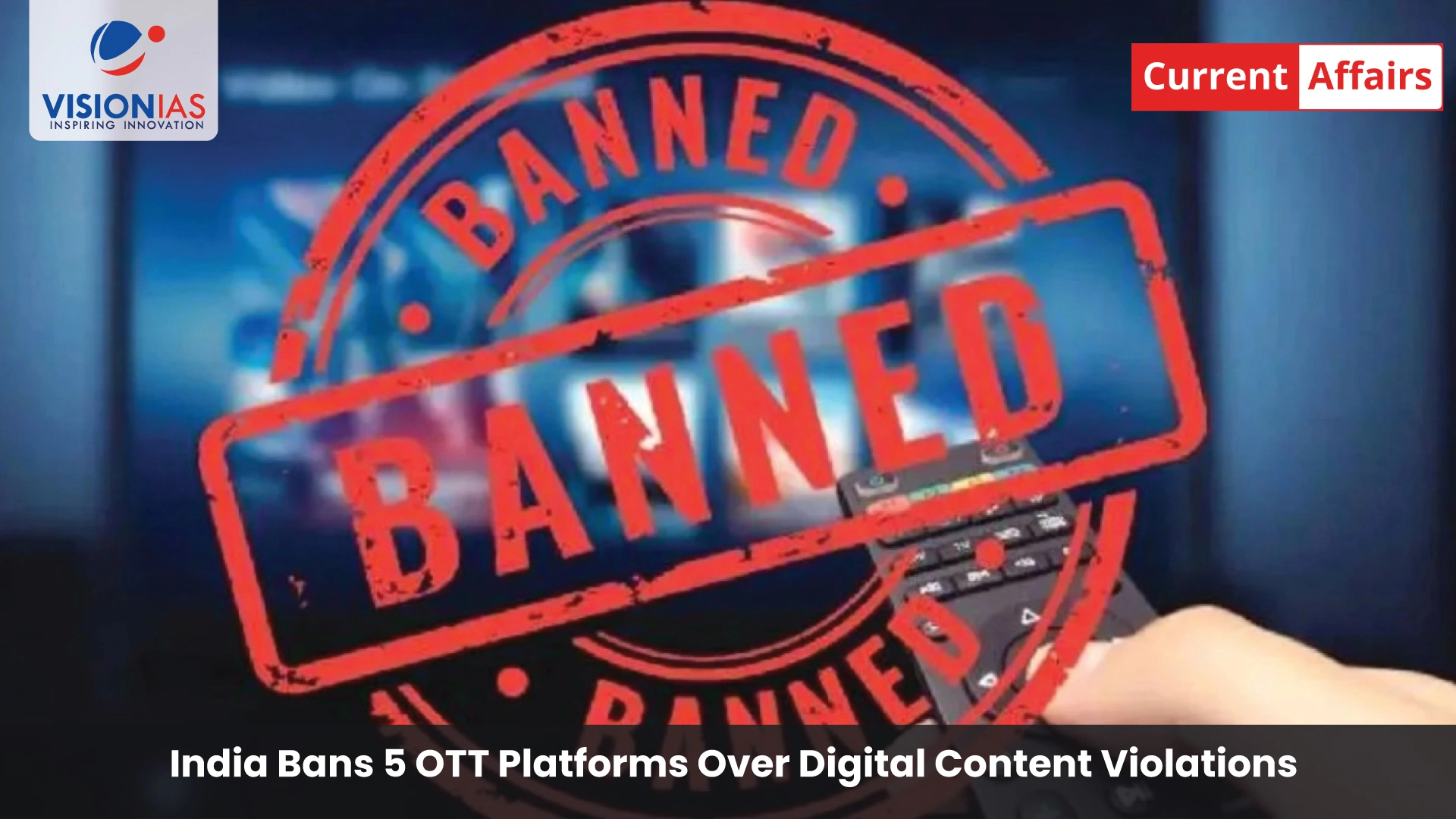










The Indian government blocked five OTT platforms for hosting inappropriate content in accordance with the Information Technology Rules, 2021.
On 24 February, India banned 5 OTT (Over-The-Top) platforms namely MoodXVIP, Jugnu, Koyal PlayPro, Digi MoviePlex and Feel for streaming obscene and sexually explicit content, as per sources. Under the procedure, the government reportedly directed internet service providers to block access to OTT platforms under the Information Technology Rules 2021 and the laws against obscenity.
Need for regulation of OTT platforms
The recent blocking of multiple platforms, including the February 2026 action, reflects a sustained enforcement trend rather than an isolated intervention. As internet penetration and streaming consumption expand, regulatory scrutiny of OTT content has intensified.
Unlike films regulated under the Cinematograph Act, 1952, OTT platforms operate without prior certification, relying primarily on self-classification and post-publication oversight. Repeated government advisories, platform warnings, and blocking orders indicate concerns regarding obscene and sexually explicit content, child protection, and compliance gaps.
Regulation is therefore aimed at strengthening age-based classification, parental controls, and grievance redressal mechanisms, while clarifying intermediary liability under IT and criminal laws. At the same time, any regulatory approach must balance creative freedom under Article 19(1)(a) with reasonable restrictions under Article 19(2) relating to decency, morality, and public order.
Legal Framework Governing OTT Platform Regulation
IT Rules, 2021
The Information Technology (Intermediary Guidelines and Digital Media Ethics Code) Rules, 2021 under IT Act, 2000 provide a structured regulatory framework for digital news publishers and OTT platforms. The Rules establish a three-tier grievance redressal mechanism:
- Self-regulation by the publisher;
- Self-regulation by an industry body headed by a retired judge or eminent person; and
- Oversight by the Central Government through an Inter-Departmental Committee.
For OTT platforms, the Rules prescribe a Code of Ethics and mandate age-based classification of content (such as U, U/A, and A categories), display of content descriptors, implementation of parental locks for mature content, and reliable age verification mechanisms for adult-rated material. Platforms are also required to appoint grievance officers and ensure time-bound resolution of complaints.
The February 2026 amendment to the Rules strengthened compliance obligations, particularly in relation to obscene and sexually explicit content. It clarified due diligence requirements for intermediaries, emphasised prompt removal of unlawful material upon notice, and reinforced the government’s oversight powers in cases involving content that violates standards of decency or morality.
Section 69A of the IT Act, 2000
Section 69A of the Information Technology Act, 2000 empowers the Central Government to direct any government agency or intermediary to block public access to online information. Blocking can be ordered in the interests of sovereignty and integrity of India, defence, security of the State, friendly relations with foreign States, public order, or to prevent incitement to a cognizable offence.
The procedure is governed by the Information Technology (Procedure and Safeguards for Blocking for Access of Information by Public) Rules, 2009, which require examination by a designated committee and approval by the Ministry of Electronics and Information Technology (MeitY), except in emergencies where interim blocking is allowed. Such directions are binding on intermediaries, including internet service providers and social media platforms.
Non-compliance can attract imprisonment up to seven years and a fine. The constitutional validity of Section 69A was upheld by the Supreme Court in Shreya Singhal v. Union of India, which held that the provision contains adequate procedural safeguards.
Sections 67 and 67A of the IT Act
Sections 67 and 67A of the Information Technology Act criminalize the publication or transmission of obscene and sexually explicit material in electronic form. Section 67 penalizes the publishing or transmitting of obscene content, while Section 67A deals specifically with material containing sexually explicit acts or conduct.
These provisions apply directly to digital platforms, including OTT services, if they are found to host or disseminate prohibited content. The offences carry significant penalties, including imprisonment and fines, with enhanced punishment for repeat convictions.
Bharatiya Nyaya Sanhita, 2023
The Bharatiya Nyaya Sanhita, 2023 (BNS), which replaces the earlier Indian Penal Code, 1860, retains the core offence of obscenity with updated provisions.
Under the BNS, Section 294 punishes the sale, distribution, advertisement, or display of obscene material, including in electronic form, while Section 296 deals with obscene acts and songs. The law explicitly covers online harm, obscenity, misinformation, and other cyber-enabled offences, including those committed through social media platforms, especially against women and children.
Obscene material is understood as content that is lascivious, appeals to prurient interest, or tends to deprave and corrupt persons likely to view it. Exceptions continue for works justified in the interest of science, literature, art, or public good, subject to constitutional restrictions on decency and morality.
Indecent Representation of Women (Prohibition) Act, 1986
The Indecent Representation of Women (Prohibition) Act, 1986 aims to prohibit indecent depiction of women in advertisements, publications, writings, paintings, figures, or in any other manner. The law restricts representation that is derogatory, denigrating, or likely to deprave, corrupt, or injure public morality.
Although enacted prior to the digital era, the Act has been interpreted to extend to electronic and online media. Proposed amendments in recent years have sought to explicitly bring digital platforms within its ambit. For OTT services, content portraying women in an objectified or sexually explicit manner may attract scrutiny under this legislation in addition to the IT Act and BNS provisions.
Pattern of Enforcement
The decision where India bans 5 OTT platforms follows earlier actions.
In September 2024, warnings were issued to multiple platforms. In February 2025, the Ministry of Information and Broadcasting issued advisories directing compliance with obscenity laws and the IT Rules, 2021.
In May 2025, the series “House Arrest” on the Ullu platform was taken down after ministry intervention. On July 23, 2025, the government ordered blocking of 25 OTT platforms after consultations with departments and stakeholders. The action covered websites and mobile applications available on app stores.
The February 2026 blocking of five additional platforms indicates continued enforcement.
Conclusion
The decision where India bans 5 OTT platforms including MoodXVIP, Jugnu, Koyal PlayPro, Digi MoviePlex and Feel is based on violations of obscenity laws and non-compliance with the IT Rules, 2021. The action relies on Section 69A of the IT Act and related legal provisions.
As digital consumption expands, regulation of OTT platforms will continue to raise issues relating to intermediary liability, constitutional freedoms and public order. The development provides a case study in digital governance and media regulation in India.
Master Digital Age Governance & Technology Trends with VisionIAS Comprehensive Current Affairs →
India banned 5 OTT FAQ
1. Which OTT platforms did India reportedly ban in February 2026?
Ans. MoodXVIP, Jugnu, Koyal PlayPro, Digi MoviePlex, and Feel.
2. Why did India ban these 5 OTT platforms?
Ans. For streaming obscene and sexually explicit content.
3. What is the penalty for non-compliance with India’s OTT blocking directions?
Ans. Imprisonment up to seven years and a fine.
4. Which Supreme Court case upheld the constitutional validity of Section 69A of the IT Act 2000?
Ans. Shreya Singhal v. Union of India (2015).
5. What rules govern OTT platform content regulation in India?
Ans. The Information Technology (Intermediary Guidelines and Digital Media Ethics Code) Rules, 2021.