Current Affairs
Transgender Persons Amendment Bill 2026: Key Changes, Debate, and Impact
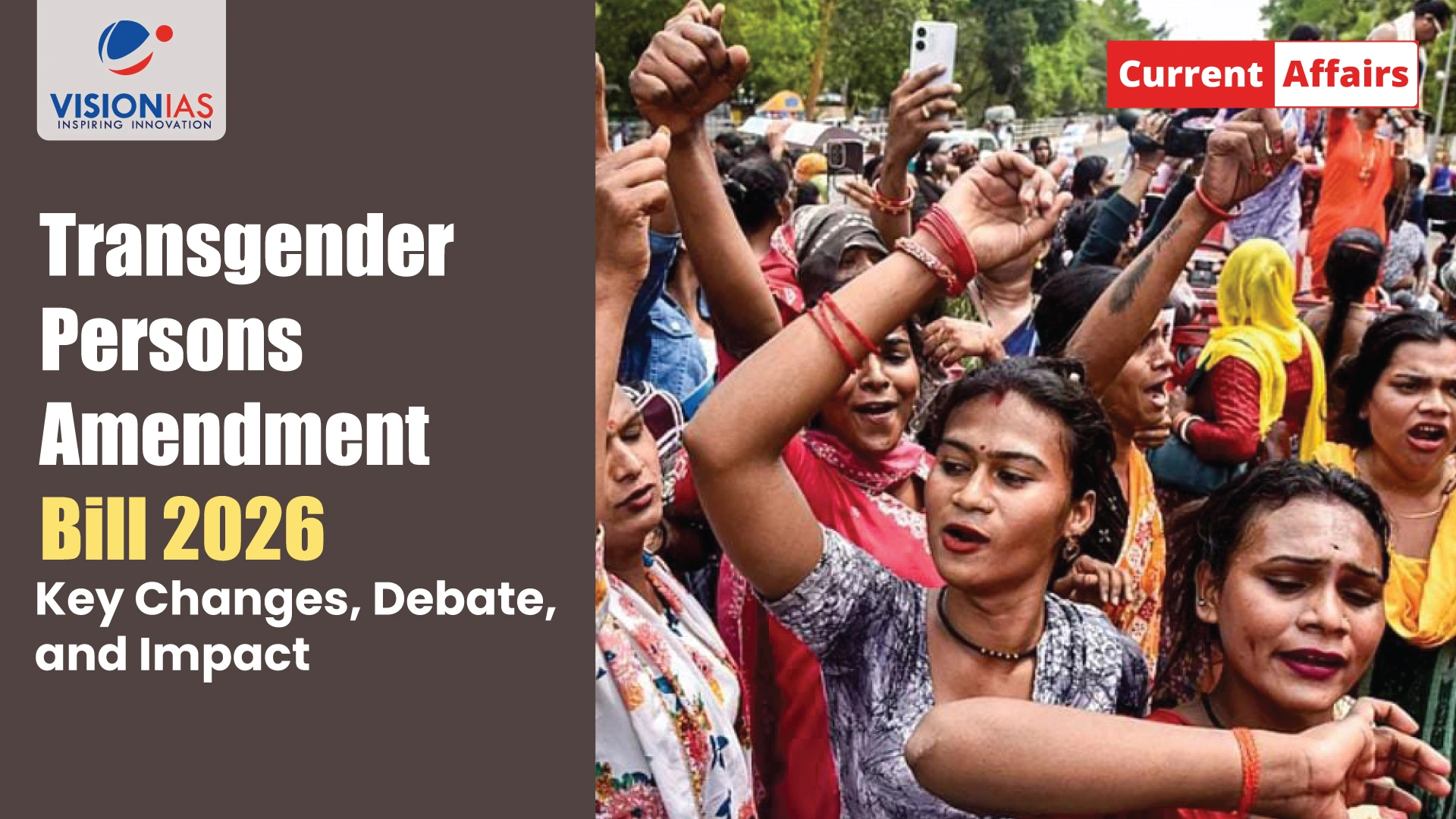













On March 24, 2026, the Lok Sabha passed by voice vote the Transgender Persons (Protection of Rights) Amendment Bill.
The Transgender Persons (Protection of Rights) Amendment Bill, 2026 was passed by voice vote in the Lok Sabha on March 24, 2026, amid a walkout by several Opposition parties. The Bill seeks to amend the Transgender Persons (Protection of Rights) Act, 2019, which provides rights and welfare protections for the transgender community in India.
Introduced in Lok Sabha on March 13, 2026 by Union Minister for Social Justice and Empowerment, the Bill has sparked significant debate across the country. While the government argues it strengthens protections and ensures targeted welfare delivery, transgender rights groups and various civil society organisations have strongly contested several of its provisions.
Background: The 2019 Act and Why It Is Being Amended
The Transgender Persons (Protection of Rights) Act, 2019 was enacted to protect transgender people from discrimination and social exclusion. It defined a transgender person broadly as anyone whose gender does not match the gender assigned at birth and included trans-men, trans-women, genderqueer individuals, and those with intersex variations.
A landmark provision of the 2019 Act was the recognition of self-perceived gender identity, consistent with the Supreme Court’s NALSA judgment of 2014, which had recognised the right of transgender persons to self-identify their gender. Under the 2019 Act, a person could obtain a Certificate of Identity from the District Magistrate based on self-declaration, without any mandatory medical examination.
The government has now introduced the Transgender Persons Amendment Bill 2026 citing that the existing definition was “vague and broad”, making it difficult to identify the genuinely oppressed persons for whom the Act was originally intended. The government also noted that the current definition was incompatible with several other statutory provisions.
Key Provisions of the Transgender Persons Amendment Bill 2026
1. Revised Definition of ‘Transgender Person’
The Bill removes the broad, self-identification-based definition from the 2019 Act and replaces it with a more narrow, listed categorisation. The new definition includes:
- Persons with socio-cultural identities such as kinner, hijra, aravani, and jogta
- Eunuchs
- Persons with intersex variations such as congenital variations in primary sexual characteristics, external genitalia, chromosomal patterns, gonadal development, or endogenous hormone production
- Persons who have been forcibly compelled to assume a transgender identity through mutilation, castration, or surgical/chemical/hormonal procedures
Crucially, the Bill explicitly excludes persons with different sexual orientations and self-perceived sexual identities from its ambit. It also removes the categories of trans-man, trans-woman, and genderqueer that were included in the 2019 Act.
2. Introduction of Medical Board for Verification
One of the most contested provisions of the Transgender Persons Amendment Bill 2026 is the mandatory involvement of a designated medical board in the identity verification process.
Under the new framework:
- An “authority” (medical board) headed by a Chief Medical Officer or Deputy Chief Medical Officer will be constituted by the Central or State Government
- The District Magistrate will issue a Certificate of Identity only after examining the board’s recommendation and, if deemed necessary, taking assistance of additional medical experts
- Persons issued a certificate will be entitled to change their first name in the birth certificate and all other official identity documents
This effectively replaces the earlier self-declaration system with a medicalised verification process, which critics argue undermines bodily autonomy and the right to dignity.
3. Strengthened Offences and Graded Penalties
The Bill substantially revises Section 18 of the principal Act, introducing graded punishments that reflect the severity and irreversibility of offences. The new penalty structure includes:
- Forced or bonded labour, denial of public access, forced displacement, and abuse: Imprisonment of 6 months to 2 years, with fine
- Kidnapping an adult and causing grievous harm to force transgender identity: Rigorous imprisonment of 10 years to life, with a minimum fine of ₹2 lakh
- Kidnapping a child and causing grievous harm to force transgender identity: Life imprisonment with a minimum fine of ₹5 lakh
- Forcing an adult to present as transgender and engage in begging/servitude: Rigorous imprisonment of 5–10 years and a minimum fine of ₹1 lakh
- Forcing a child to present as transgender and engage in begging/servitude: Rigorous imprisonment of 10–14 years and a minimum fine of ₹3 lakh
4. Changes to the National Council for Transgender Persons
The Bill modifies the composition of the National Council for Transgender Persons. It stipulates that State Government and Union Territory representatives must be of a rank not below Director, nominated on a rotational basis one each from North, South, East, West, and North-East regions.
Concerns and Significance
Key Concerns Raised by Civil Society and Activists
- Undermining the NALSA Judgment: The removal of self-perceived gender identity contradicts the Supreme Court’s landmark 2014 ruling, raising questions about constitutional validity.
- Treating Identity as a Medical Condition: Subjecting transgender persons to examination by a medical board reinforces a pathologising approach to gender identity, which is contrary to global best practices and the principles of bodily autonomy and dignity.
- Exclusion of Recognised Identities: Removing trans-men, trans-women, and genderqueer individuals from the definition effectively strips a large section of the community of the legal protections previously afforded by the Act.
- Lack of Consultation: Highlighting concerns over inadequate consultation, transgender rights groups, civil society leaders, and community members have been protesting since the Bill’s introduction, demanding its withdrawal or at least its referral to a Parliamentary Standing Committee for wider deliberation.
Positive Aspects Highlighted by Proponents
- Stronger Penal Safeguards: The graded penalty system for offences such as abduction, forced bodily harm, and exploitation through begging/servitude provides much-needed legal teeth to the Act.
- Protection of Bodily Integrity: By specifically penalising forced identity changes and irreversible bodily harm, the Bill reinforces constitutional guarantees against forced labour and trafficking.
- Targeted Welfare Delivery: A more precise definition could, in principle, help ensure welfare benefits reach the most marginalised sections of the transgender community who face extreme social exclusion.
Conclusion
The passage of the Transgender Persons (Protection of Rights) Amendment Bill, 2026 marks a significant moment in the legal history of transgender rights in India. The NALSA judgment of 2014 remains the constitutional benchmark for transgender rights in India, and any potential legislative departure from its principles is bound to face judicial scrutiny.
While the government’s stated intent is to ensure targeted welfare delivery, prevent exploitation, and strengthen penal protections, the legislation raises various debatable constitutional and ethical questions about the right to self-identification, bodily autonomy, and dignity.
Master Digital Age Governance & Technology Trends with VisionIAS Comprehensive Current Affairs →
Transgender Persons Amendment Bill 2026
1.When was the original Transgender Persons (Protection of Rights) Act enacted?
Ans. 2019.
2. What body verifies transgender identity under the 2026 Amendment Bill?
Ans. A designated medical board headed by a Chief Medical Officer or Deputy Chief Medical Officer.
3. What is the maximum punishment for kidnapping a child to force a transgender identity under the 2026 Bill?
Ans. Life imprisonment with a minimum fine of ₹5 lakh.