Current Affairs
India–South Korea Sign MoU to Deepen MSME Cooperation
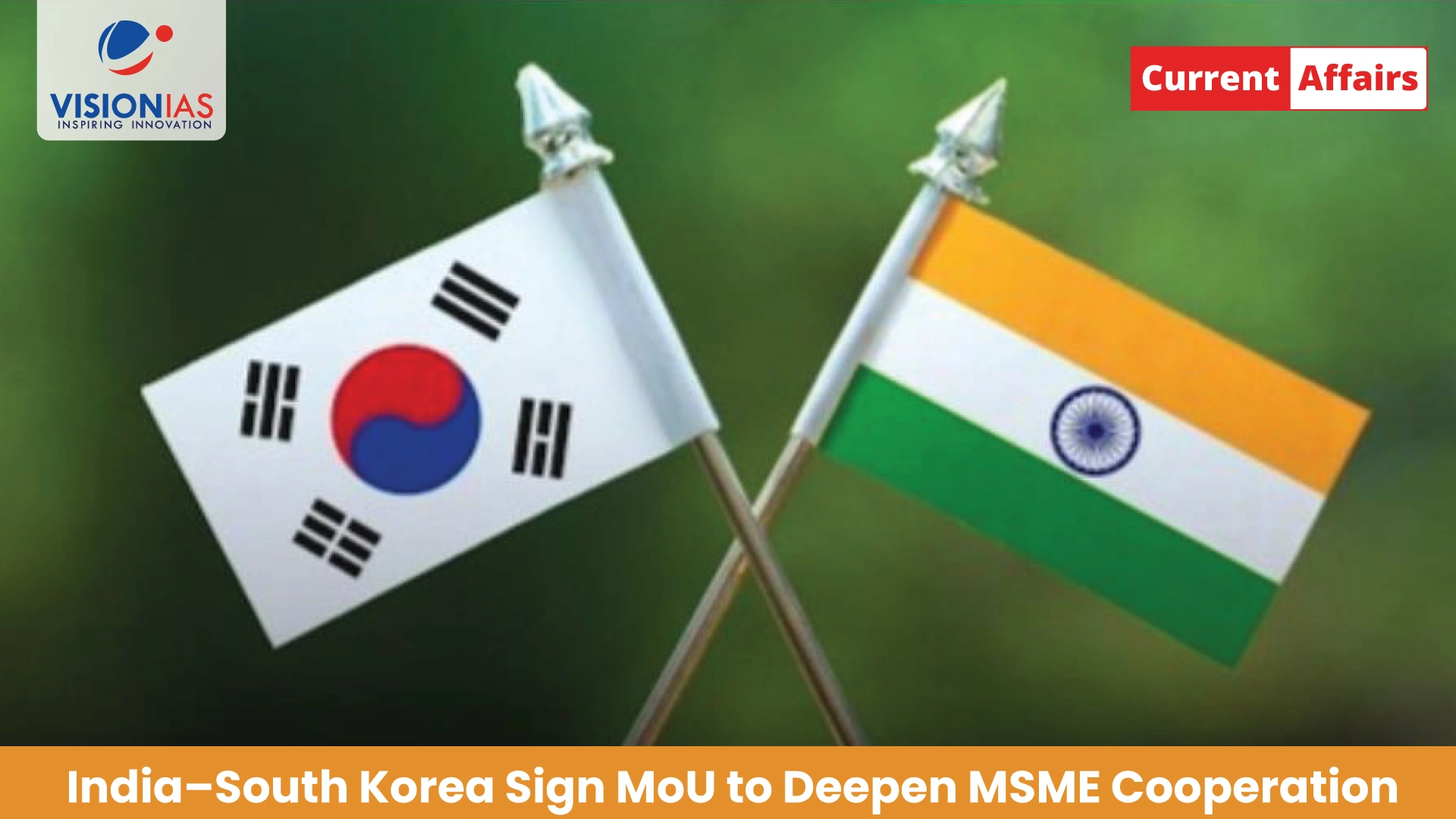






India and the Republic of Korea have signed a MoU to strengthen cooperation in the MSME sector during the visit of the South Korean President to India.
India and South Korea have taken a significant step forward in strengthening their bilateral economic ties. On April 20, 2026, during the State Visit of Republic of Korea (ROK) President Lee Jae Myung to New Delhi, the two nations signed a Memorandum of Understanding (MoU) on MSME cooperation, a milestone agreement that places micro, small and medium enterprises at the heart of their expanding partnership.
The MoU was signed between India’s Ministry of Micro, Small and Medium Enterprises (MSMEs) and South Korea’s Ministry of SMEs and Startups. It establishes a structured framework for collaboration covering information exchange, sharing of best practices, business matchmaking, and technical cooperation with the shared goal of boosting trade, investment, and inclusive economic growth.
This agreement forms a key pillar of the newly announced Joint Strategic Vision for the India–ROK Special Strategic Partnership (2026–2030), signalling that MSMEs are being recognised as strategic engines of bilateral progress.
India–South Korea Relations: A Foundation Built Over Decades
The India–ROK Special Strategic Partnership, formally established in 2015, has grown steadily across defence, trade, technology, and culture. Today, bilateral trade stands at $27 billion, though India faces a trade deficit of $15.19 billion, a structural imbalance that both sides are actively working to address.
The Comprehensive Economic Partnership Agreement (CEPA), signed in 2010, laid the foundation for trade liberalisation between the two countries. However, India has long sought its upgrade to correct the trade deficit and ensure a more balanced, reciprocal partnership. During President Lee’s visit, both leaders agreed to resume and expedite CEPA upgrade negotiations for early conclusion, a development that could significantly benefit Indian exporters, including MSMEs seeking greater access to Korean markets.
India views South Korea as a critical partner in its Act East Policy, while Seoul regards New Delhi as a central pillar of its pragmatic diplomacy. Both nations are vibrant democracies sharing democratic values and a common vision for a free, open, and prosperous Indo-Pacific region.
Key Outcomes of President Lee’s State Visit
Strengthening Political and Strategic Foundations
- Annual leader-level meetings have been institutionalised to provide continuous guidance to the India–ROK Special Strategic Partnership.
- South Korea joined the Indo-Pacific Oceans Initiative (IPOI), a non-treaty-based voluntary arrangement launched by India reflecting deepened alignment on Indo-Pacific security and maritime cooperation.
- Both sides agreed to launch the inaugural Defence and Foreign Affairs 2+2 Dialogue at Vice Minister levels, reinforcing strategic trust.
Economic Cooperation
- Bilateral trade is targeted to be doubled to $54 billion by 2030, reflecting the ambition of the Joint Strategic Vision.
- An India–ROK Economic Security Dialogue was launched to enhance supply chain resilience, market diversification, and cooperation in cutting-edge technologies.
- The India–ROK Industrial Cooperation Committee, a new ministerial dialogue, was established to boost industrial collaboration across automobiles, semiconductors, chemicals, shipbuilding, and more.
Maritime and Shipbuilding
A Comprehensive Partnership in Shipbuilding, Shipping, and Maritime Logistics was adopted, supported by a shared vision framework: VOYAGES (Vision for Operation of Yard Assisted Growth with Efficiency and Scale). This aligns with India’s Maritime Amrit Kaal vision and leverages South Korea’s status as a global leader in shipbuilding.
Technological Cooperation
The India–Korea Digital Bridge was launched to drive cooperation in Artificial Intelligence, semiconductors, and the IT sector reinforcing both countries’ ambitions as digital powerhouses. The Korea–India Defence Accelerator (KIND-X) was also unveiled to connect defence start-ups, investors, incubators, and universities from both sides.
Climate Cooperation
South Korea joined the International Solar Alliance (ISA), while India joined the Global Green Growth Institute (GGGI), headquartered in Seoul and established as a treaty-based international intergovernmental organisation at the RIO+20 Conference in 2012. Both sides also concluded an MoU on Cooperation in the Field of Climate and Environment and a cooperative framework under Article 6.2 of the Paris Agreement.
People-to-People Ties
The year 2028–29 has been designated as the Year of India–ROK Friendship, to be celebrated through a series of cultural events. A Mumbai Korea Centre is also set to be launched, fostering collaboration between K-pop and Bollywood, two of Asia’s most influential cultural forces.
What the MSME MoU Means for India
Unlocking New Markets and Investment Channels
The India–South Korea MSME MoU opens fresh avenues for Indian small businesses to engage with Korean counterparts especially in sectors where South Korean companies hold global leadership: electronics, auto components, chemicals, and display technology. Business matchmaking initiatives will be central to helping smaller Indian firms access Korean industrial networks and global supply chains.
Technology Transfer and Innovation
One of the most transformative dimensions of this MSME cooperation is the potential for technology transfer and innovation collaboration. India’s small businesses have long faced gaps in adopting advanced manufacturing technologies. South Korea’s expertise in green manufacturing, precision engineering, and digital tools presents a timely opportunity to modernise India’s MSME sector.
Employment Generation and Inclusive Growth
Both nations have underscored that MSME cooperation must serve as a driver of employment generation and inclusive growth. India’s MSME sector — comprising over 63 million enterprises — already accounts for nearly 30% of GDP and employs over 110 million people. Structured collaboration with a technologically advanced economy like South Korea can accelerate productivity improvements and create higher-quality jobs across manufacturing and services.
Defence Cooperation: A Pillar of the Strategic Partnership
India–South Korea defence ties have matured significantly. The 2020 Roadmap to Defence Industry Cooperation laid the groundwork, and the K9-Vajra self-propelled howitzers — built in India through technology transfer by a South Korean firm — stand as a flagship example of successful Make in India collaboration. Both sides are now working to replicate this model in Self-Propelled Air Defence Gun-Missile Systems and other platforms.
The newly launched KIND-X (Korea–India Defence Accelerator) will further this momentum by connecting start-ups, investors, incubators, and defence research universities from both countries — fostering a new generation of co-developed defence technologies.
Conclusion
The signing of the India–South Korea MSME MoU on April 20, 2026, is a forward-looking step that recognises the transformative potential of small businesses in shaping both nations’ economic futures. By fostering structured collaboration, business matchmaking, and technical cooperation, India and South Korea are building a partnership that is inclusive, innovation-driven, and mutually beneficial.
From the Indo-Pacific Oceans Initiative to the Digital Bridge, from the K9-Vajra howitzers to the Year of India–ROK Friendship, President Lee’s State Visit has produced a vision that is both wide in scope and deep in substance. At its core, the India–ROK Special Strategic Partnership is no longer just a diplomatic declaration, it is a living, growing framework for shared prosperity.
Master Digital Age Governance & Technology Trends with VisionIAS Comprehensive Current Affairs →
India–South Korea MSME MoU
1. When was the India–South Korea MSME MoU signed?
Ans. April 20, 2026.
2. Which Indian ministry signed the MSME MoU with South Korea?
Ans. India’s Ministry of Micro, Small and Medium Enterprises.
3. What is the current bilateral trade figure between India and South Korea?
Ans. $27 billion.
4. What strategic partnership framework does the MSME MoU fall under?
Ans. The India–ROK Special Strategic Partnership (2026–2030).
5. What is KIND-X?
Ans. A Korea–India Defence Accelerator connecting defence start-ups, investors, incubators, and universities from both countries.