Current Affairs
Constitution (131st Amendment) Bill Defeated in Lok Sabha
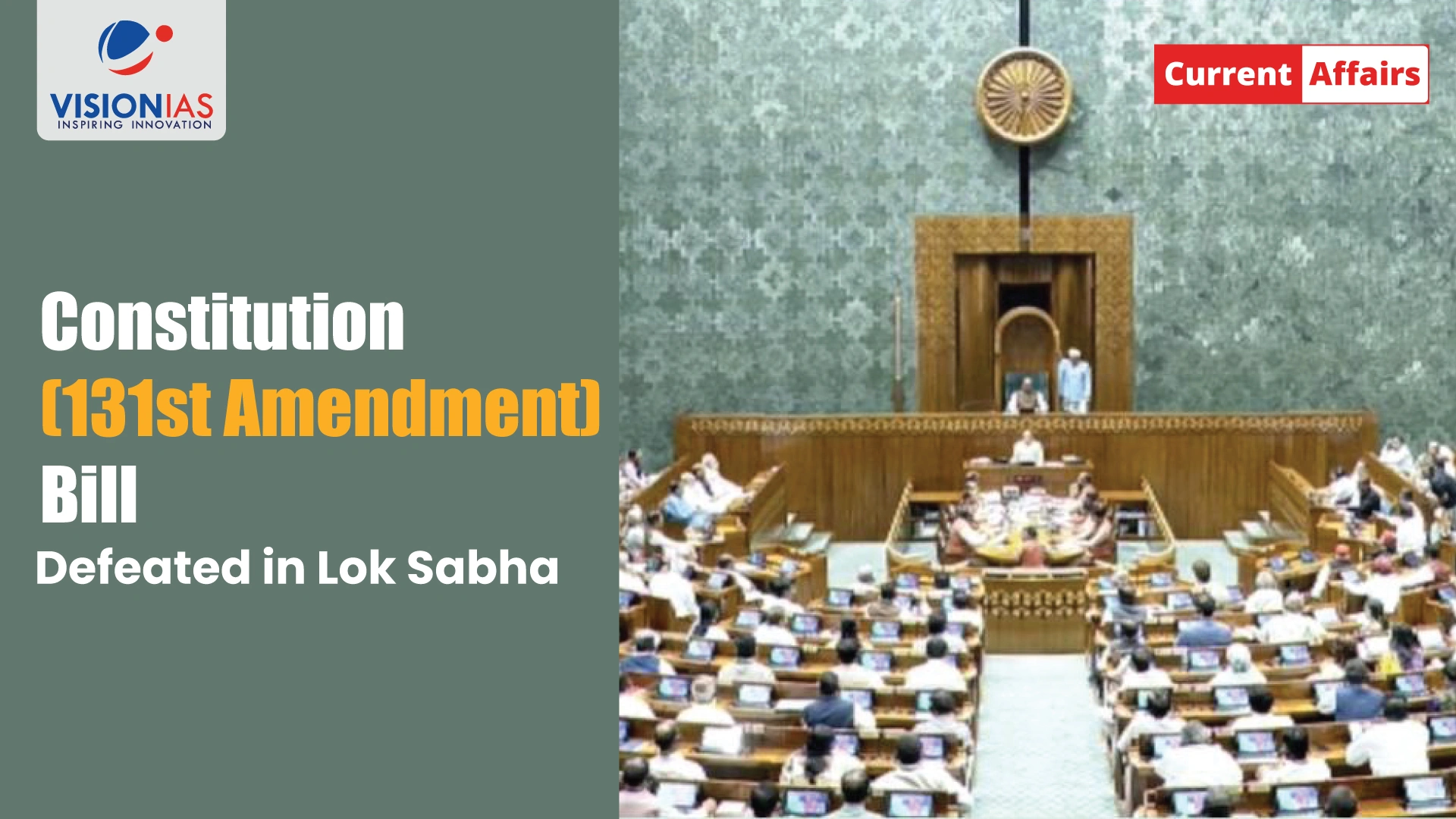














The Constitution (131st Amendment) Bill, 2026, proposing expansion of the Lok Sabha, delinking Delimitation with 2026 Census and operationalizing Women’s Reservation, was defeated in the Lok Sabha after failing to secure the required majority.
On April 17, 2026, the Constitution (131st Amendment) Bill, 2026, failed to secure the constitutionally mandated two-thirds majority in the Lok Sabha. Despite receiving 298 votes in favour, it fell 54 votes short of the required 352. The outcome highlighted the lack of consensus on key structural aspects of the Bill, particularly its linkage with delimitation and seat expansion.
What is the 131st Constitution Amendment Bill?
A central feature of the Constitution (131st Amendment) Bill, 2026 was the proposal to expand the Lok Sabha from 543 to 850 seats (815 from states and 35 from Union Territories). This would mean that fewer people will be represented by a representative, potentially ensuring better governance.
The Bill also sought to accelerate the delimitation process by deleting the third provision of Article 82, which currently mandates delimitation after the first Census conducted post-2026. This will enable delimitation to be carried out using Census data available before the 2026–27 Census.
Further, the amendment proposed changes to Article 334A to enable the Women’s reservation framework to be implemented using the 2011 Census as the baseline, instead of waiting for a future Census. This shift was intended to fast-track political representation for women, making it potentially feasible to introduce reservation ahead of the 2029 General Elections.
In essence, the Bill combined Lok Sabha seat expansion, restructuring of constituencies by delimitation, and a revised Census benchmark to operationalise women’s reservation within a defined timeline. While doing so, it also raises important debates around federal balance, population-based representation, and the sequencing of electoral reforms.
Understanding the Background: Women’s Representation in Legislatures
The development also has implications for the broader goal of Nari Shakti in legislative representation. Women currently hold only 74 seats (around 14%) in the 18th Lok Sabha, significantly below the proposed 33% benchmark. In contrast, Panchayati Raj Institutions have achieved nearly 46% women’s representation, indicating that higher participation is institutionally feasible.
The Nari Shakti Vandan Adhiniyam (106th Constitutional Amendment Act, 2023) has provided the framework for 33% reservation in Parliament and State Legislatures. But its implementation remains contingent on delimitation, underscoring the gap between constitutional provisions and actual representation at present.
Why Did the Constitution (131st Amendment) Bill, 2026 Fail?
Parliamentary Debate: Key Positions
The three-day special session (April 16–18, 2026) centred on a core disagreement: support for women’s reservation in principle, but opposition to its linkage with delimitation.
The government’s position was to implement reservation by 2029 through 2011 Census-based delimitation. The opposing position was to implement 33% reservation on the existing 543 Lok Sabha seats immediately, without any delimitation linkage.
Two conditions were placed before the government for potential consensus:
- Any guarantee of proportional representation must be written into the bill’s text, not just verbally assured.
- Women’s reservation must be delinked from the delimitation process.
Procedural Aspects: Constitutional Threshold
Under Article 368, a constitutional amendment requires:
- A majority of total membership of the House, AND
- A two-thirds majority of members present and voting.
With 528 members participating, the government needed 352 votes. It secured only 298, a shortfall of 54.
Following the defeat, the government also withdrew two companion legislations: the Delimitation Bill, 2026, and the Union Territories Laws (Amendment) Bill, 2026, as they were linked to the 131st Amendment.
Point of Contention: North-South Federal Fault Line
At the heart of the opposition lay a federal concern. The proposal for raising seats in Lok Sabha and the use of 2011 Census data for women’s reservation raised concerns among southern and northeastern states about delimitation, which have successfully controlled their populations.
This concern, often called the demographic penalty, refers to states being disadvantaged in representation despite successfully implementing population control. Seat allocation has been frozen since the 42nd Amendment (1976), based on the 1971 Census. The 131st Amendment proposed to break that freeze, which led to unified resistance from the opposition parties.
States like Tamil Nadu (Total Fertility Rate (TFR): 1.7) and Kerala (TFR: 1.8) feared a loss of political representation in an expanded Lok Sabha, while high-growth northern states like Bihar (TFR: 3.0) and Uttar Pradesh (TFR: 2.4) potentially stood to gain seats.
Projections suggested that in an expanded Lok Sabha, the southern states’ share could decline, raising concerns over representation. The government claimed a 50% increase in seats for states including an increase from 129 to 195 seats for Karnataka, Andhra Pradesh, Telangana, Tamil Nadu, and Kerala. Based on these claims, in a House of around 816 seats post-delimitation, the southern states’ share would remain broadly stable at around 23.8%, compared to the current 23.76%, indicating a marginal increase rather than a significant decline. However, these claims were not explicitly provided for in the Bill’s text.
Conclusion
The defeat of the Constitution (131st Amendment) Bill, 2026, underscores the broader institutional tension between electoral reforms, representation, and federal balance. While the Bill sought to combine seat expansion, delimitation, and enhanced representation for women, concerns emerged over the sequencing of reforms and their implications for states with varying population growth rates.
Going forward, the pathway for such reforms is likely to involve a comprehensive Census, a calibrated delimitation exercise, and wider political consensus to ensure equitable representation across regions. Any future iteration of the Bill will need to reconcile structural electoral changes with federal sensitivities, balancing demographic realities with principles of fairness and inclusivity in India’s representative framework.
Master Digital Age Governance & Technology Trends with VisionIAS Comprehensive Current Affairs →
Constitution (131st Amendment) Bill, 2026 FAQs
1. What was the Constitution (131st Amendment) Bill, 2026?
Ans. A bill proposing expanding Lok Sabha seats and fast-tracking delimitation for women’s reservation in Parliament using the 2011 Census.
2. What majority is required to pass a constitutional amendment in India?
Ans. A two-thirds majority of members present and voting, plus a majority of total House membership.
3. Why did southern states oppose the 131st Amendment Bill?
Ans. They feared losing parliamentary seats after expansion of Lok Sabha and delimitation despite successfully controlling their populations.
4. What is the Nari Shakti Vandan Adhiniyam?
Ans. The 106th Amendment Act of 2023, which originally promised 33% women’s reservation in Parliament.
5. What companion bills were withdrawn after the 131st Amendment’s defeat?
Ans. The Delimitation Bill, 2026, and the Union Territories Laws (Amendment) Bill, 2026.