Current Affairs
India Census 2027: World’s First Digital Census Begins on April 1, 2026
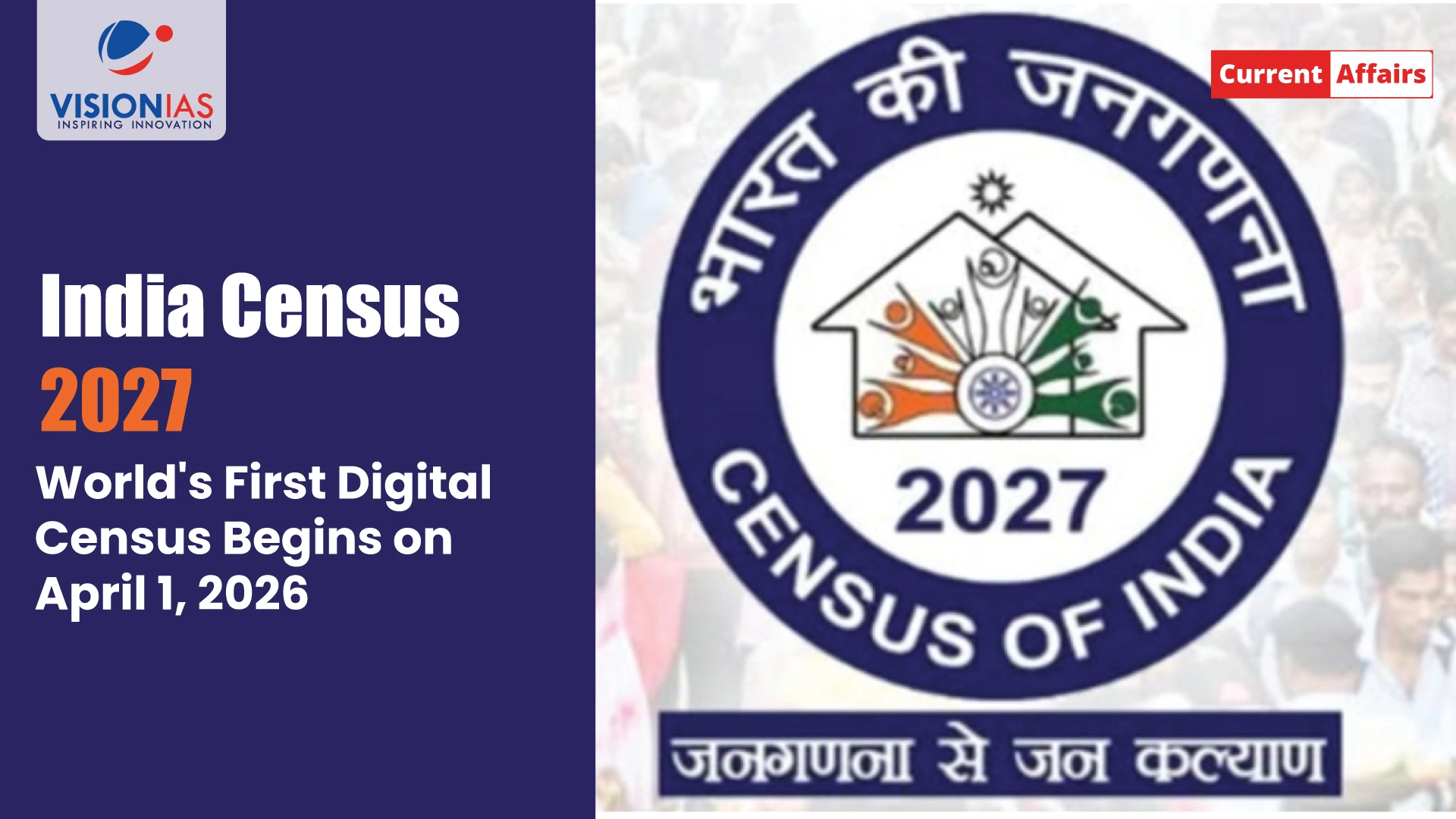













The first phase of Census-2027, the world’s largest population census exercise, will begin from 1, April, 2026.
India Census 2027 officially commenced its first phase on April 1, 2026. As the 16th Census in the series and the 8th since Independence, this exercise is unprecedented in scale and ambition: it is the world’s first fully digital population census, covering over 1.4 billion people.
Conducted under the authority of the Office of the Registrar General & Census Commissioner of India (ORGI) under the Ministry of Home Affairs, the India Census 2027 will deliver demographic and socio-economic data with speed, accuracy, and granularity never achieved before.
What Makes India Census 2027 Historic?
For decades, India’s decennial census relied on millions of field workers, paper forms, and manual data entry, a process that took years to produce final results. The 2021 Census was disrupted by the COVID-19 pandemic, creating a critical data gap that affected welfare planning, constituency delimitation, and economic indicators.
Census 2027 is not a rescheduled count. It is a complete re-engineering of the enumeration process. For the first time, the digital transformation of census methodology means data will be collected, validated, and processed in near real-time.
The government has approved an outlay of over ₹11,718 crore for this exercise.
Two-Phase Structure: House Listing and Population Enumeration
The India Census 2027 is structured across two phases.
Phase I: House Listing Operations (HLO)
The first phase, House Listing (HLO), begins on April 16, 2026, and continues until May 15 in the first batch. Enumerators will systematically list all buildings and structures across the country.
Key activities include:
- Geo-tagging of every building and assigning a unique identification number to each structure
- Recording housing conditions, amenities, and household assets
- Capturing data on drinking water access, sanitation, energy use, and digital connectivity, including smartphone and internet ownership
The first states and Union Territories to undertake the HLO process include Andaman and Nicobar Islands, Goa, Karnataka, Lakshadweep, Mizoram, Odisha, Sikkim, the NDMC area, and Delhi Cantonment Board.
This phase directly feeds into government programmes like Pradhan Mantri Awas Yojana (PMAY) and Jal Jeevan Mission, helping evaluate the on-ground impact of such schemes.
Phase II: Population Enumeration (PE)
Population Enumeration (PE) is scheduled for February 2027, with March 1, 2027 as the national reference date.
For snow-bound areas such as Ladakh, Jammu and Kashmir, Himachal Pradesh, and Uttarakhand, the reference date is October 1, 2026, with enumeration conducted in September 2026 to avoid winter disruptions.
This phase captures individual-level data on age, gender, religion, education, occupation, migration, and caste, providing the raw material for evidence-based policymaking for the next decade.
Digital Transformation: How It Works
The digital transformation powering Census 2027 is built on four integrated platforms developed by the Centre for Development of Advanced Computing (C-DAC):
- Houselisting Block Creator (HLBC): A satellite-imagery-based web-mapping tool that allows Charge Officers to define enumeration zones with geographic precision, replacing hand-drawn maps of the past.
- HLO Mobile Application: A secure app supporting 16 languages, with an offline mode for low-connectivity rural areas. Built-in validation checks ensure data quality at the point of collection.
- Self-Enumeration Portal (se.census.gov.in): Heads of households can fill their census details online in 16 languages before the enumerator visits. Upon submission, they receive a unique 16-digit SE ID that the enumerator verifies during the door-to-door visit.
- Census Management and Monitoring System (CMMS): A real-time dashboard for over 3.2 million field personnel, tracking enumeration progress across every district and sub-district.
Registrar General and Census Commissioner of India has confirmed that robust data security measures are in place, including end-to-end encryption, role-based access controls, and multi-factor authentication, all aligned with the Digital Personal Data Protection (DPDP) Act, 2023 and the Census Act, 1948.
Caste Enumeration: Historic First Since 1931
One of the significant aspects of India Census 2027 is the inclusion of comprehensive caste enumeration, a practice last undertaken in 1931.
While Scheduled Castes (SCs) and Scheduled Tribes (STs) have always been counted for constitutional reservation purposes, Other Backward Classes (OBCs) and other caste groups have remained uncounted for nearly a century. The Cabinet Committee on Political Affairs (CCPA) approved caste enumeration in April 2025, recognising the need for socio-economic data to ensure inclusive development.
This data will:
- Enable evidence-based targeting of welfare and reservation policies
- Provide the state with real numbers to move beyond contested estimates used in policy debates
- Serve as the foundation for inclusive development strategies that address entrenched inequalities
The 2011 Socio-Economic and Caste Census (SECC) generated over 46 lakh unique caste and sub-caste names, many of which were phonetic variants or clan names. ORGI is developing a classification methodology to reconcile regional variations and ensure data integrity.
Scale, Workforce, and Public Awareness
The India Census 2027 involves nearly 3.2 million enumerators, supervisors, and master trainers, primarily teachers and government officials, generating an estimated 1.02 crore person-days of employment.
To encourage public participation, the government has introduced two mascots: Pragati (representing a female enumerator) and Vikas (representing a male enumerator), symbolising gender equality in the national mission.
Citizens are urged by the Registrar General and Census Commissioner to provide accurate information to surveyors, as the data determines the quality of planning for education, health, housing, and infrastructure for the next decade.
Why This Census Matters: Implications for India’s Future
The data from India Census 2027 will shape the country on multiple fronts:
- Delimitation: Updated population data will redefine Lok Sabha and State Assembly constituencies, frozen since 1971, potentially redistributing political representation across states.
- Welfare Targeting: Granular data on assets, amenities, and income will allow targeted delivery of government schemes, moving India toward precision governance.
- Disaster Management: The geo-tagged spatial archive will help authorities map structural density and population distribution for effective disaster response.
- SDG Monitoring: Data on water, sanitation, and energy supports India’s commitments under Sustainable Development Goals 6 and 7.
Conclusion
India Census 2027 is more than a headcount. It is a digital transformation of how the state understands its citizens. From the Self-Enumeration portal to satellite-based house listing, from caste enumeration to real-time monitoring of 3.2 million field workers, this exercise sets a new global standard.
As the world’s first fully digital population enumeration, it will shape India’s policies, politics, and planning for an entire decade.
Master Digital Age Governance & Technology Trends with VisionIAS Comprehensive Current Affairs →
India Census 2027 FAQs
1. When does India Census 2027 begin?
Ans. April 1, 2026.
2. Which census number is India Census 2027 in the series?
Ans. 16th Census overall, 8th since Independence.
3. What makes the India Census 2027 historic?
Ans. It is the world’s first fully digital population census.
4. When was caste last enumerated in an Indian Census before 2027?
Ans. 1931.
5. How will India Census 2027 data affect Lok Sabha constituencies?
Ans. It will redefine constituency boundaries frozen since 1971, redistributing political representation across states.