Current Affairs
Passive Euthanasia in India: What the Harish Rana Case Means for End-of-Life Care
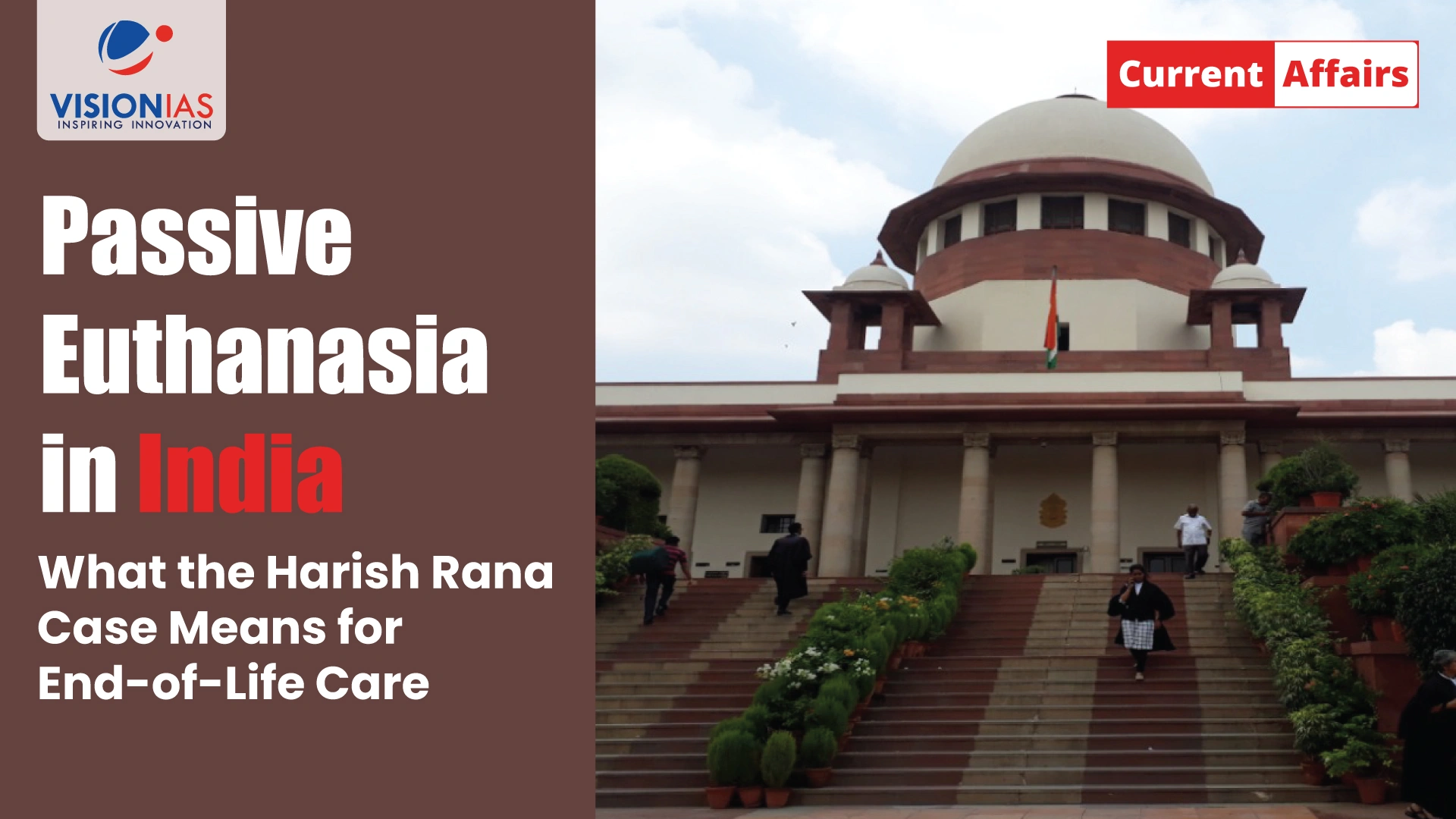












The Supreme Court of India permitted passive euthanasia for a patient who had been in a Persistent Vegetative State (PVS) for over 12 years.
In March 2026, the Supreme Court of India permitted passive euthanasia for Harish Rana, a 32-year-old man who had been in a Persistent Vegetative State (PVS) for over 12 years following a head injury in 2013. Acting on the Court’s order, doctors at AIIMS, New Delhi initiated the medical protocol to withdraw life-sustaining treatment and shift him to palliative care, allowing him to die with dignity.
This is one of the first real-world applications of India’s passive euthanasia framework, a legal structure built over decades through Supreme Court judgments. Once the euthanasia protocol was approved, Harish Rana was shifted to the Palliative Care Unit at AIIMS Institute Rotary Cancer Hospital (IRCH). The case has reignited debate on the euthanasia protocol in India: what it is, how it works, and why a comprehensive law is still needed.
What Is Euthanasia?
Euthanasia refers to the hastening of death to relieve a patient’s suffering. It is classified into two types:
- Passive Euthanasia: A patient is allowed to die naturally by withholding or withdrawing medical treatment that sustains life, such as ventilator support, dialysis, or Clinically Assisted Nutrition and Hydration (CANH).
- Active Euthanasia: A physician administers lethal drugs to end the life of a terminally ill patient. This remains illegal in India but is permitted in countries like the Netherlands and Belgium.
The euthanasia protocol in India is about passive euthanasia. It is not about ending life, but about stopping artificial prolongation of an existence that offers no hope of recovery.
Legal Journey: From Aruna Shanbaug to Harish Rana
India’s passive euthanasia framework has evolved through a series of constitutional milestones.
Key Judgments That Shaped the Euthanasia Protocol
- Aruna Shanbaug v. Union of India (2011): The Supreme Court allowed passive euthanasia under strict conditions, subject to High Court oversight and a medical board. This case focused on the conversation about ethical management of terminal illness.
- Common Cause v. Union of India (2018): The Supreme Court held that the right to die with dignity is a Fundamental Right under Article 21 of the Constitution. The judgment legalised Living Wills (Advance Medical Directives) and laid down the first guidelines for the passive euthanasia protocol in India.
- Common Cause (Modified Guidelines, 2023): The Court simplified the process by reducing the role of judicial officers and establishing a two-tier medical board system to make decisions faster and more practical.
- Harish Rana v. Union of India (2026): The first application of these principles in a clinical setting. The Court ruled that Clinically Assisted Nutrition and Hydration (CANH), including PEG feeding tubes, constitutes a medical treatment and can be withdrawn if it no longer serves the patient’s best interest.
How Does the Euthanasia Protocol Work in India?
The passive euthanasia protocol involves a two-stage review process to ensure no decision is made by a single individual.
Step 1: Primary Medical Board
The treating hospital forms a Primary Medical Board comprising:
- The treating physician
- Two subject-matter experts with at least five years of experience
This Board assesses whether the patient’s condition is irreversible and whether continuing treatment serves any therapeutic purpose. It then discusses the prognosis with the patient’s family and records a consensus.
Step 2: Secondary Medical Board
If the Primary Board recommends withdrawal, the case goes to a Secondary Medical Board, which includes:
- A doctor nominated by the Chief Medical Officer (CMO) of the district
- Two independent experts not part of the Primary Board
This Board must give its decision within 48 hours. Once both boards agree, the hospital informs the Judicial Magistrate of the First Class (JMFC). The magistrate’s formal approval is no longer required under the 2023 reforms.
Best Interest Principle
A core pillar of the euthanasia protocol is the Best Interest Principle. When a patient cannot make decisions for themselves, as in the Harish Rana case, medical boards and family members must ask: What would the patient have wanted?
This involves a balance between:
- Medical considerations: Is the treatment futile? Does it only prolong suffering?
- Non-medical considerations: What were the patient’s known values, wishes, and quality of life expectations?
In the Harish Rana case, the Court waived the standard 30-day consideration period because both boards and the family unanimously agreed recovery was impossible.
Living Wills: Empowering Individuals Before Crisis
Advance Medical Directives, called Living Wills, allow individuals to document in advance the treatments they wish to accept or refuse if they lose the capacity to decide. The 2023 modification removed the need for a Judicial Magistrate’s countersignature. Now, a notary or gazetted officer can attest the document.
A Living Will can specify:
- Treatment preferences such as no mechanical ventilation or artificial nutrition
- A surrogate decision-maker who can act on the patient’s behalf
- Personal wishes regarding dignity, gender of caregivers, and religious rites
The Harish Rana case was made more complex because there was no Living Will. The Court has urged that Living Wills be stored in the patient’s Ayushman Bharat Health Account (ABHA) so that hospitals can retrieve directives in emergencies. With over 79.71 crore ABHA accounts already created, this integration can make the euthanasia protocol accessible and proactive.
Challenges and Implementation Gaps
Despite the legal framework, implementation of the euthanasia protocol remains uneven:
- Few states, including Maharashtra, Goa, and Karnataka, have created the CMO-nominated panel required for Secondary Medical Boards
- Private hospitals often avoid initiating the protocol out of fear of litigation, even when withdrawal is clinically and legally appropriate
- Living Will clinics are absent across India. The first such clinic in a private hospital in North India opened recently at Apollo Hospital, New Delhi
Conclusion
The 2026 Harish Rana judgment represents the finalization of a decade-long judicial journey toward a humane end-of-life protocol in India. By establishing that Clinically Assisted Nutrition and Hydration is a medical treatment that can be legally withdrawn, the Supreme Court has removed the final semantic barrier to the practical application of the Common Cause guidelines.
As the Supreme Court observed, the family’s decision in the Harish Rana case was not an act of giving up. It was “an act of profound compassion and courage.” That is the spirit India’s passive euthanasia framework must uphold.
Master Digital Age Governance & Technology Trends with VisionIAS Comprehensive Current Affairs →
India’s Passive Euthanasia Protocol
1. Is passive euthanasia legal in India?
Ans. Yes, since 2018.
2. What Supreme Court case legalized passive euthanasia in India?
Ans. Common Cause v. Union of India (2018).
3. What is a Living Will in India?
Ans. A document where individuals pre-specify which life-sustaining treatments they want withheld if they become incapacitated.
4. Who oversees the passive euthanasia protocol in India?
Ans. A two-tier system of Primary and Secondary Medical Boards.
5. What is the Best Interest Principle in India’s euthanasia protocol?
Ans. It is the standard by which medical boards determine what treatment a patient unable to decide for themselves would have wanted, based on their values and prognosis.