Abhyaas
From Weak Spots to Strong Attempts: The Abhyaas Approach to UPSC Prelims
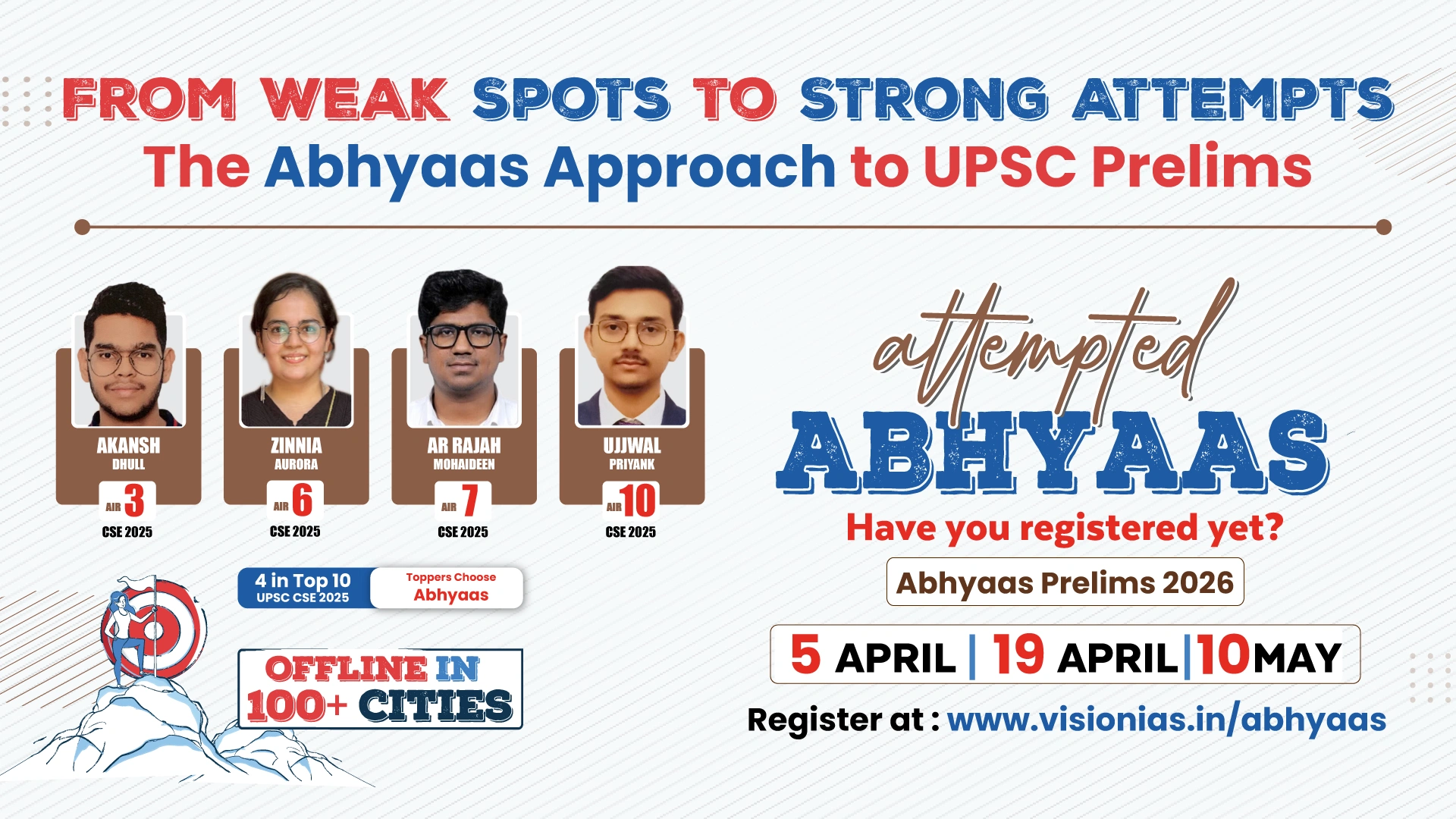









In the course of preparing for the UPSC Preliminary Examination, aspirants gradually develop a sense of familiarity with the syllabus. Subjects that once appeared fragmented, begin to form a coherent structure. Revision cycles reinforce concepts, and repeated exposure to questions builds a certain degree of confidence.
Yet, even at this stage, performance in tests often reveals an underlying pattern—the presence of persistent weak spots.
These may not always be obvious in terms of content. Sometimes, they appear as recurring errors in elimination, hesitation in attempting questions, misjudgment of difficulty, or inconsistency in accuracy. Despite adequate preparation, these weak spots continue to influence outcomes.
This is where the nature of preparation changes. The focus is no longer on what remains to be studied, but on what needs to be corrected and strengthened.
Understanding Weak Spots in Prelims Preparation
Weakness in UPSC Prelims is not limited to lack of knowledge. More often, it is linked to how knowledge is applied under exam conditions.
- Conceptual Gaps: Certain topics may appear clear during revision but lead to confusion when tested through application-based questions.
- Inconsistent Accuracy: Aspirants may perform well in familiar areas but struggle to maintain accuracy across diverse subjects.
- Ineffective Elimination: Inability to confidently eliminate incorrect options often results in missed opportunities or incorrect attempts.
- Poor Attempt Calibration: Over-attempting leads to negative marking, while under-attempting restricts scoring potential.
- Time Allocation Issues: Spending disproportionate time on difficult questions disrupts overall performance.
These weak spots are not static. They evolve with preparation and become visible primarily through testing.
Why Weakness Persists Despite Preparation
One of the reasons weak areas persist is that preparation is often reinforcement-driven rather than correction-driven. Aspirants tend to:
- Revisit familiar topics more frequently than difficult ones
- Focus on content expansion rather than performance refinement
- Evaluate preparation based on effort rather than outcomes
As a result, weak areas remain unaddressed, even as overall preparation appears to improve. This creates a situation where knowledge increases, but performance does not improve proportionately.
The Need for Converting Weakness into Strength
For effective Prelims preparation, identifying weaknesses is only the first step. What matters is the ability to systematically convert those weaknesses into strengths. This requires a process that is:
- Diagnostic: Understanding not just what went wrong, but why it went wrong.
- Iterative: Applying corrections across multiple attempts to ensure improvement is sustained.
- Structured: Following a disciplined approach to testing, analysis, and revision.
- Performance-Oriented: Focusing on how preparation translates into marks, rather than how much content has been covered.
Such a process transforms preparation from passive revision into active refinement.
Abhyaas: A Structured Approach to Performance Refinement
In this context, All India Abhyaas Prelims (GS + CSAT) Mock Test Series 2026 emerges as a structured platform that supports this transition from identifying weak spots to strengthening attempts.
Conducted across 100+ cities, Abhyaas is designed as a nationwide UPSC Prelims simulation, enabling aspirants to attempt full-length General Studies (GS) and CSAT papers in an offline OMR-based format, closely aligned with the actual examination.
For UPSC Prelims 2026, the All India Abhyaas tests are scheduled on: 5 April, 19 April, and 10 May 2026
The structure allows aspirants to engage in a cycle of attempt → analysis → correction → reattempt, which is central to improving performance.

Register : Abhyaas Prelims 2026
Learning from the Preparation Approach of Successful Candidates
If one reflects on the preparation journeys of several UPSC toppers across recent years who have engaged with structured prelims simulations such as Abhyaas, a consistent pattern becomes visible.
Candidates like Shubham Kumar (AIR 1, CSE 2020), Ankita Agarwal (AIR 2, CSE 2021), Ishita Kishore (AIR 1, CSE 2022), Aditya Srivastava (AIR 1, CSE 2023), Shakti Dubey (AIR 1, CSE 2024), or Akansh Dhull (AIR 3, CSE 2025) among others, reflect an approach where preparation goes beyond content coverage to include deliberate performance refinement.
Their journeys underline the importance of testing, evaluation, and systematic improvement as integral components of serious prelims preparation.
Key Aspects that Enable the Abhyaas Approach
- Realistic Examination Simulation: Abhyaas recreates the conditions of the actual exam, enabling aspirants to experience pressure, time constraints, and competition.
- Identification of Weak Areas: Structured testing helps reveal patterns in mistakes—whether conceptual, strategic, or behavioural.
- In-Depth Performance Analysis: Detailed insights allow aspirants to understand the nature of their errors and prioritize areas for improvement.
- Iterative Testing Cycles: Multiple tests enable aspirants to apply corrections and observe whether improvement is consistent.
- All India Benchmarking: Comparative evaluation helps aspirants understand whether their improvement is competitive.
- Expert-Led Discussions: Post-test discussions clarify concepts, strengthen reasoning, and refine question-solving approaches.
- Personalized Mentoring Support: Targeted feedback helps aspirants address specific weaknesses and align preparation with exam demands.
Conclusion
The journey to clearing UPSC Prelims is not defined by the absence of weaknesses, but by the ability to identify, address, and improve them systematically.
Preparation, when left unexamined, often reinforces strengths while leaving weaknesses intact. However, when supported by structured testing and analysis, it becomes a process of continuous refinement.
The Abhyaas approach reflects this philosophy—where preparation is not only tested, but improved through cycles of evaluation and correction.
Because in the end, success in Prelims depends not on perfection, but on the ability to convert weaknesses into strong, confident attempts in the exam hall.
Watch VisionIAS Faculties Tips on Abhyaas Prelims 2026