UPSC News
UPSC to Release Provisional Answer Key from CSE 2026: A Step Towards Greater Transparency
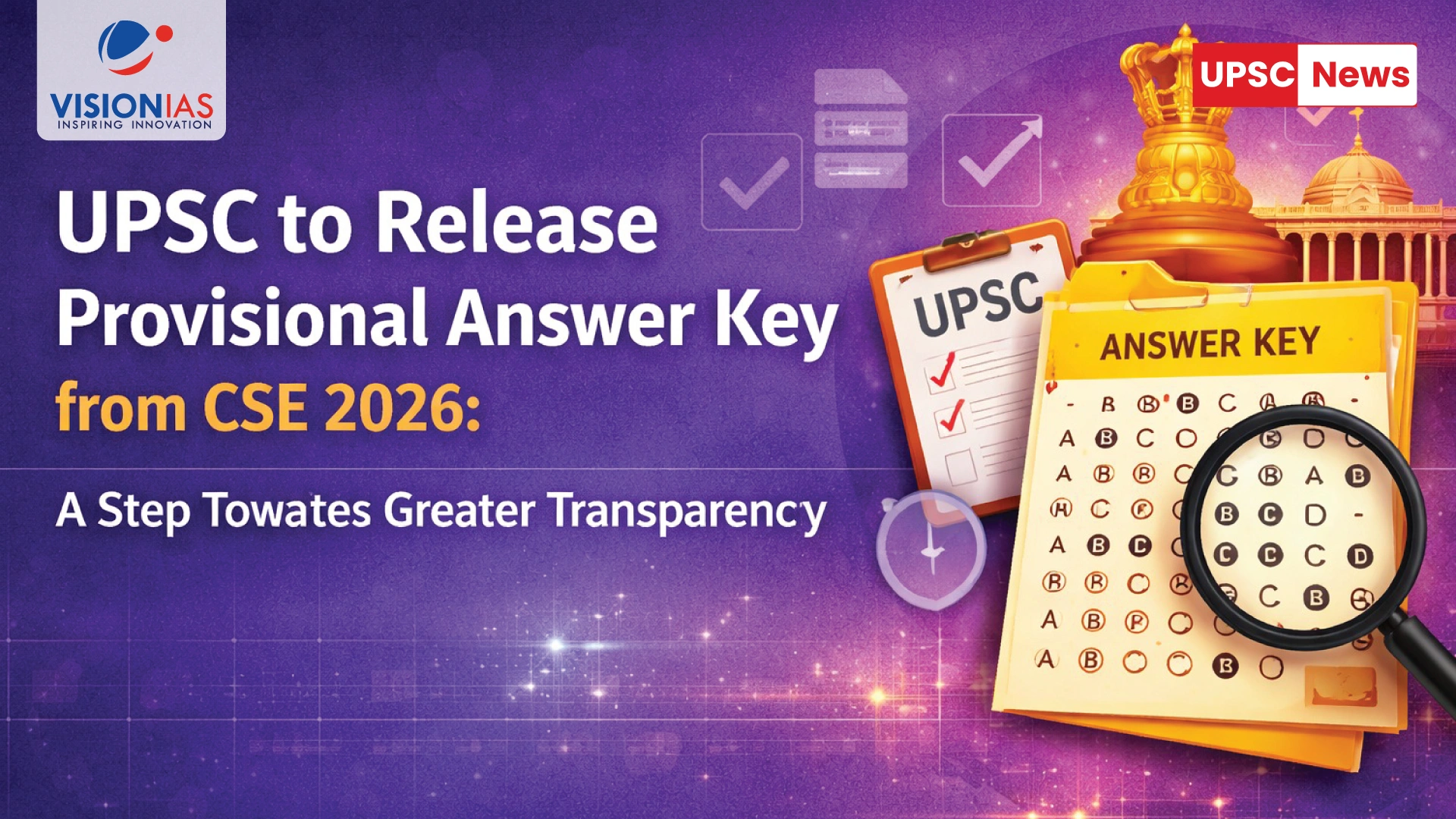










The Union Public Service Commission (UPSC), long regarded as one of the most credible examination bodies in India, is set to introduce a significant reform in its examination process. Beginning with the Civil Services Preliminary Examination 2026, UPSC will release a Provisional Answer Key shortly after the exam—marking a shift toward enhanced transparency, accountability, and candidate engagement.
This development, rooted in judicial direction and administrative reform, has important implications for lakhs of aspirants across the country. Understanding its context, rationale, and impact is essential.
The Policy Shift: What Has Changed?
As per recent official communication placed before Parliament, UPSC has formulated guidelines to release the Provisional Answer Key after the Preliminary Examination.
This reform will be applicable:
- From CSE Prelims 2026 onwards
- Across all structured examinations conducted by UPSC
At the same time, the Commission has clarified:
- Final marks of the Preliminary Examination will continue to be released only after the final result of the entire examination cycle (i.e., after Mains and Interview stages are completed).
This creates a balanced framework—offering transparency without compromising the integrity of the evaluation process.
Judicial Backdrop: Supreme Court Intervention
The reform is not merely administrative—it is rooted in judicial oversight. The decision comes in compliance with a ruling of the Supreme Court of India in Writ Petition (Civil) No. 118/2024, where the Court emphasized the need for greater transparency in public examinations.
Key Judicial Principles Involved:
- Fairness in competitive examinations
- Right to information for candidates
- Reduction of arbitrariness in evaluation
This intervention reflects a growing judicial emphasis on procedural transparency in high-stakes examinations.
The QPRep Portal: Institutionalizing Candidate Feedback
One of the most impactful components of earlier reforms is the introduction of a structured grievance mechanism. UPSC operationalizes the Question Paper Representation Portal (QPRep), accessible on its website upsconline.nic.in, through which candidates can:
- Challenge discrepancies in Questions and Provisional Answer Keys
- Submit representations within a defined time window
- Track grievance resolution
This had replaced the earlier scattered modes of communication with a formal, centralized, and accountable system.
Additionally, grievances can still be raised through:
- CPGRAMS (Centralized Public Grievance Redress System)
- Official email channels

Maintaining Evaluation Integrity: Moderation and Marks Disclosure
While introducing transparency, UPSC has retained key safeguards to ensure fairness in evaluation.
- Delayed Disclosure of Marks: Prelims marks will still be released only after the final result. It will prevent strategic manipulation and psychological bias in subsequent stages
- Inter-Subject Moderation: UPSC has reiterated its commitment to Inter-subject moderation in optional papers and ensuring no subject gives undue advantage/disadvantage. This addresses long-standing concerns about scaling and variations in difficulty levels across optionals
UPSC has also made public its methodology regarding moderation, reinforcing institutional transparency.
CSAT Clarification: Reaffirming Its Qualifying Nature
The Commission has once again clarified the role of CSAT (Paper II):
- It is a qualifying paper
- Requires only 33% marks
- Questions are aligned to matriculation-level standards
This clarification is important amid recurring debates about:
- Difficulty levels
- Language bias
- Aptitude vs. knowledge balance
Implications for Aspirants: A Structural Shift in Preparation
This reform is not merely administrative—it has the potential to reshape how aspirants approach the immediate post-Prelims phase and, more broadly, how they make strategic decisions in their preparation journey.
- Increased Certainty Post-Exam: One of the most immediate outcomes of this reform is the reduction of uncertainty that traditionally follows the Preliminary Examination. With the availability of an official answer key, aspirants will be able to evaluate their performance with far greater accuracy. This shifts the process away from dependence on multiple unofficial answer keys, which often vary and create confusion. The presence of a single authoritative reference point brings clarity at a crucial juncture.
- More Informed Decision-Making: This clarity directly feeds into better decision-making. Aspirants will be in a stronger position to assess their likelihood of qualifying for the next stage and plan their preparation accordingly. Instead of operating in a space of ambiguity, candidates can align their Mains preparation strategy with a more realistic understanding of their performance, making their efforts more focused and efficient.
- Accountability in Question Framing: Another subtle but significant impact lies in the increased accountability it introduces into the question-setting process. When answer keys are made public and open to scrutiny, the system naturally moves toward greater precision. Over time, this is likely to reduce ambiguities and improve the overall quality of questions, as the process becomes more responsive to valid feedback and corrections.
- Structured Challenge Mechanism: The availability of a formal mechanism to challenge discrepancies further strengthens this reform. Aspirants who identify factual errors or inconsistencies are no longer limited to informal discussions or scattered representations. Instead, they can engage with the system through a structured and recognized channel, contributing to a more robust and credible evaluation process.
Broader Significance: Transparency with Responsibility
This move reflects a broader shift in public institutions toward greater openness, but in a manner that is structured and purposeful rather than excessive. It signals a transition from opacity to structured transparency, and from a one-directional evaluation system to a more participatory framework where stakeholders have a defined role.
At the same time, UPSC has been careful not to compromise the integrity of the examination process. Complete or unregulated transparency could introduce challenges such as increased litigation, administrative burden, or disruptions in the multi-stage evaluation system. By limiting disclosure to the answer key while retaining control over marks and final evaluation stages, the Commission ensures that transparency does not come at the cost of stability.
In this sense, the reform represents a calibrated balance—where transparency enhances trust, administrative efficiency is maintained, and the credibility of the examination remains intact.

Conclusion: A Reform Anchored in Trust
The decision to release the Provisional Answer Key marks an important evolution in the UPSC examination framework. It brings together judicial direction, administrative foresight, and the practical needs of aspirants into a coherent and forward-looking reform.
For aspirants, it introduces clarity, offers a fair opportunity to raise concerns, and builds greater confidence in the system. For the institution, it reinforces its credibility, responsiveness, and commitment to fairness.
Ultimately, this reform goes beyond the act of releasing answer keys. It represents a deeper strengthening of the relationship between the examining body and the aspirants—one that is grounded in transparency, trust, and a shared commitment to fairness in the evaluation process.