Prelims
UPSC Prelims 2026 : Detailed Analysis of GS1 with Answer Key
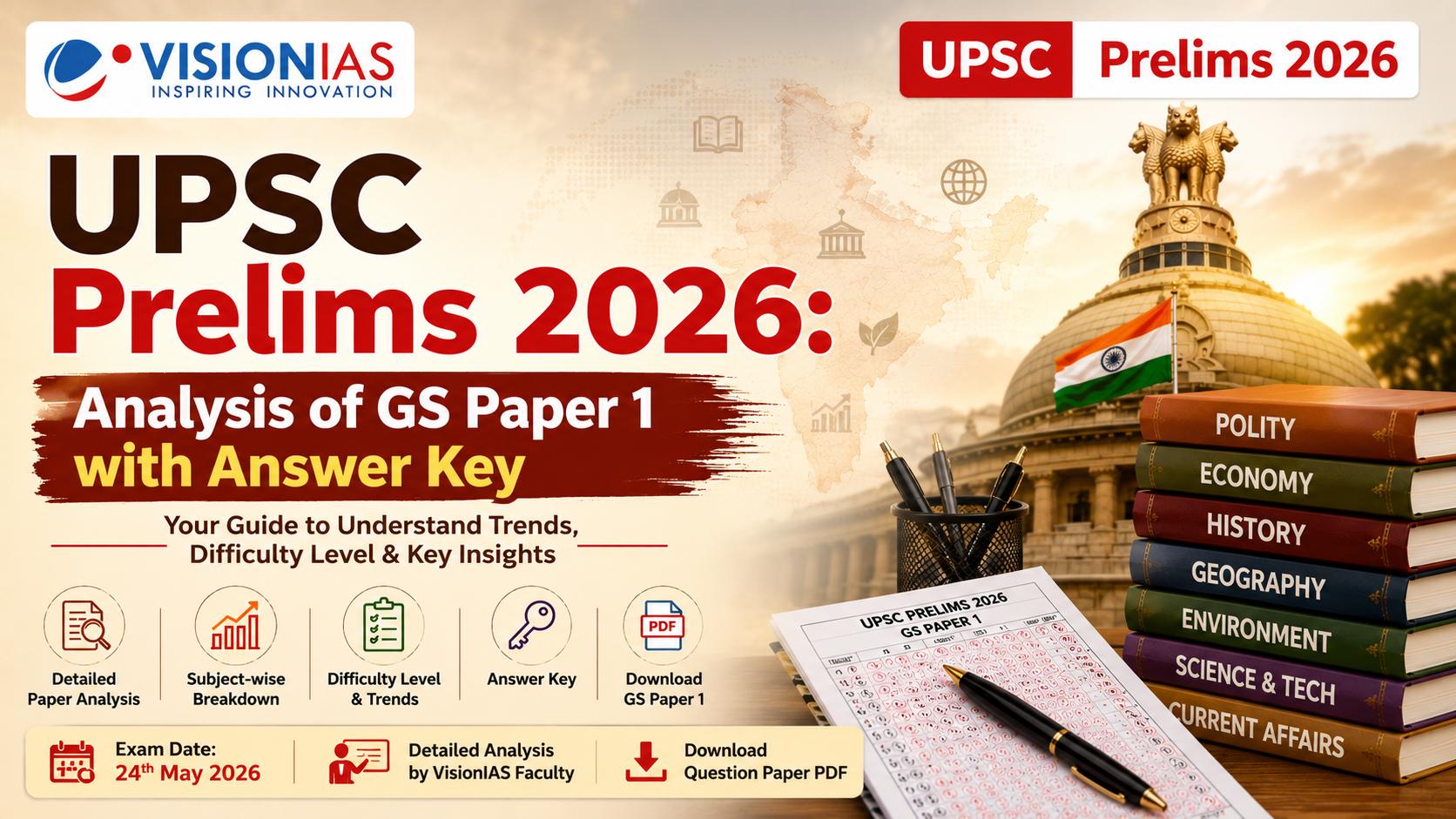




Your strategic guide to understand UPSC Prelims 2026 subject-wise trends, difficulty levels of UPSC Paper 1, and preparation insights for UPSC 2027
The UPSC Civil Services Preliminary Examination is the gateway to India’s most prestigious services including the Indian Administrative Service (IAS), Indian Police Service (IPS), and Indian Foreign Service (IFS).
In the prelims stage, General Studies Paper 1 (GS Paper I) plays a pivotal role, assessing an aspirant’s grasp over diverse subjects like History, Geography, Polity, Economy, Environment, Science & Technology, and Current Affairs.
Prelims serves as a screening test—only those who clear the cut-off in UPSC Paper 1 and score a minimum of 33% in CSAT (Paper II) qualify for the Mains stage of UPSC CSE.
This blog presents a detailed analysis of UPSC 2026 Prelims Question Paper (GS Paper I), examining subject-wise trends, difficulty levels, comparison with UPSC PYQs, and key takeaways to help aspirants—both current and future—align their strategy with the evolving nature of UPSC General Studies.
UPSC 2026 General Studies Paper 1 Overview
- Total Questions: 100
- Total Marks: 200
- Negative Marking: 1/3rd for every incorrect answer
- Time: 2 Hours
UPSC Prelims 2026 General Studies Question Paper -1
Download UPSC CSE Prelims 2026 Question Paper
UPSC CSE Prelims 2026 Provisional Answer Key (Official)
UPSC, for the first time, released the Provisional Answer Key for UPSC Prelims 2026 on 27 May soon after the conduct of the examination.
Download UPSC Provisional Answer Key – Available Now
Subject-wise Question Distribution of UPSC Prelims 2026 GS Paper 1
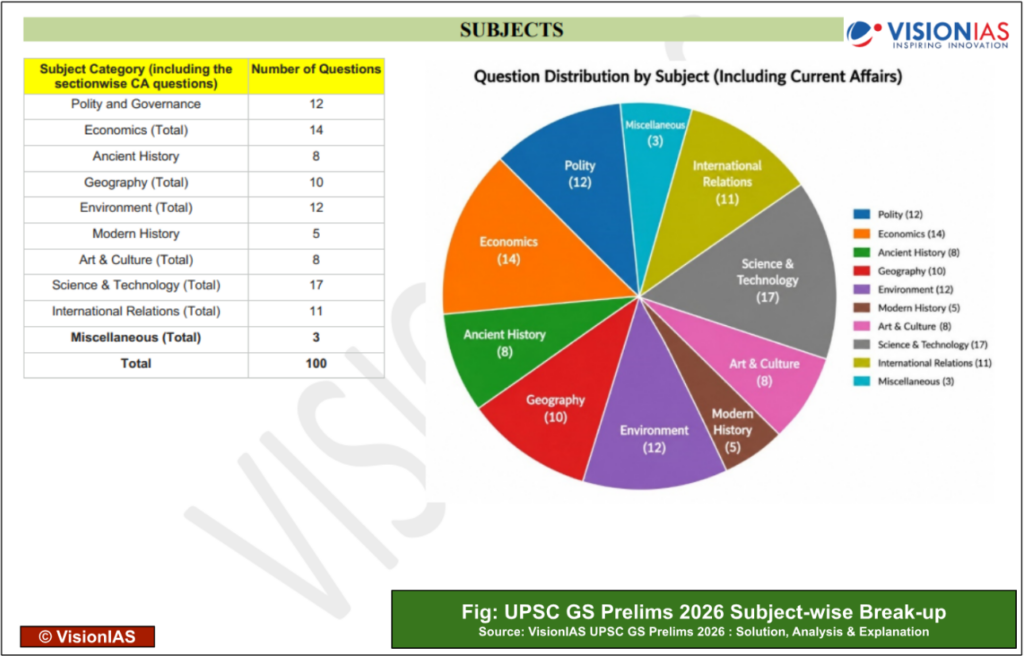
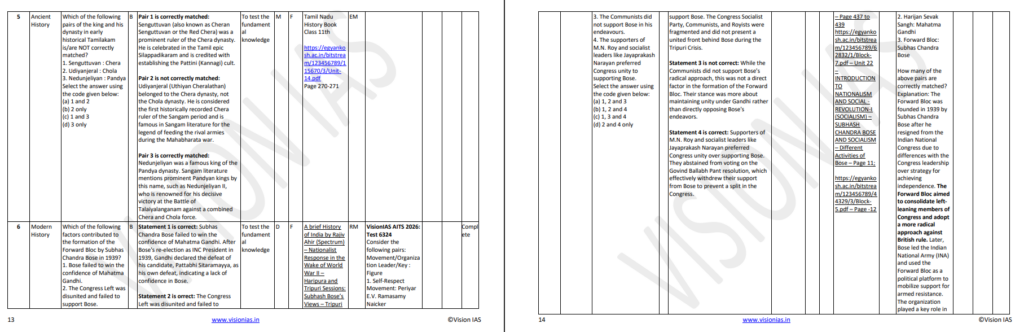
To know more about General studies for UPSC 2026 with the subject wise break-up, detailed explanation, difficulty level, nature of question, its source type and Vision IAS resource linkages, download VisionIAS – UPSC GS Prelims 2026: Solution, Analysis & Explanation
UPSC Prelims 2026: Overall Trend and Key Takeaways
This year’s GS Paper I stood out for its sheer intellectual demand. Here are the defining trends you need to understand:
- Tougher than last year — Over one-third of the paper was classified as difficult, with lengthy, layered questions replacing straightforward recall-based ones. A calm, elimination-focused approach was the real differentiator.
- New question formats — UPSC introduced a three-layered evidence–inference format: Roman numeral statements → numbered inferences → answer choices. These tested not just knowledge, but analytical reasoning and logical deduction.
- Science & Technology surged — With 15+ questions, S&T recorded its highest share in nearly a decade, focusing on defence technologies, Artificial Intelligence, LLMs, and drones. Basic science was almost absent.
- International Relations at peak — 11 questions from IR, the highest in recent memory, tested India’s external engagements, regional groupings, and some deeply obscure themes (older UN missions, BIMSTEC-linked facilities).
- History reshaped — Modern Indian History contributed a mere 5 questions; Medieval History was completely absent. Ancient History and Art & Culture dominated with 8 questions each, testing analytical interpretation over direct recall.
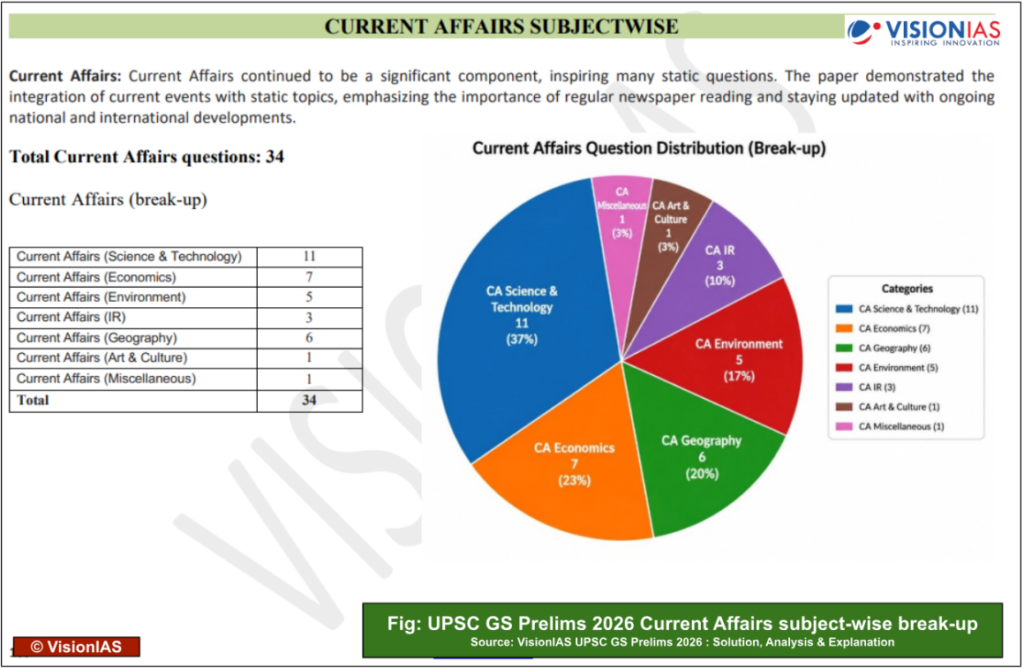
- Current Affairs with an integrated twist — Nearly one-third of the paper was current affairs-linked, but rarely as standalone facts. Questions demanded application of current developments alongside static concepts.
Watch Detailed Analysis of UPSC Prelims GS Paper-1 by VisionIAS Faculty
Comparison with Previous Years: A Glimpse of 2025
The UPSC Prelims 2025 GS Paper I emphasized a balanced preparation strategy.
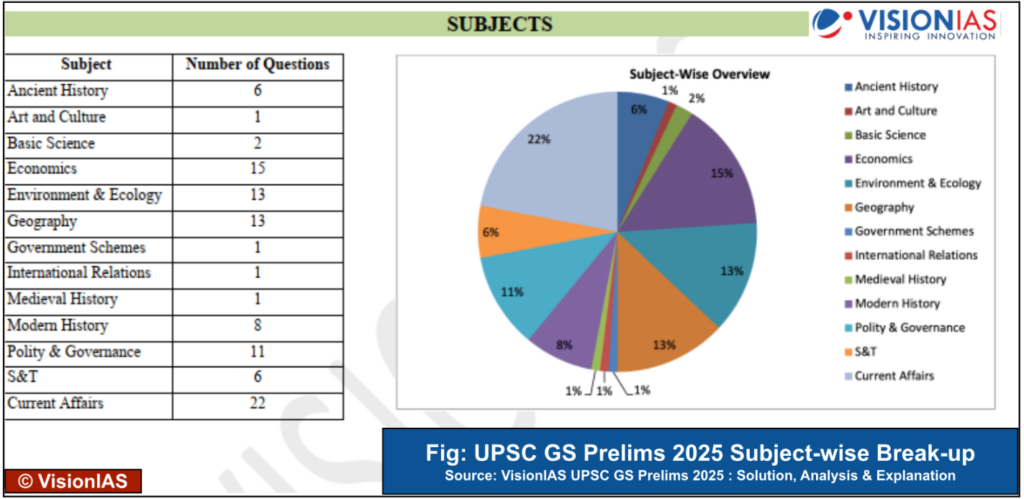
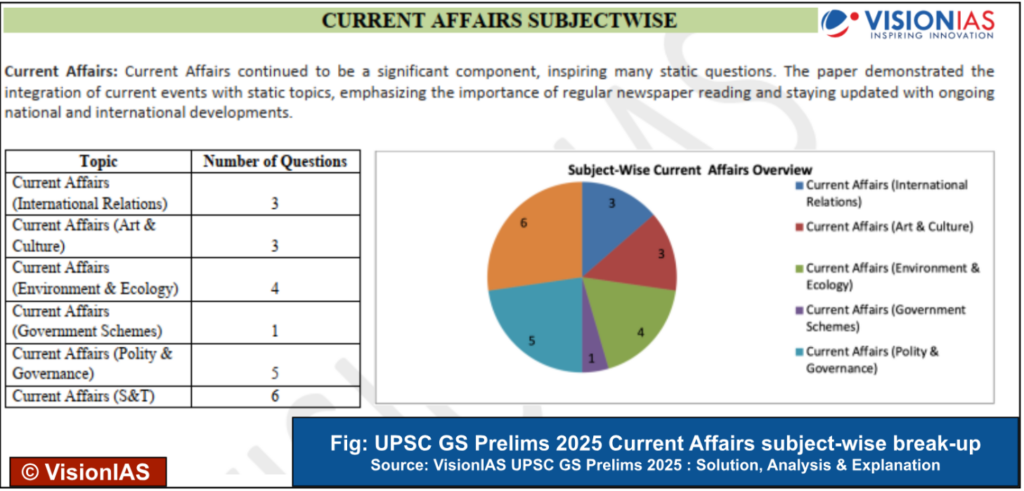
Key observations from UPSC Paper 1 Prelims 2025:
- UPSC 2025 paper appeared to be on a moderately tougher side. Questions in almost all the subjects ranged from easy to medium to difficult level. The paper in almost all sections touched upon core, basic and fundamental themes having current affairs in focus. This made the paper more relevant and current affairs dominated.
- The format of the options in the questions was twisted as instead of numerals, Roman settings was used for e.g. (d) I, II and III. Assertion reason type questions have seen an increase this year, with some being presented using three statements. These questions typically consist of an assertion followed by two reasons.
- Many questions though framed on a single topic demanded in-depth knowledge of multiple facts from the students.
- Static portions like Geography, Environment, Economics, S&T, Polity & Ancient & Modern History etc. were given due weightage. And on the other hand, sections like Art & Culture and Medieval History saw a dip.
- This year’s International Relations section underscored the significance of consistently engaging with newspapers and current affairs magazines, alongside regular mapping practice. The IR questions were on the expected lines, featuring a dynamic mix with an emphasis on regional groupings (e.g., BIMSTEC, BRICS), memberships (e.g., NATO), and UN-declared years.
- In the Polity section, UPSC has asked in-depth core questions necessitating a fundamental and precise understanding from the candidates on topics such as Anti-defection, Pardoning powers, Ordinances etc. As a departure from last year, no direct questions on political philosophy, Preamble etc. were asked.
- In the Governance section, questions focused on specific ministries and organizations, assessing candidates’ understanding of their functions and roles. For instance, the Enforcement Directorate (ED) and the Directorate of Revenue Intelligence (DRI) were highlighted, emphasizing their mandates in enforcing economic laws and combating financial crimes. Additionally, questions addressed boards such as the National Automotive Board, testing candidates’ knowledge of regulatory bodies and their impact on respective sectors.
- In the History section, questions from Ancient and Modern History were given more weightage over Art & Culture and Medieval History which signifies a pattern change. However, the topics asked in these sections saw inclination towards asking core static themes using standard sources and few questions linked with Current Affairs like Rajendra-I – Srivijaya invasion inspired from the news related to renaming of Port Blair to Sri Vijiya Puram, Gandhi Peace Prize etc.
- Geography and Environment remain pivotal sections in the examination. Geography questions spanned from foundational topics in the NCERTs—such as isotherms and the International Date Line—to more tricky ones like the International North-South Transport Corridor (INSTC) and time zones.
- Conversely, the Environment section placed a stronger focus on contemporary issues, emphasizing emerging technologies like Direct Air Capture and artificial rainfall, alongside pressing concerns related to climate change. Notably, there was a shift from the traditional emphasis on species and behavioral studies.
- The number of questions from Economics was close to the average taken over the last 10 years. The themes ranged from fiscal policy (union budget) to agriculture. Two questions from digital payment systems were also featured. Surprisingly, there was no direct question from National Income Accounting and two similar questions with an element of calculation (basic arithmetic) featured from the section Government revenue & expenditure. The financial market did get a substantial space, as questions on AIF, stock market featured in this year’s CSE.
- As regards to S&T and Basic Science, the questions were reasonable in number. In S&T, questions featured from all the important topics like space sector, defense, IT, biotech and cutting edge technologies. Except for the two basic science questions, all the questions were based on current affairs. Surprisingly, there were two questions related to Electric Vehicles. And the difficulty level of the questions was moderate to difficult.
To know more about General studies for UPSC with the subject wise analysis, current affairs subject wise distribution, difficulty level, nature of question and its source type, download VisionIAS – UPSC GS Prelims 2025: Solution, Analysis & Explanation
VisionIAS Subject-wise 10 year UPSC PYQ Analysis
UPSC Prelims GS Previous Year Trend (2017-2025)
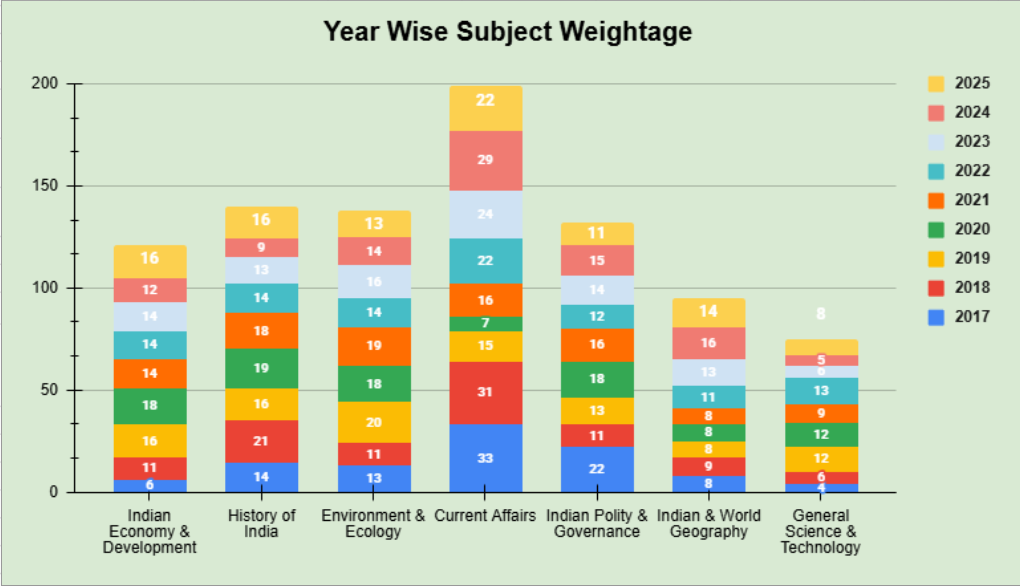
Lessons & Strategy for Future UPSC 2027 Preparation and beyond
Insights from recent UPSC PYQs reveals clearly that:
- Strong foundational understanding is non-negotiable for clearing UPSC Prelims.
- Conceptual clarity is key—rote learning alone won’t help.
- Balanced preparation is essential: No static subject can be ignored—give equal attention to Polity, History, Geography, Economy, Environment, and Science & Technology.
- Mere selective preparation is ineffective—broad syllabus coverage is the only viable strategy.
Practice is the Prelims Success Mantra
Regular practice through high-quality mock tests enhances speed, accuracy and elimination skills. Mock tests simulate real exam temperament, and consistent revision sharpens retention and decision-making under pressure—essential for handling the unpredictable nature of UPSC Prelims Question Papers.Quick revision materials, crisp notes, and smart revision tools are game-changers for last-mile effectiveness.
Know the Topper way of surviving UPSC’s toughest MCQ format, Watch: VisionIAS Toppers Talk.
Key Learning for Future Aspirants Targeting UPSC 2027
1. Integrate Current Affairs with Static Subjects
UPSC increasingly asks questions where current events are embedded within static frameworks.
- Link newspaper reading with standard books and class notes
- For subjects like Polity, Economy, Geography, and Environment, connect conceptual theories with current events
This improves memory and enhances your ability to apply concepts to questions.
2. Don’t Ignore Environment and CSAT
- The environment continues to have 15–20 questions, many based on factual details and conservation initiatives. With regular revision, it becomes a scoring subject.
- CSAT, although qualifying, is not to be underestimated—its rising complexity led to many failures in 2023 & 2024.Regularly practice comprehension, basic maths, and reasoning to avoid surprises.
3. Focus on Conceptual Clarity & Interdisciplinary Linkages
UPSC questions test understanding, not mugging. Grasp the broader context of concepts like inflation, federalism, monsoon, biodiversity etc. Clarity from NCERTs, PYQs and standard sources helps tackle complex or indirect questions with confidence.
4. Prepare for Elimination-Based MCQ Strategy
Options are now more complex, often including traps like: “Only one is correct”, factually tricky phrasing among others. To master the elimination skill, identify keywords, spot contradictions, use general awareness, narrow down when unsure. Mastery improves by solving UPSC PYQs and mock tests—a skill often decisive for cracking UPSC CSE.
Further, join Sandhan Personalised Tests for a Strategic Re-Evaluation of Your Preparation. And also use:
- PT365 for Current Affairs
- Mains365 for continuity in GS preparation
Conclusion
A clear trend is emerging in UPSC General Studies—a shift towards analytical thinking and balanced paper setting. Aspirants who rely not just on one subject or limited topics but maintain consistency across static and current affairs are rewarded.
This confirms that UPSC’s evaluation is moving from memory-based to reasoning-driven. The ability to interlink concepts, apply logic, and remain calm under pressure is now a must-have skill.
As seen in recent years, aligning yourself with this evolving PYQ trend is the only pathway to success in UPSC Prelims.