English
India-Nordic Relations Elevated to Green Technology & Innovation Strategic Partnership
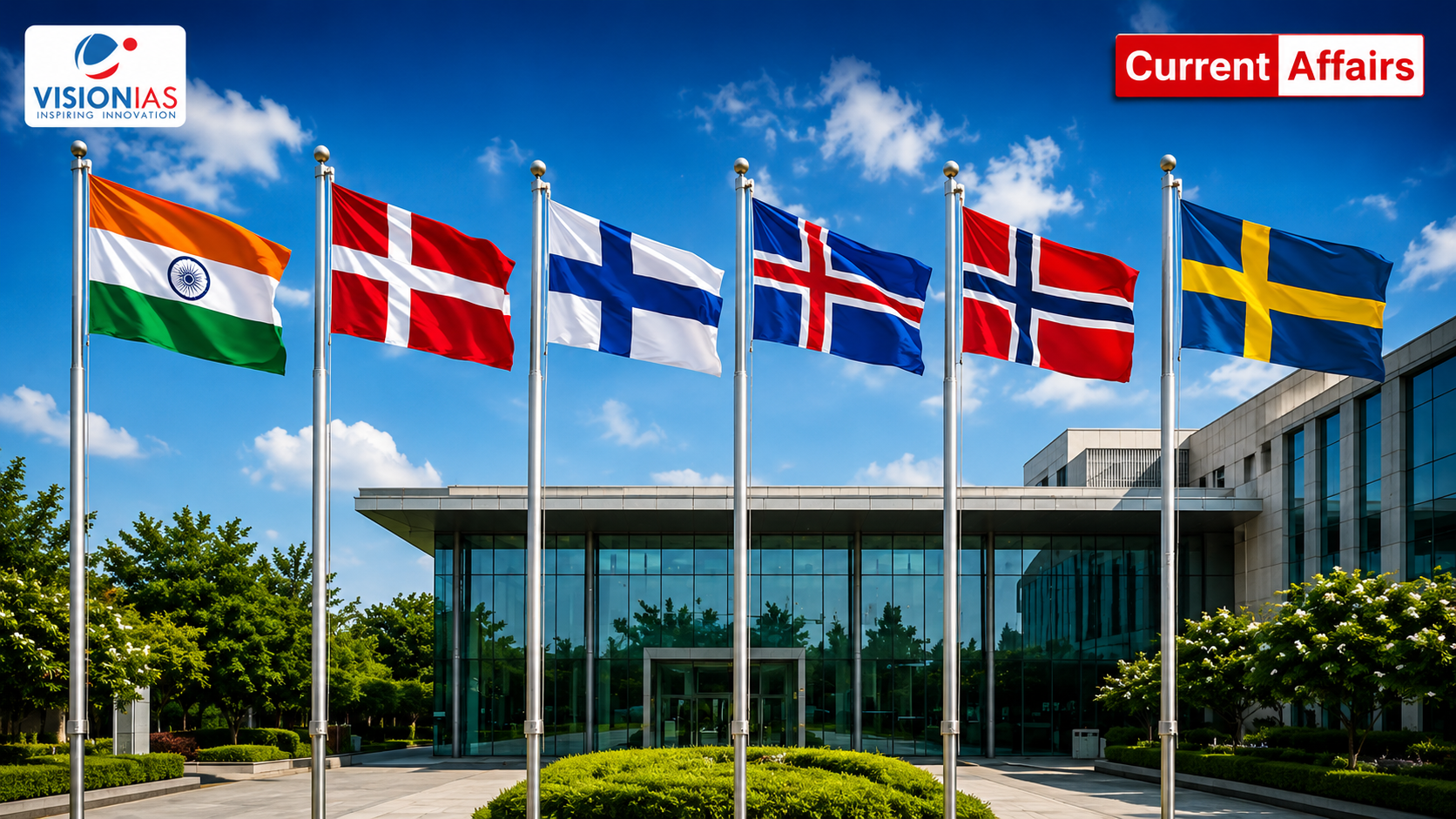

















In 3rd India–Nordic Summit in Oslo, India and the Nordic countries decided to elevate their relationship into a Green Technology and Innovation Strategic Partnership.
In a landmark development for Indian diplomacy, the Prime Minister of India participated in the 3rd India-Nordic Summit held in Oslo on May 19, 2026, hosted by Norwegian Prime Minister Jonas Gahr Støre. The summit brought together the leaders of Denmark, Finland, Iceland, Norway, and Sweden, the five Nordic nations along with India.
The most significant outcome of the summit was the decision to elevate India-Nordic relations to a Green Technology and Innovation Strategic Partnership. This upgrade reflects the growing strategic depth, economic dynamism, and shared values between India and the Nordic bloc and signals a new era of collaboration in clean energy, digital innovation, and sustainable development.
Background: India-Nordic Summit
The India-Nordic Summit format was established to institutionalise high-level dialogue between India and the five Nordic countries. The first summit was held in Stockholm in 2018, the second in Copenhagen in 2022, and now the third in Oslo in 2026.
Indian Prime Minister (PM) highlighted the impressive growth in bilateral trade ties between India and the Nordic nations. The trade increased four-fold over the past decade, while Nordic investments in India have risen by approximately 200 per cent. The next summit will be hosted by Finland in Helsinki.
Green Technology and Innovation: Core of the New Partnership
The decision to build a Green Technology and Innovation Strategic Partnership is rooted in a complementary logic: the Nordic countries bring world-class expertise in sustainability, clean energy, and advanced technology, while India offers scale, a skilled workforce, and a rapidly growing innovation ecosystem.
Each Nordic Nation Brings Unique Strengths
Indian PM outlined the distinct contributions of each Nordic country to the partnership:
- Iceland: expertise in geothermal energy and sustainable fisheries
- Norway: leadership in the blue economy and Arctic affairs
- Sweden: advanced manufacturing and defence technologies
- Finland: telecommunications and digital infrastructure
- Denmark: cybersecurity and health technologies
Together, these strengths align well with India’s goals of achieving 500 GW of renewable energy capacity, becoming a global hub for green hydrogen, and building trusted digital public infrastructure.
Key Green and Innovation Initiatives
- Mission LiFE: The Nordic countries expressed support for India’s Mission LiFE (Lifestyle for Environment), which focuses on behavioural change to address climate change and promote sustainable consumption.
- LeadIT 3.0: The Leadership Group for Industry Transition (LeadIT), a platform for public-private collaboration on decarbonising hard-to-abate sectors, was welcomed. Iceland joined as its newest member.
- Renewable Energy Targets: The Nordic partners appreciated India’s ambitious renewable energy commitments and emphasised the need for affordable climate finance, technology transfer, and capacity building for developing countries.
- Carbon Capture & Green Hydrogen: Leaders agreed to accelerate cooperation in zero- and low-emission technologies including carbon capture, utilisation and storage (CCUS), and green hydrogen.
Trade, Investment, and Economic Cooperation
The summit placed significant emphasis on deepening trade and investment ties. The Indian PM invited Nordic countries to explore investment opportunities in green transition, blue economy, shipbuilding, green shipping, renewable energy, water management, and defence sectors. He also specifically invited Nordic nations to establish a presence in GIFT City, Gujarat, India’s first operational smart city and international financial services centre.
Two major trade milestones were highlighted at the summit: the conclusion of the India-EU Free Trade Agreement in January 2026 and the entry into force of the India-EFTA Trade and Economic Partnership Agreement (TEPA) in October 2025. Under TEPA, EFTA states have committed to target investments of USD 100 billion in India, aimed at creating one million direct jobs.
The leaders also underscored the importance of the India-Middle East-Europe Economic Corridor (IMEC) as a key connectivity initiative linking the Nordic and Indo-Pacific regions and diversifying critical global value chains.
Digital Innovation and Artificial Intelligence: Shaping the Future Together
A prominent theme at the summit was the transformative power of Artificial Intelligence (AI) and digital technologies. The leaders emphasised the need for inclusive, human-centric AI applications and open-source solutions that ensure new technologies benefit all sections of society.
Both sides agreed to advance discussions on AI governance that is transparent, democratic, equitable, and rights-based. Cooperation was also agreed in secure and trusted digital infrastructure, including 5G and next-generation 6G communications, STEM research, industrial R&D, and greater exchange between start-ups and incubators on both sides.
Maritime Security, Blue Economy, and Space Cooperation
Maritime Security and the Indo-Pacific
As leading maritime nations, India and the Nordic countries reaffirmed their commitment to a free, open, peaceful, and prosperous Indo-Pacific in accordance with UNCLOS. They agreed to cooperate through bilateral dialogues and multilateral platforms like the Indo-Pacific Oceans Initiative (IPOI) and India’s ‘MAHASAGAR’ vision (Mutual and Holistic Advancement for Security and Growth Across Regions).
Cooperation to address Illegal, Unreported and Unregulated (IUU) fishing, piracy, maritime pollution, and safety of seafarers was also discussed. Maritime Security Dialogues with Norway and Denmark were formally instituted.
Arctic Cooperation and Indo-Pacific Linkages
The leaders acknowledged the growing inter-linkages between the Arctic and Indo-Pacific regions and recognised new opportunities for cooperation in this evolving strategic space.
They highlighted the potential for expanding collaboration in Arctic polar research, climate studies, and environmental issues. The leaders also reaffirmed their shared commitment to advancing dialogue and cooperation in the Arctic through established multilateral frameworks.
Space: New Frontier for India-Nordic Cooperation
The summit welcomed the Framework Agreement between ISRO and the Norwegian Space Agency for cooperation in the exploration and peaceful uses of outer space. A proposal for a Swedish payload on India’s upcoming Venus Orbiter Mission was also highlighted as a concrete example of growing space-sector collaboration.
Geopolitics, Multilateralism, and Counter-Terrorism
The leaders reiterated their commitment to a reformed United Nations, including an expanded UN Security Council (UNSC). The Nordic countries reaffirmed their support for India’s permanent membership in a reformed UNSC. India’s application to the Nuclear Suppliers’ Group (NSG) was also welcomed by Nordic leaders.
On counter-terrorism, the leaders unequivocally condemned terrorism in all its forms, including cross-border terrorism. The leaders also called for dialogue and diplomacy to resolve conflicts in Ukraine and West Asia.
Conclusion
The elevation of India-Nordic relations to a Green Technology and Innovation Strategic Partnership marks a pivotal moment in India’s engagement with Europe. It signals India’s ambition to position itself as a trusted global partner in the green transition and digital era combining Nordic innovation with Indian scale.
From clean energy and AI governance to maritime security and Arctic research, the breadth of this partnership reflects the strategic maturity of modern India-Nordic relations. With the 4th Summit to be hosted by Finland in Helsinki, the India-Nordic story is only growing stronger.
Master Digital Age Governance & Technology Trends with VisionIAS Comprehensive Current Affairs →
India-Nordic Summit FAQs
1. What is the new status of India-Nordic relations as of 2026?
Ans. Green Technology and Innovation Strategic Partnership.
2. What is Iceland’s specific contribution to the India-Nordic Green Technology Partnership?
Ans. Expertise in geothermal energy and sustainable fisheries.
3. Which new member joined LeadIT at the 3rd India-Nordic Summit?
Ans. Iceland.
4. What investment target have EFTA states committed to under the India-EFTA TEPA agreement?
Ans. USD 100 billion, aimed at creating one million direct jobs in India.
5. Which two space agencies signed a Framework Agreement at the 3rd India-Nordic Summit?
Ans. ISRO and the Norwegian Space Agency.