Prelims PYQs
UPSC CSE Prelims 2026 Question Paper (GS , CSAT) Download PDF with Answer Key & Subject-Wise Analysis
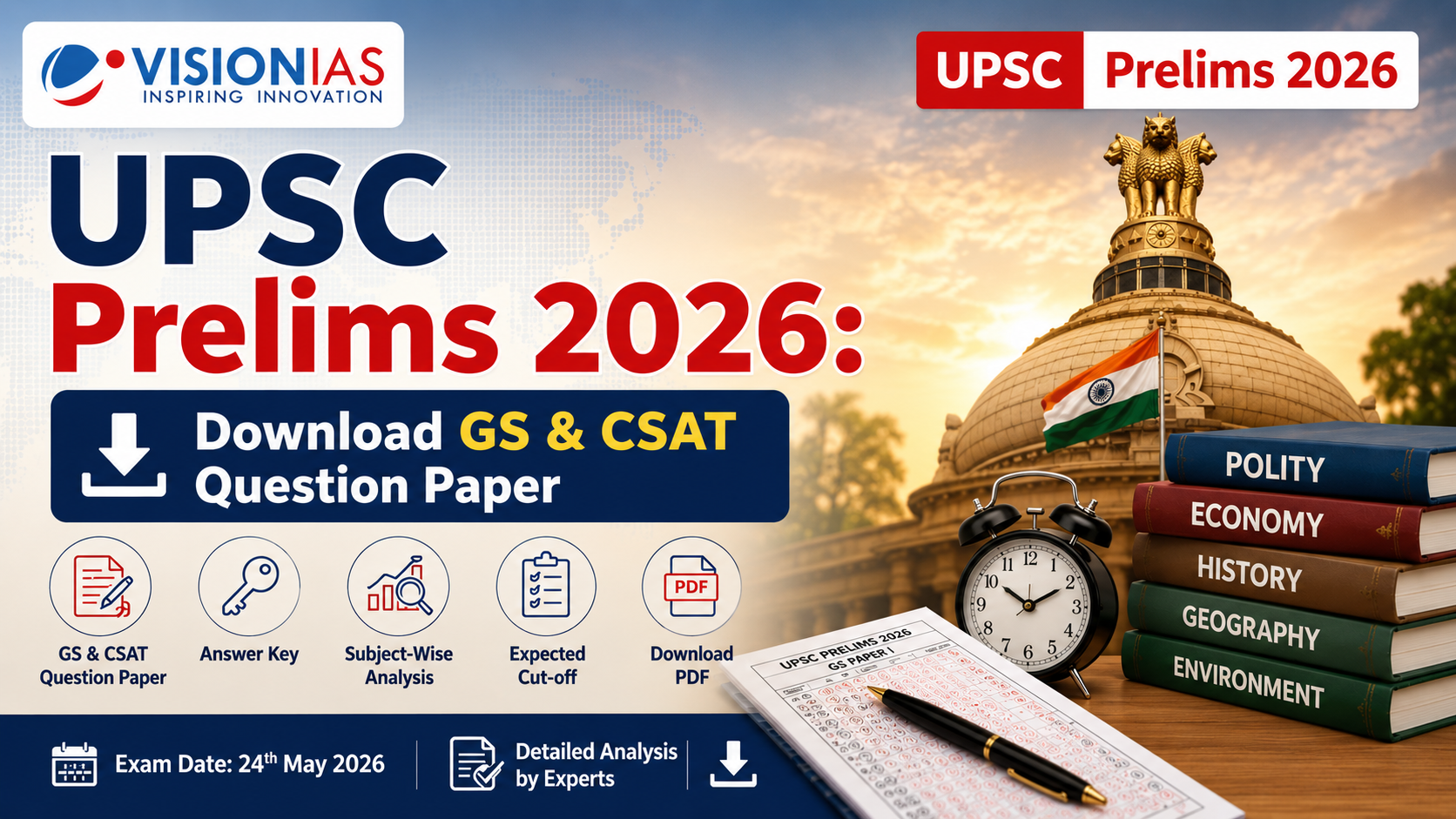












Get the UPSC CSE Prelims 2026 GS and CSAT Paper PDF with Answer key and explore expected structure, analysis, and key takeaways for your UPSC preparation strategy.
The UPSC Civil Services Preliminary Examination 2026, successfully conducted on May 24, marks a significant milestone in the journey of aspirants preparing for India’s most prestigious competitive examination.
With lakhs of candidates expected to appear across the country, this year’s UPSC 2026 Prelims paper is anticipated to reflect the hallmark unpredictability of UPSC, assessing not just knowledge and information, but also analytical ability, decision-making, and time management skills.
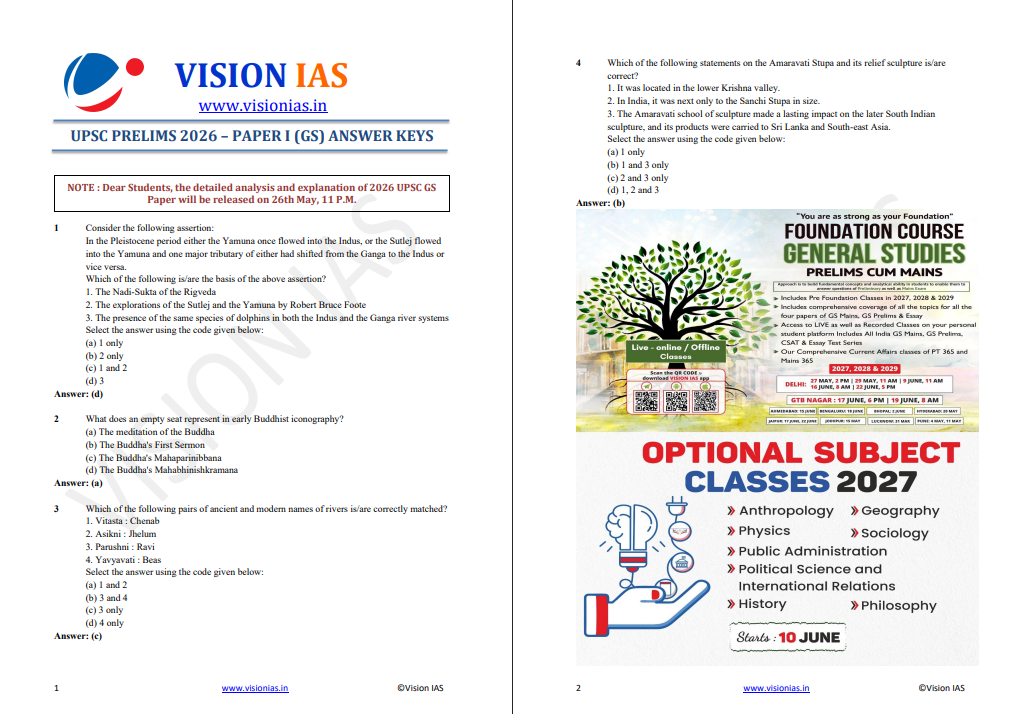
UPSC CSE Prelims 2026 General Studies Question Paper -1 with Answer Key
Download UPSC CSE Prelims 2026 Question Paper with Answer Key
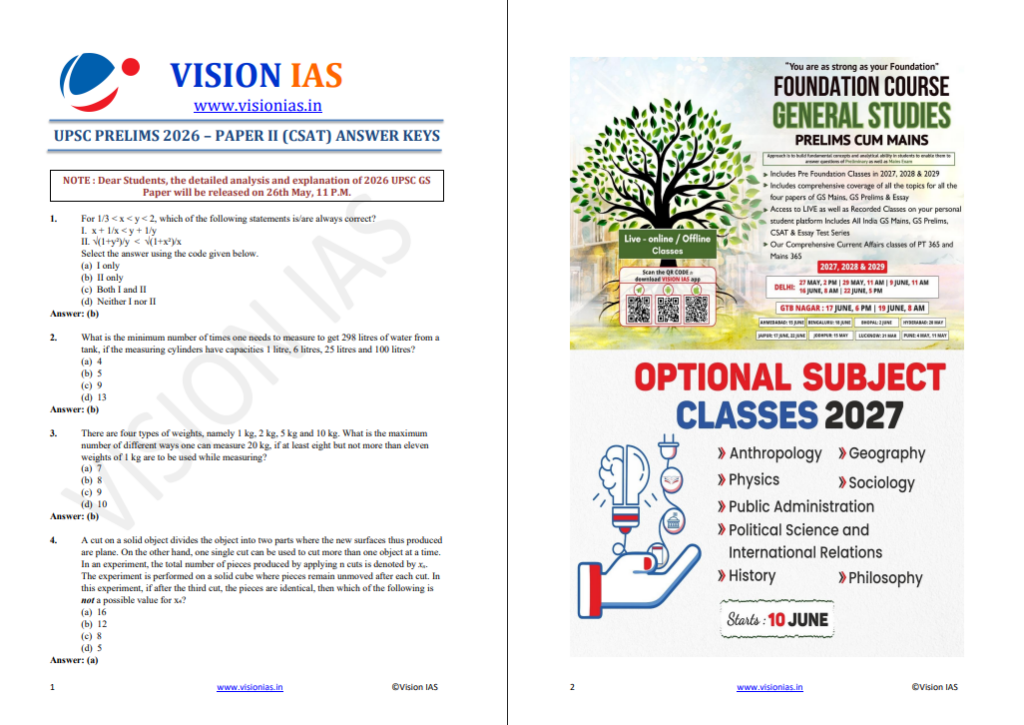
UPSC CSE Prelims 2026 CSAT Question Paper with Answer Key
Download UPSC CSAT Question Paper 2026 with Answer Key
UPSC CSE Prelims 2026 Paper has been officially conducted on 24th May 2026. Aspirants can access the UPSC 2026 Prelims Question Paper PDF for both GS Paper 1 and CSAT. Candidates are encouraged to review the UPSC CSE Prelims Question Paper 2026 Answer Key to estimate their scores and assess their performance.
To assist your preparation and evaluation, UPSC CSE Prelims 2026 Question Paper PDF Download links are available online. Download the complete set to practice, revise, or analyze trends from the UPSC 2026 Prelims Question Paper now.
UPSC CSE Prelims 2026 Expected Cut-off
Participate in the Expected Cut-Off Survey
Participate in the Expected Cut-Off Survey and contribute to a data-backed expected cut-off estimate built from inputs shared by aspirants across the country. The greater the participation, the more accurate and representative the estimate will be.
Submit your score and join us on 26th May, when we reveal the final expected cut-off estimate for UPSC CSE Prelims 2026.
Click, to participate in Expected Cut-Off Survey – (live Now)
Expected Cut-Off for UPSC Prelims 2026
After the Expected Cut-Off Survey (from 26th May onwards), check category-wise cut-off estimates based on paper difficulty, student feedback, and historical trends to assess your performance without waiting for the official cut-off figures.
Click to check, UPSC CSE Prelims 2026 Expected Cut-off
Also Read, about UPSC Cut off (Official): UPSC Cut-Off with Past 6 Years’ Data
VisionIAS UPSC CSE Prelims 2026 Answer Key
Download VisionIAS UPSC Prelims 2026 GS Answer Key
Download VisionIAS UPSC CSAT 2026 Answer Key
Also explore, Vision IAS UPSC Prelims Past Year Paper Solution and explanation
UPSC CSE Prelims 2026 Provisional Answer Key
Download UPSC Provisional Answer Key – Coming Soon
UPSC CSE Prelims Syllabus Overview
General Studies Paper I (200 Marks | 2 Hours)
- Current events of national and international importance
- History of India and Indian National Movement
- Indian and World Geography – physical, social, economic geography
- Indian Polity and Governance – Constitution, Political System, Panchayati Raj, Public Policy, Rights issues, etc.
- Economic and Social Development – sustainable development, poverty, inclusion, demographics, social sector initiatives
- Environmental Ecology, Biodiversity, and Climate Change – general issues, no subject specialization needed
- General Science
UPSC CSAT (Paper II) (200 Marks | 2 Hours – Qualifying Paper)
- Comprehension
- Interpersonal skills including communication
- Logical reasoning and analytical ability
- Decision-making and problem-solving
- General mental ability
- Basic numeracy (Class X level), data interpretation (charts, graphs, tables)
Note: A minimum of 33% marks is required to qualify Paper II (CSAT).
UPSC CSE Prelims Exam Timings
GS Prelims (Paper I): 9:30 – 11:30 AM
CSAT (Paper II): 2:30-4:30PM
Also Read, UPSC Syllabus – Prelims, Mains and Optionals subjects.
UPSC Exam Day: A Test of Knowledge, Readiness & Real Learning
The UPSC CSE Prelims exam day is not just the outcome of months of preparation, but a real test of readiness and temperament. Beyond the immediate results, what truly benefits aspirants is the ability to deeply analyze the UPSC CSE prelims question paper like its nature and demands of the question paper and match it with their preparation.
The post-exam phase becomes a bridge between experience and future success, where analysis is not merely academic—it’s a strategic tool for correction, redirection, and smarter planning.
Why Post-Exam Analysis Is Critical
Analyzing the UPSC CSE Prelims question paper—its trend, theme, and evolving pattern—is crucial not just for this year’s aspirants, but also for future candidates. A detailed analysis helps identify:
- Static vs dynamic components
- Subject-wise weightage
- Difficulty level
- Emerging themes and shifting priorities
Such insights can refine strategies, help choose the right resources, and avoid common mistakes—making it an essential step for aspirants targeting UPSC 2027 and beyond.
Platforms like VisionIAS Sandhan can support such learning by enabling question-level analysis and UPSC PYQ based practice. Coupled with mock tests, this approach builds exam temperament and decoding ability.
Read, about UPSC Cut off (Official): UPSC Cut-Off with Past 6 Years’ Data
UPSC CSE Prelims 2026 Expected Cut-off- To be updated soon
Focus Areas in UPSC CSE Prelims 2026 – What’s New?
Get a comprehensive breakdown of the question paper, covering:
- Subject-wise analysis (History, Polity, Economy, Environment, Science & Tech, Current Affairs)
- Paper pattern and topic distribution
- Thematic shifts from previous years
- Detailed analysis of questions
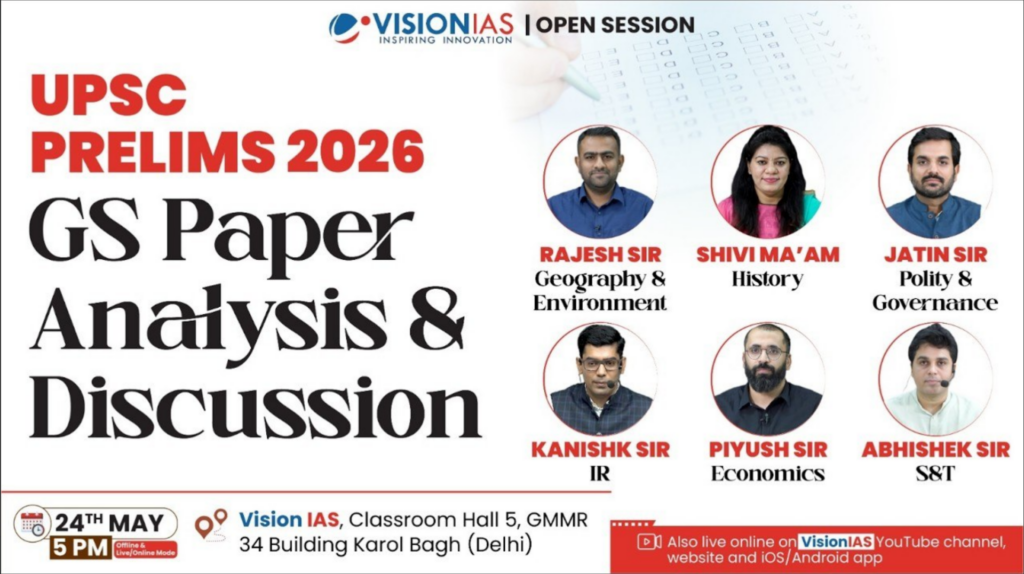
Watch Detailed Analysis of GS Paper-1 by VisionIAS Faculty
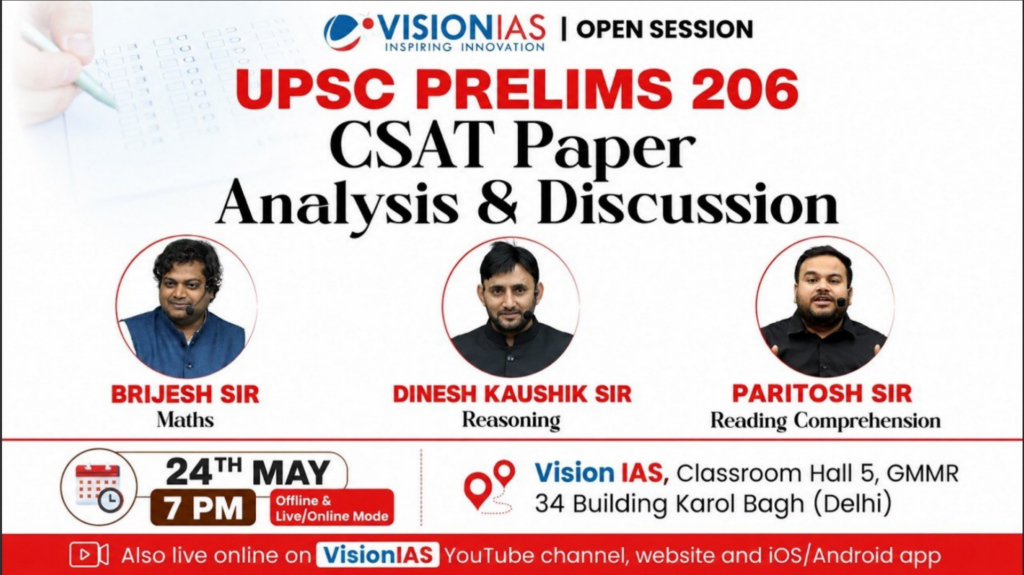
Watch Detailed Analysis of CSAT 2026 by VisionIAS Faculty
Detailed Analysis GS 1
Read, Detailed Analysis of UPSC Paper 1, GS Prelims 2026
Detailed Analysis GS 2 (CSAT)
Read, Detailed Analysis of UPSC Paper 2, CSAT 2026
Previous year UPSC question paper PDF can be accessed on the official UPSC website.
This structured classification will help aspirants pinpoint areas emphasized in 2026 and guide them on where to focus more in the future.
UPSC CSE Prelims 2026: Key Details at a Glance
| UPSC CSE 2026 | Details |
| UPSC CSE Prelims Exam Date | 24 May 2026 |
| Result Announcement | Available soon |
| Total Candidates Appeared | To be updated |
| Total Vacancies | 933 |
| Where to check Prelims result | To be updated |
| No. of Candidates Qualified Prelims 2026 | To be updated post result |
Download UPSC CSE Prelims 2026 Question Paper PDF with Solutions & Explanations – To be Updated
Glimpse of UPSC Prelims Previous Year 2025 Subject-Wise Breakup – GS Paper I
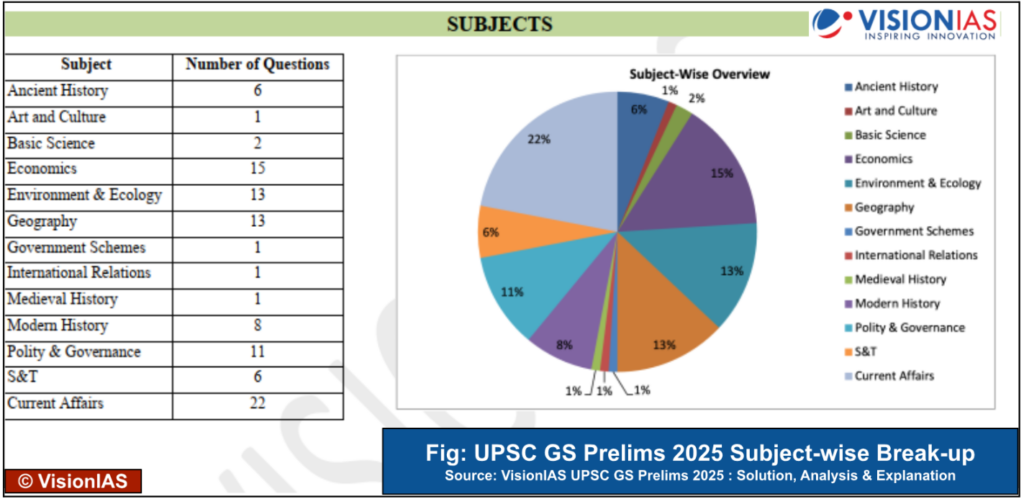
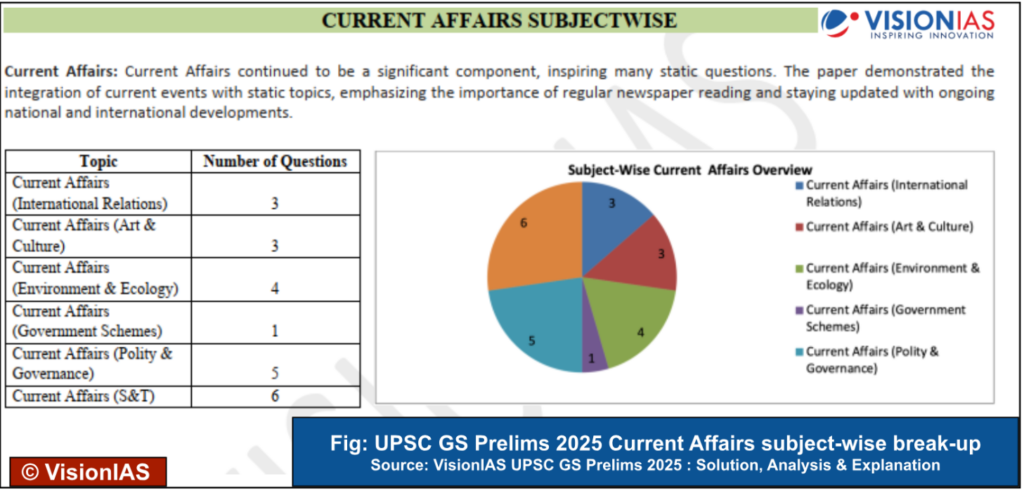
Download UPSC CSE Prelims 2025 GS Question Paper PDF with Answer Key
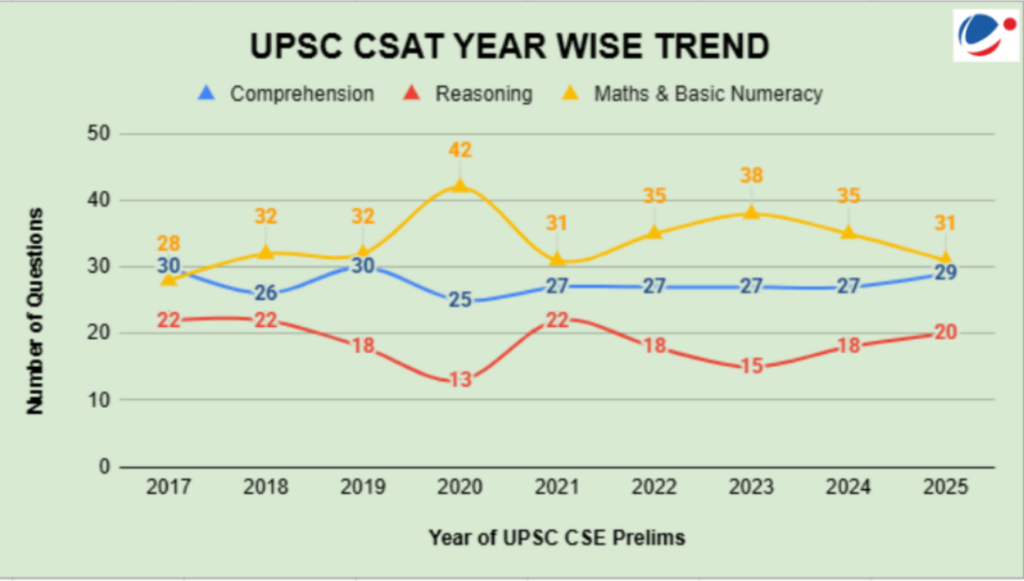
Glimpse of UPSC Prelims Previous Year 2025 CSAT (Paper II) Section-Wise Analysis
| Section (UPSC CSAT) | No. of Questions |
| Reading Comprehension | 29 |
| Logical Reasoning & Analytical Ability | 20 |
| Maths & Basic Numeracy | 31 |
Download UPSC CSE Prelims 2025 CSAT Question Paper PDF with Answer Key
UPSC Prelims consistently emphasizes deep conceptual clarity over superficial knowledge. A continued trend is the integration of multiple topics in a single question, making interdisciplinary preparation more crucial.
Areas such as environmental policy, international relations, and Indian polity saw increased focus on application-based understanding. Future aspirants should prepare for thought-provoking, decision-oriented questions that assess clarity and maturity, rather than rote memory.
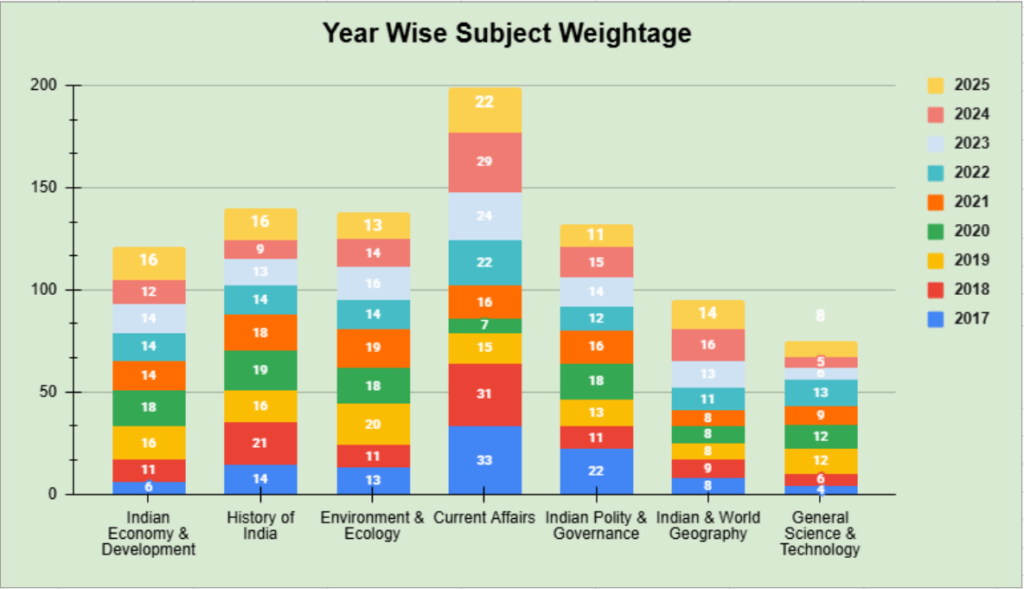
UPSC CSE Prelims GS and CSAT Previous Year Trend (2017-2025)
UPSC GS Prelims Year-Wise Subject Weightage
UPSC CSAT Year Wise Trend
Difficulty Level: GS vs CSAT
- GS Paper I: Generally moderate, with a balanced mix of static and current affairs. It demands both breadth and depth in preparation.
- CSAT: Increasingly becoming a challenge due to time-consuming reading comprehension and complex logical reasoning.
The rising difficulty of CSAT reinforces that it should not be treated as a mere qualifying paper—it demands consistent practice and targeted preparation.
Current Affairs + Conceptual Clarity: A Winning Formula
Current affairs continue to hold importance—but not in a direct or factual form. Recent papers reflect a deeper integration of current topics with core concepts, especially in Polity, Economy, and Science & Tech.
For example, questions related to new bills or international events required knowledge of constitutional provisions or global institutions. This highlights the need for a blended approach to studying current affairs and foundational concepts.
Tools like the Daily Smart Quiz, monthly magazines, PT365, and Mains365 help sharpen both recall and analytical application.
Advice for UPSC 2027 Aspirants
- Focus on conceptual clarity rather than rote learning. Build a strong base with NCERTs and standard texts.
- Practice elimination techniques and analytical reasoning using PYQs and mocks.
- Strengthen CSAT with regular drills in comprehension, reasoning, and basic math.
- Combine monthly current affairs with static subjects through a topic-based approach.
- Use PYQs to decode exam patterns and develop mental discipline under test conditions.
UPSC CSE Prelims 2026 – FAQ
Q1: What is the UPSC CSE Prelims 2026?
The UPSC CSE Prelims 2026 is the first screening stage of the Civil Services Examination, conducted by the Union Public Service Commission on 24th May 2026. The UPSC CSE Prelims consists of two objective-type papers — General Studies (GS Paper 1) and the Civil Services Aptitude Test (CSAT) — and serves as the gateway to UPSC Mains 2026.
Q2: Where can I download the UPSC CSE Prelims 2026 Question Paper PDF?
The UPSC CSE Prelims 2026 Question Paper PDF for both GS Paper 1 and CSAT Paper 2 is available for download on the VisionIAS website. The UPSC Prelims 2026 question paper pdf includes subject-wise analysis, answer keys, and detailed solutions. Download the complete UPSC 2026 Prelims paper here: https://visionias.in/blog/upsc-news/upsc-prelims-2026-question-paper-gs-csat-download-with-answer-key-subject-wise-analysis
Q3: What is the overall difficulty level of the UPSC CSE Prelims 2026 Paper?
Based on initial candidate reactions, the UPSC CSE Prelims 2026 paper was moderate to difficult. A full difficulty analysis of the UPSC 2026 Prelims paper is available on the VisionIAS blog.
Q4: What is the expected cut-off for UPSC Prelims 2026?
The expected cut-off for UPSC CSE Prelims 2026 will be estimated based on paper difficulty, candidate feedback, and past trends. UPSC 2026 cut-off figures will be compiled after VisionIAS conducts its Expected Cut-Off Survey from 26th May 2026. Check category-wise estimates here: https://visionias.in/blog/upsc-news/upsc-prelims-2026-expected-cut-off-and-past-years-official-cut-offs
Q5: Is the UPSC CSE Prelims 2026 Answer Key available?
Yes. The UPSC CSE Prelims 2026 provisional answer key for both GS and CSAT is available on the VisionIAS website. Notably, for the first time, UPSC itself will release a provisional answer key for UPSC 2026 shortly after the exam. Access the key here: https://visionias.in/blog/upsc-news/upsc-prelims-2026-provisional-answer-key-calculate-gs-csat-marks
Q6: How do I calculate my score using the UPSC CSE Prelims 2026 Answer Key?
To calculate your score from the UPSC CSE Prelims 2026 question paper, award +2 marks for every correct answer and deduct 0.66 marks for every wrong answer in GS Paper 1. The same scheme applies to CSAT. Download the UPSC CSE Prelims 2026 question paper pdf, compare your responses with the answer key, and estimate your UPSC 2026 score before the official result.
Q7: Where can I find a subject-wise analysis of the UPSC 2026 Prelims Paper?
A detailed subject-wise analysis of the UPSC 2026 Prelims paper — covering History, Polity, Economy, Environment, Science & Tech, and Current Affairs — is available on the VisionIAS blog. The analysis includes topic-wise breakup, difficulty level, static vs dynamic split, and shift in question patterns in the UPSC CSE Prelims 2026 paper compared to previous years. Read: https://visionias.in/blog/prelims-pyqs/upsc-prelims-2026-detailed-analysis-of-gs1-with-answer-key
Q8: What is the difference between the UPSC CSE Prelims 2026 Provisional Key and the Official Answer Key?
The UPSC CSE Prelims 2026 provisional answer key is released shortly after the exam and is open for candidate objections. The official UPSC 2026 answer key is published after reviewing all challenges and is final. VisionIAS releases its own expert-verified key for the UPSC 2026 Prelims paper immediately after the exam so aspirants can get an early, reliable score estimate.
Q9: How many vacancies are there for UPSC CSE 2026, and who qualifies through Prelims?
A total of 933 vacancies have been notified for UPSC CSE 2026 across services including IAS, IPS, IFS, and other Group A and B Central Services. Candidates who clear the UPSC CSE Prelims 2026 cut-off proceed to the Mains stage. Only GS Paper 1 marks are counted for the merit list — CSAT is qualifying with a minimum of 33%.
Q10: What should I do after checking the UPSC CSE Prelims 2026 Answer Key?
If your estimated score from the UPSC CSE Prelims 2026 answer key is near or above the expected cut-off for Prelims 2026, start Mains preparation immediately — don’t wait for the official result. Enroll in VisionIAS programmes like Mains Edge 45, Mentorship Programme, Mains Test Series, Essay Classes, and Ethics Case Studies Classes. Starting early gives you a decisive edge if you clear UPSC 2026.