Current Affairs
Sarojini Naidu: Nightingale of India & Freedom Fighter
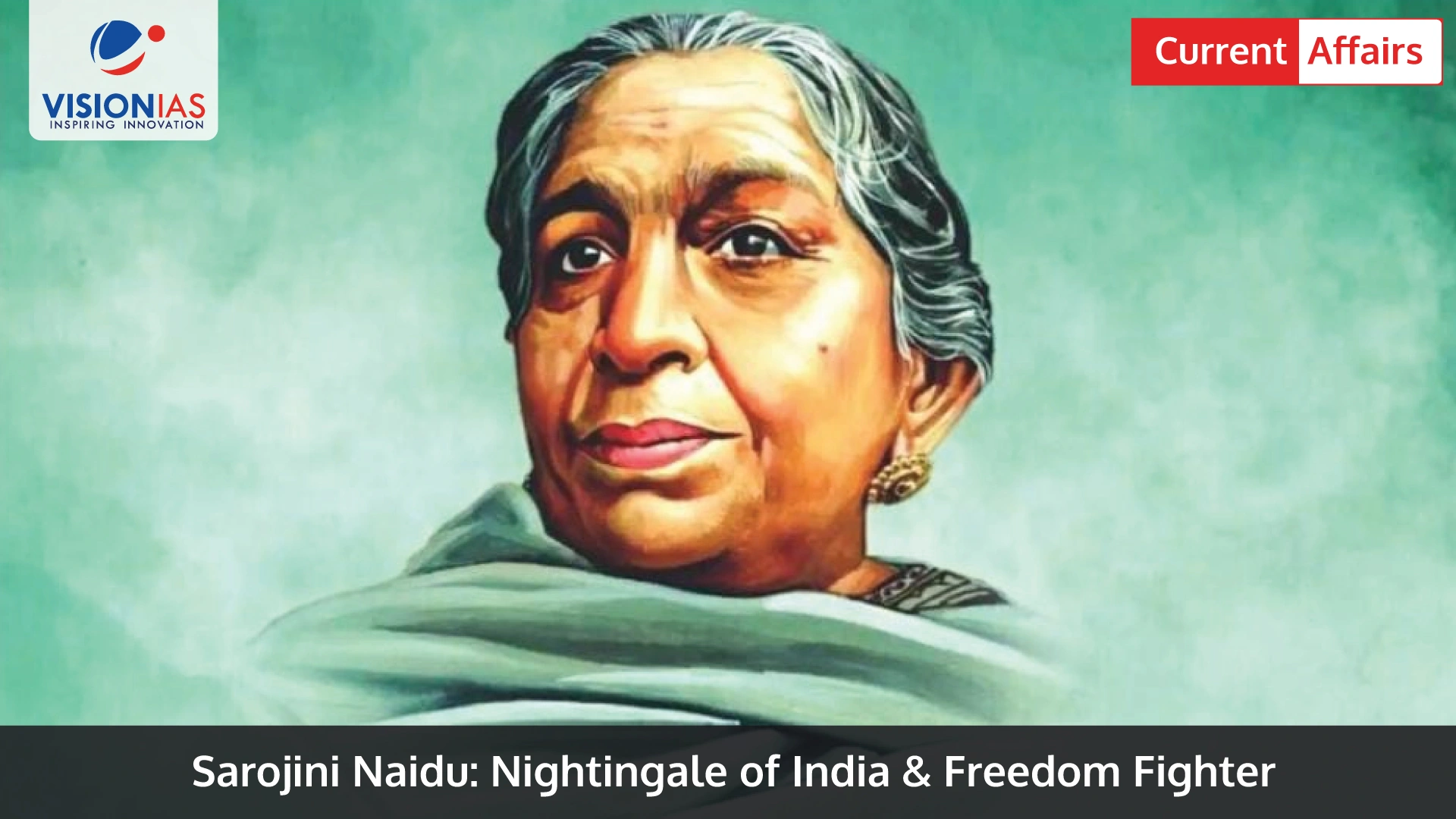
















India celebrates National Women’s Day on February 13, 2026 in honour of Sarojini Naidu on her 147th birth anniversary.
Born on February 13, 1879, in Hyderabad, Sarojini Naidu grew up to become one of the most celebrated women leaders of the 20th century. This year marks the 147th birth anniversary of Sarojini Naidu. On February 13, India celebrates National Women’s Day in her honour, a fitting tribute to a woman whose poetry, politics, and sheer courage reshaped the nation. Known as the “Nightingale of India” (Bharat Kokila), she remains the symbol of India’s freedom movement, women’s rights, and the enduring power of cultural expression as a tool of national aspiration.
Freedom Fighter: Role in the Indian National Movement
Political Awakening and Mentorship
The Partition of Bengal in 1905 catalysed Sarojini Naidu’s formal entry into the independence struggle. Between 1903 and 1917, she came into close contact with Gopal Krishna Gokhale, Rabindranath Tagore, Muhammad Ali Jinnah, and Annie Besant, before becoming one of Mahatma Gandhi’s most trusted lieutenants. Sarojini Naidu was a staunch advocate for Hindu-Muslim unity, a commitment rooted in her secular, pluralist upbringing in multicultural Hyderabad.
In 1916, she authored a biography of Muhammad Ali Jinnah titled Muhammad Ali Jinnah: An Ambassador of Unity, praising his role in the Lucknow Pact as a landmark moment of communal cooperation.
Salt Satyagraha and Dharasana Raid
As a disciple of Mahatma Gandhi, Sarojini Naidu joined the Non-Cooperation Movement and protested against the Rowlatt Act (1919). Her most defining act of courage came during the Salt Satyagraha of 1930. Following Mahatma Gandhi’s arrest on May 5, 1930, Sarojini Naidu assumed command of the Dharasana Salt Works raid, leading 2,500 volunteers in the face of brutal British repression, with unflinching non-violence.
Her leadership at Dharasana drew international attention particularly through the reporting of journalist Webb Miller and became a defining symbol of the Indian national movement on the world stage. She was subsequently arrested and imprisoned for six months. During the Quit India Movement of 1942, she spent 21 months in jail alongside Mahatma Gandhi at the Aga Khan Palace.
Champion of Women’s Rights: The Living Bridge
Sarojini Naidu’s advocacy for Indian women formed the bedrock of her political identity. She argued that true independence would be meaningless without the concomitant freedom and empowerment of Indian women.
Key milestones in her women’s rights advocacy:
- 1917- Women’s Indian Association (WIA): Co-founded with Annie Besant and Muthulakshmi Reddy, giving women a formal platform to organise and demand their rights.
- 1917- Franchise Delegation: Led a 14-woman delegation to meet Secretary of State Edwin Montagu and Viceroy Lord Chelmsford to demand women’s right to vote.
- 1929- Sarda Act: Mobilised public support for legislation to restrain child marriage and combat the dowry system.
- 1930-AIWC Presidency: Served as the fourth president of the All India Women’s Conference, campaigning against child marriage, dowry, and the purdah system.
International Advocacy and Women’s Rights
Sarojini Naidu’s commitment to women’s rights extended beyond India’s borders through her participation in international forums and her strategic advocacy for legislative reform. She played a key role in drafting the Memorandum of Understanding on women’s franchise, which demanded equal voting rights for women without property or educational qualifications, challenging the limited franchise proposed by the British.
At the Round Table Conference in London (1931), she presented conjoint memoranda alongside other Indian leaders, arguing for constitutional safeguards for women’s political representation and equal citizenship rights. She was one of the few Indian women to address the East Africa Indian Congress in 1924, where she spoke on racial equality and colonial injustice.
As a delegate to the All-Asian Women’s Conference in Lahore (1931), she championed women’s education and economic independence across Asia. Her participation in the Congress of the International Alliance for Women demonstrated her belief that women’s liberation was essential to national freedom and social progress, linking the struggles for gender equality, anti-colonialism, and democratic reform on a global stage.
Political Milestones: First Woman at the Helm
In 1925, Sarojini Naidu was elected President of the Indian National Congress at the Kanpur session, the first Indian woman to hold this position. In the same year as India’s independence, she was appointed Governor of the United Provinces (now Uttar Pradesh) on August 15, 1947, making her the first woman to be appointed as an Indian state governor. She also served as a member of the Constituent Assembly, contributing to the drafting of the Constitution of India emphasising the importance of a national flag as a symbol of unity and dignity.
Literary Legacy
Sarojini Naidu earned the title “Nightingale of India” for her lyrical verse and melodious poetry that sang of India’s beauty, sorrow, and aspirations. Her collections remain touchstones of Indo-Anglian literature, capturing the vibrancy of Indian life while offering subtle social critique of colonialism, gender inequality, and social injustice.
Her four major collections are:
- The Golden Threshold (1905): Her debut poetry collection, which established her as the first Indian woman poet writing in English. The collection featured poems about Indian life, nature, love, and death. The ‘Folk Songs’ section captured the spirit and social fabric of Indian life, bringing its rhythms and traditional themes to English readers.
- The Bird of Time (1912): This collection explored themes of life, death, and the seasons, while also featuring patriotic verses that reflected her involvement in India’s independence movement.
- The Broken Wing (1917): The volume offered meditations on love, destiny, and sacrifice, with poems responding to the tragedy of the First World War.
- The Feather of the Dawn (1961): This posthumous collection was compiled by her daughter Padmaja Naidu and served as a tribute to the poet’s voice and vision.
Poems like “Indian Weavers” and “Bangle Sellers” used the rhythms of everyday Indian life to explore birth, marriage, and death. Her poem “The Lotus”, dedicated to Mahatma Gandhi, used the flower’s purity amid mud as a metaphor for Mahatma Gandhi’s resilience. This demonstrated how Sarojini Naidu blurred the boundaries between lyric poetry and political rhetoric, making literature itself a form of activism.
In “The Pardah Nashin”, she offered a moving and subtle satire on the constraints imposed on women behind the veil. And in “The Gift of India”, she questioned the heavy sacrifice Indian soldiers made in the First World War for a cause that was not their own.
Conclusion
The 147th birth anniversary of Sarojini Naidu celebrates her place at the heart of India’s national memory moving from a figure of the history books to a living inspiration for gender equality and values-based public service.
Sarojini Naidu’s life as poet, freedom fighter, and the first female governor of an Indian state exemplifies how one is defined not just by power, but by heart, resilience, and the courage to fight for justice.

Master Digital Age Governance & Technology Trends with VisionIAS Comprehensive Current Affairs →
Sarojini Naidu FAQs
1. When was Sarojini Naidu born?
Ans. February 13, 1879.
2. Why is Sarojini Naidu called the Nightingale of India?
Ans. For her poetry and lyrical contributions to Indo-Anglian literature.
3. What is National Women’s Day in India?
Ans. February 13, celebrated in honor of Sarojini Naidu’s birth anniversary.
4. What was Sarojini Naidu’s first poetry collection?
Ans. The Golden Threshold (1905).
5. When did Sarojini Naidu become Congress President?
Ans. 1925 at Kanpur session.