Current Affairs
National Vaccination Day: India’s Significant Health Frontier
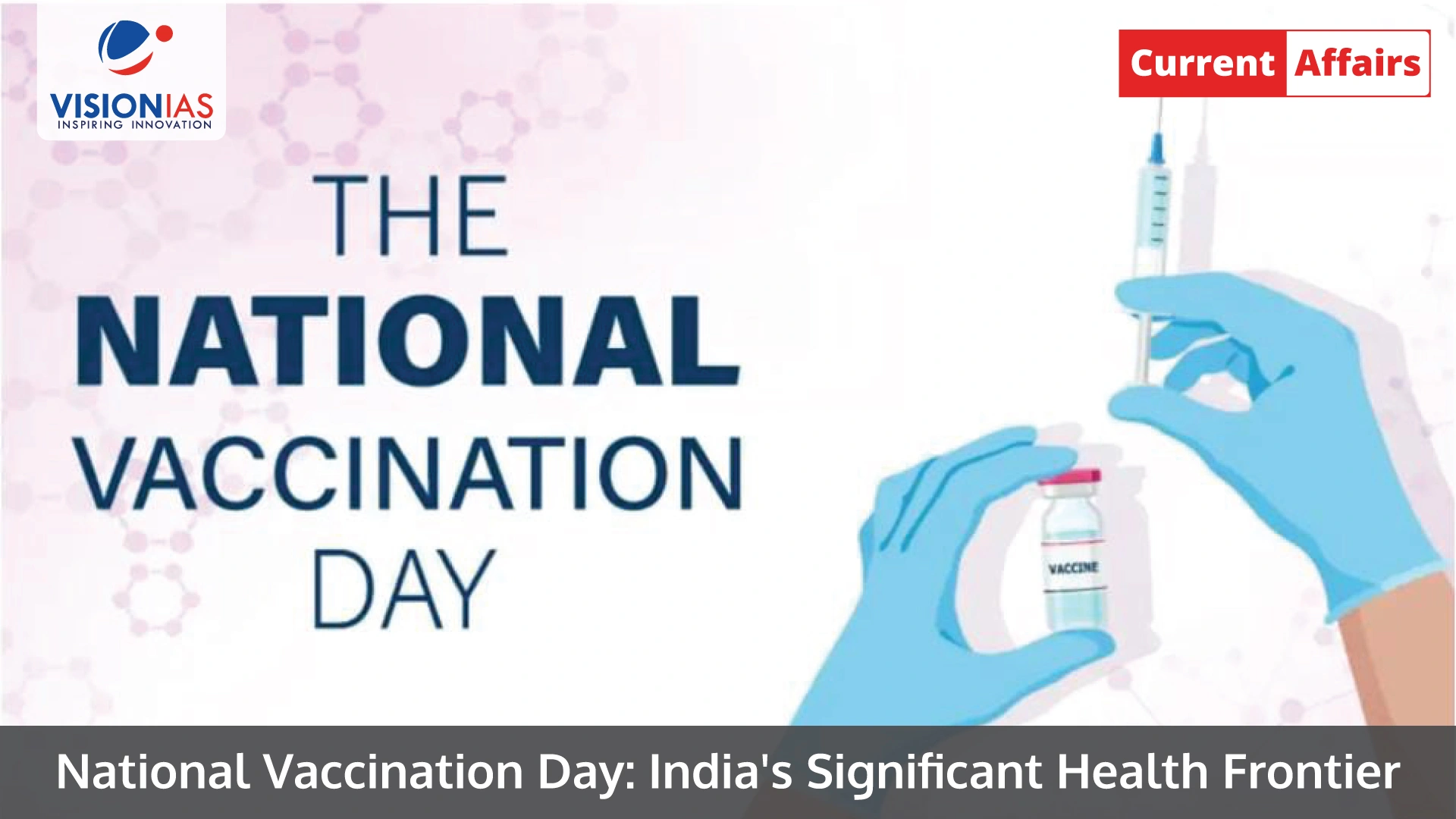







National vaccination day, observed every year on March 16, has taken on renewed significance in 2026.
National Vaccination Day, also known as National Immunisation Day, is observed on March 16 every year in India. The date commemorates the first oral polio vaccine dose administered under the Pulse Polio Immunisation Programme on March 16, 1995, a turning point that eventually led to India being declared polio-free in 2014.
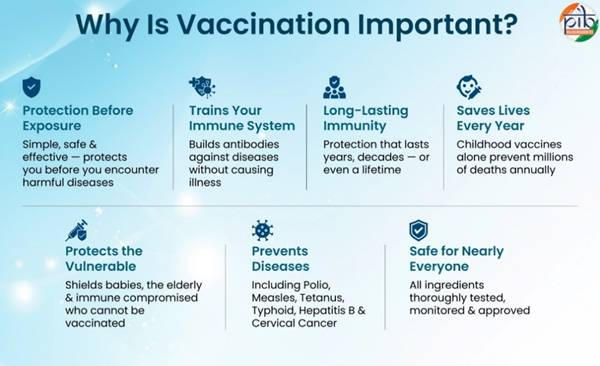
The day serves as a reminder that vaccines remain one of the most powerful and cost-effective tools in preventive healthcare. The day highlights that the full immunisation coverage has risen from 62% in 2015 to 98.4% as of January 2026.
What Is the Universal Immunisation Programme?
The Universal Immunisation Programme (UIP), launched in 1985 and implemented by the Ministry of Health and Family Welfare, provides free vaccines to children and pregnant women against 12 diseases. It reaches approximately 2.9 crore pregnant women and 2.54 crore newborns every year.
The objectives of the UIP are to increase immunisation coverage, improve quality of services, maintain a reliable cold chain system, monitor performance, and achieve self-sufficiency in vaccine production.
Vaccines Covered Under the UIP
The vaccines provided under the India immunisation programme protect against the following diseases:
- Tuberculosis (severe childhood form)
- Diphtheria
- Pertussis (Whooping Cough)
- Tetanus
- Polio
- Measles
- Rubella
- Hepatitis B
- Meningitis & Pneumonia (Hib)
- Rotavirus Diarrhoea
- Pneumococcal Pneumonia
- Japanese Encephalitis
These vaccines form the backbone of child and maternal health in India. In a bid to strengthen this ecosystem, in 2026, the India immunisation programme took its most significant step yet by extending its reach beyond infectious diseases to cancer prevention.
2026 HPV Vaccination Campaign
Burden of Cervical Cancer in India
Cervical cancer is the second most common cancer among Indian women. India accounts for nearly 25% of global cervical cancer deaths, with over 1.2 lakh new cases and approximately 80,000 deaths every year. A new case is diagnosed every four minutes.
Human Papillomavirus (HPV) is the primary cause of cervical cancer. Vaccination before exposure to the virus is the most effective preventive measure available.
Campaign Details
The nationwide HPV vaccination India campaign was launched on February 28, 2026, from Ajmer, Rajasthan, by the Prime Minister of India. It targets approximately 1.15 crore girls aged 14 years across all 36 States and Union Territories.
The Gardasil-4 vaccine, a quadrivalent vaccine protecting against HPV types 16, 18 (high-risk cancer-causing) and 6, 11 (which cause genital warts), is being administered under a single-dose schedule. Based on WHO recommendations, a single dose provides long-lasting protection against high-risk HPV strains, simplifying logistics and widening reach.
HPV vaccination is voluntary, and parental consent is mandatory before every dose. Each vaccination site is linked to 24×7 Adverse Events Following Immunisation (AEFI) Management Centres for medical oversight.
Infrastructure Behind India’s Immunisation Programme
Cold Chain Network
Vaccines must be stored within a precise temperature range from manufacture to administration. India’s cold chain is one of the largest in the world, spanning nearly 30,000 cold chain points from national depots down to Primary Health Centres. These are equipped with over 1.06 lakh ice-lined refrigerators and deep freezers, and 432 walk-in coolers and freezers.
To manage this infrastructure, the Ministry of Health and Family Welfare uses the Electronic Vaccine Intelligence Network (eVIN), which tracks vaccine stocks and storage temperatures in real time across the country.
Community Health Workers
Frontline workers, including ASHAs (Accredited Social Health Activists), Anganwadi Workers, and link workers, play a central role in reaching every child and pregnant woman, including those in urban slums, remote villages, and underserved communities.
Digital Platforms
U-Win, launched in October 2024, is a digital platform available in 12 languages. It helps people locate vaccination centres, manage appointments, and maintain vaccination records. One user can register up to 10 people under a single mobile number.
CoWIN, the platform used during COVID-19, tracked over 220 crore doses and laid the foundation for India’s current digital immunisation management system.
Mission Indradhanush: Reaching the Unreached
Despite the reach of the UIP, many children remained unvaccinated or partially vaccinated. Mission Indradhanush was launched in 2015 to address this gap through targeted campaigns. It has since completed 12 phases across 765 districts, vaccinating 5.46 crore infants and 1.32 crore pregnant women.
The mission uses interministerial coordination and door-to-door surveys to identify children who have been missed by routine immunisation. It specifically targets hard-to-reach populations in urban slums, brick kilns, construction sites, and remote settlements.
Why Vaccination Matters Beyond Health
Vaccines save lives, but their impact extends further. Preventing disease reduces the financial burden on families who would otherwise face costs of surgery, hospitalisation, or long-term treatment. The HPV vaccination India initiative, for instance, prevents cancer that requires expensive surgery, radiation, and chemotherapy.
A healthy child becomes a healthy adult. A healthy population contributes more to the workforce and to the country’s social and economic progress. The percentage of zero-dose children has been halved in just one year, from 0.11% in 2023 to 0.06% in 2024, a measurable sign of what a sustained India immunisation programme can achieve.
Conclusion
On this national vaccination day, India is at an important moment in its public health journey. The launch of the HPV vaccination drive, the continued strengthening of the Indian immunisation programme, and the availability of the Gardasil-4 vaccine at government health facilities across every State and UT reflect a commitment to preventive healthcare.
Whether it is adults protecting themselves through influenza, shingles, or Hepatitis B vaccines, or adolescent girls receiving the HPV vaccine to prevent cervical cancer, vaccination at every stage of life is an investment in a healthier future.
As we mark national vaccination day 2026, the message is clear: vaccines save lives, and it is never too early or too late to be protected.
Master Digital Age Governance & Technology Trends with VisionIAS Comprehensive Current Affairs →
National Vaccination Day
1. When is National Vaccination Day observed in India?
Ans. March 16 every year.
2. Why is National Vaccination Day celebrated on March 16?
Ans. It commemorates the first oral polio vaccine dose administered under the Pulse Polio Immunisation Programme on March 16, 1995.
3. What is India’s Universal Immunisation Programme?
Ans. A free government initiative providing vaccines against 12 life-threatening diseases.
4. What is the primary cause of cervical cancer?
Ans. Human Papillomavirus (HPV).
5. What is India’s broader strategy against cervical cancer beyond vaccination?
Ans. It combines HPV vaccination with screening programmes, early diagnosis, and treatment support through the public health system.