Recent UPSC Prelims patterns reveal a significant shift in how economic questions are framed. The examination now demands analytical understanding of fiscal mechanisms, monetary instruments, and contemporary financial innovations rather than mere factual recall. Aspirants relying solely on basic textbooks and daily news sources find themselves inadequately prepared for the nuanced nature of modern economic questions.
VisionIAS's PT365 Economy addresses this preparation challenge through a specialized framework that combines theoretical foundations with current developments, helping aspirants develop the comprehensive understanding that UPSC Prelims demands.
Thematic Clustering for Interconnected Understanding
PT365 Economy employs an innovative thematic clustering methodology that sets it apart from traditional preparation materials. Instead of presenting isolated facts, the document organizes related topics under unified themes, creating meaningful conceptual connections.
Government initiatives addressing workforce development are examined collectively, revealing underlying policy philosophy and implementation strategies across different sectors. The Reserve Bank of India's multifaceted operations spanning regulatory functions, monetary management, and financial stability measures are presented as an integrated system rather than disconnected components.
Economic terminology often creates confusion when similar concepts overlap. PT365 Economy eliminates this ambiguity through methodical comparison of related terms and frameworks.
The distinctions between Foreign Direct Investment and Foreign Portfolio Investment are clarified through detailed analysis of their characteristics, regulatory requirements, and economic consequences. Banking concepts like Nostro and Vostro accounts, which regularly feature in financial sector questions, receive side-by-side treatment that ensures clarity. This systematic differentiation builds the conceptual precision required for evaluating complex statement-based questions.
Specialized Coverage of Niche Yet Examination-Relevant Topics
A distinctive strength of PT365 Economy lies in its attention to specialized financial concepts that mainstream resources typically ignore but UPSC frequently incorporates. The document provides detailed explanations of technical terms and mechanisms that aspirants rarely encounter through conventional study methods.
Advanced financial concepts including switch auctions, transition bonds, safe harbour provisions, and financial fraud risk assessment frameworks are demystified with contextual examples and practical applications. These niche areas, despite limited media coverage, have consistently appeared in recent UPSC examinations.
Balanced Fusion of Foundational and Contemporary Knowledge
Maintaining equilibrium between permanent economic principles and evolving developments presents a constant challenge in preparation. PT365 Economy achieves this balance through careful content curation that avoids information excess.
Fundamental concepts such as deficit measurement methodologies, taxation frameworks, and monetary transmission channels receive clear explanation. These core principles are then linked to recent policy developments—latest RBI decisions, GST amendments, or evolving Free Trade Agreement negotiations.
This synthesis enables aspirants to tackle both theoretical questions and current affairs-based queries with equal proficiency. The document maintains strict examination focus, incorporating only information that directly enhances UPSC performance rather than burdening aspirants with peripheral details.
Graphical Presentation for Enhanced Comprehension
PT365 Economy recognizes that complex economic data becomes significantly more accessible through structured visual formats. The document strategically employs charts and organized tables to present critical information systematically.
These visual frameworks function as effective revision aids, allowing aspirants to review extensive information efficiently during the crucial pre-examination period. The format particularly assists in answering questions requiring comparative analysis of multiple economic policies or instruments.
How PT365 Economy Anticipated Recent UPSC Questions
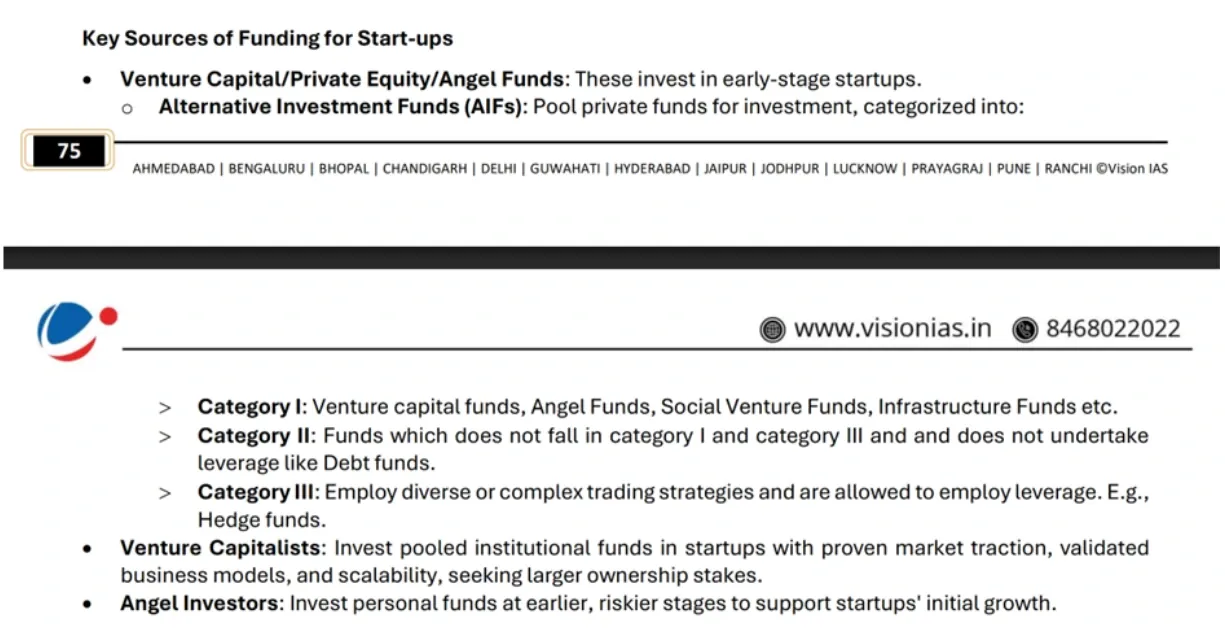
PT365 Economy offered extensive analysis of Alternative Investment Funds, detailing regulatory frameworks and explicitly categorizing various investment instruments under this classification. This thorough preparation enabled aspirants to accurately answer the Prelims 2025 question:
Q. With reference to investments, consider the following: (UPSC 2025)
I. Bonds
II. Hedge Funds
III. Stocks
IV. Venture Capital
How many of the above are treated as Alternative Investment Funds?
(a) Only one
(b) Only two
(c) Only three
(d) All the four
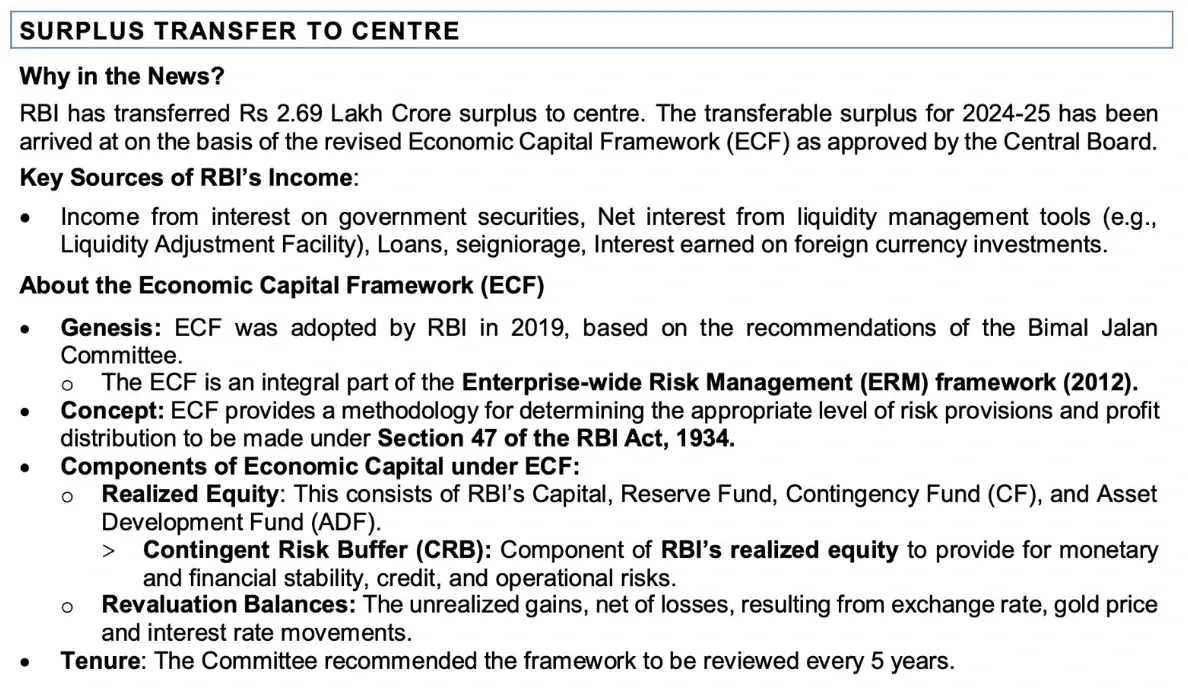
The document's comprehensive examination of RBI's revenue generation mechanisms covered all significant income channels including government securities operations, foreign currency transactions, and currency management activities. This directly equipped aspirants for the Prelims 2025 question:
Q. Which of the following are the sources of income for the Reserve Bank of India? (UPSC 2025)
I. Buying and selling Government bonds
II. Buying and selling foreign currency
III. Pension fund management
IV. Lending to private companies
V. Printing and distributing currency notes
Select the correct answer using the code given below:
(a) I and II only
(b) II, III and IV
(c) I, III, IV and V
(d) I, II and V
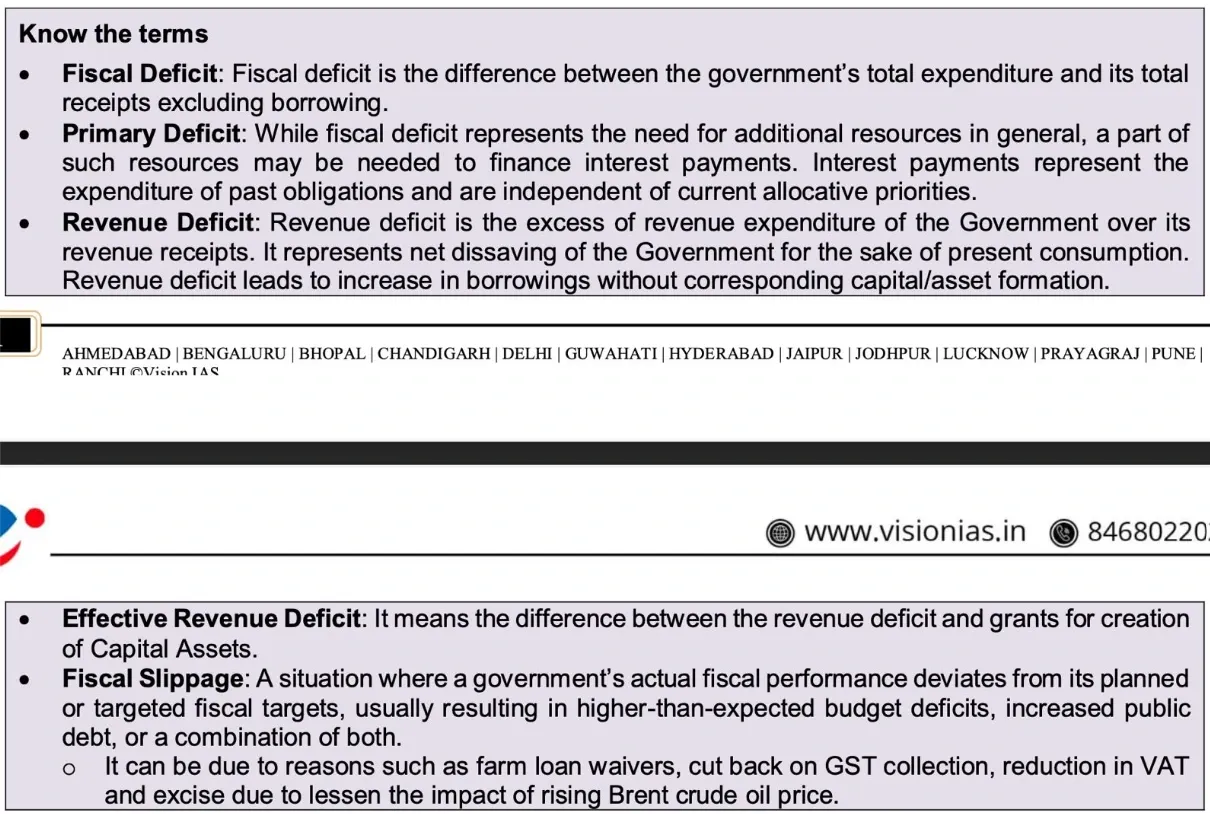
PT365 Economy's treatment of budgetary indicators featured comprehensive explanations with worked examples for revenue deficit, fiscal deficit, and primary deficit calculations. This preparation proved essential for the computation-based Prelims 2025 question:
Q. Suppose the revenue expenditure is Rs.80,000 crores and the revenue receipts of the Government are Rs.60,000 crores. The Government budget also shows borrowings of Rs.10,000 crores and interest payments of Rs.6,000 crores. Which of the following statements are correct? (UPSC 2025)
I. Revenue deficit is Rs.20,000 crores.
II. Fiscal deficit is Rs.10,000 crores.
III. Primary deficit is Rs.4,000 crores.
Select the correct answer using the code given below.
(a) I and II only
(b) II and III only
(c) I and III only
(d) I, II and III
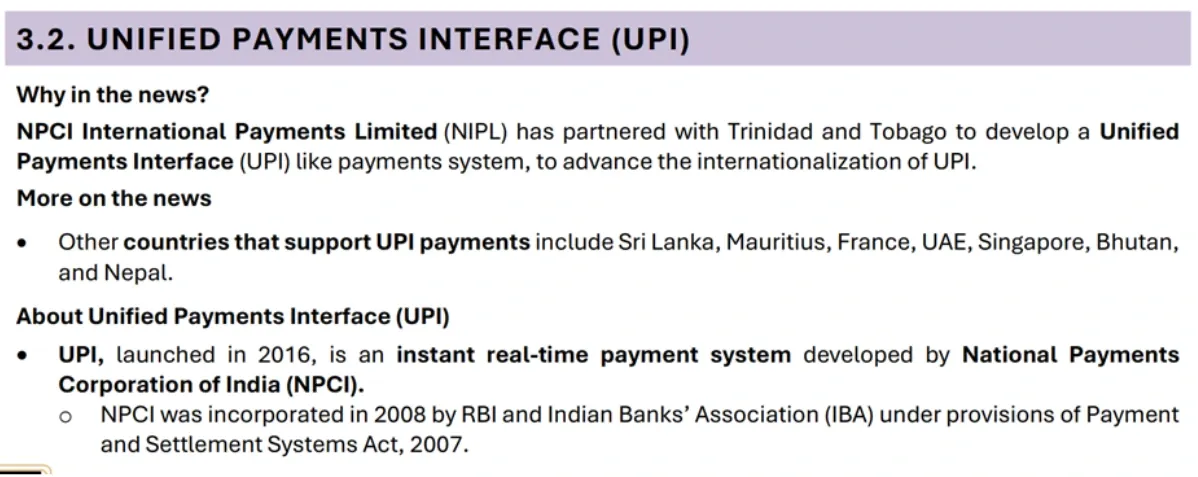
The document's dedicated section on digital payment infrastructure included thorough coverage of UPI's global expansion, specifically identifying nations where merchant payment acceptance was operational. This preparation directly addressed the Prelims 2025 question:
Q. Consider the following countries: (UPSC 2025)
I. United Arab Emirates
II. France
III. Germany
IV. Singapore
V. Bangladesh
How many countries amongst the above are there other than India where international merchant payments are accepted under UPI? (UPSC 2025)
(a) Only two
(b) Only three
(c) Only four
(d) All the five
These consistent predictions demonstrate PT365 Economy's methodical approach to identifying examination-oriented content and delivering it with the precision and depth that UPSC requires.
Building a Complete UPSC Preparation Strategy with PT365
While PT365 Economy delivers prelims-specific content, VisionIAS advocates combining it with additional preparation resources for comprehensive success.
The VisionIAS Digital Current Affairs offers a comprehensive suite of resources that enable aspirants to seamlessly blend static knowledge with dynamic current affairs, providing a significant advantage in tackling the evolving nature of UPSC questions. The platform's resources are meticulously organized by themes, aligning with the UPSC syllabus. This structure allows aspirants to quickly locate relevant information when crafting answers to specific questions.
Know More About VisionIAS Digital Current Affairs
Conclusion
UPSC Prelims consistently proves that economic preparation demands more than superficial newspaper browsing or standard reference books. The examination evaluates sophisticated understanding of policy instruments, capacity to differentiate between comparable concepts, and familiarity with both established frameworks and emerging trends.
VisionIAS's PT365 Economy fulfills these diverse requirements through its distinctive combination of exhaustive coverage, methodical comparisons, visual learning tools, and examination-centered methodology. The document's proven record of anticipating UPSC questions validates its position as an indispensable preparation resource.
Click here to Download PT365 Economy