Human Rights Day is observed worldwide on 10 December to mark the anniversary of the Universal Declaration of Human Rights (UDHR).
Every year on December 10, the world observes Human Rights Day, marking the anniversary of the Universal Declaration of Human Rights (UDHR). Adopted by the United Nations General Assembly in 1948, this document established fundamental rights that belong to every individual, regardless of race, religion, nationality, or status. As we commemorate this milestone in 2025, the theme "Our Everyday Essentials" invites us to rediscover how human rights shape our daily existence.
Legacy of the Universal Declaration of Human Rights
The Universal Declaration of Human Rights stands as a common standard of achievement for all peoples and nations. Proclaimed in Paris on December 10, 1948, it was the first document to articulate fundamental human rights deserving universal protection. The UDHR emerged from the aftermath of World War II, representing humanity's determination to prevent such atrocities from recurring.
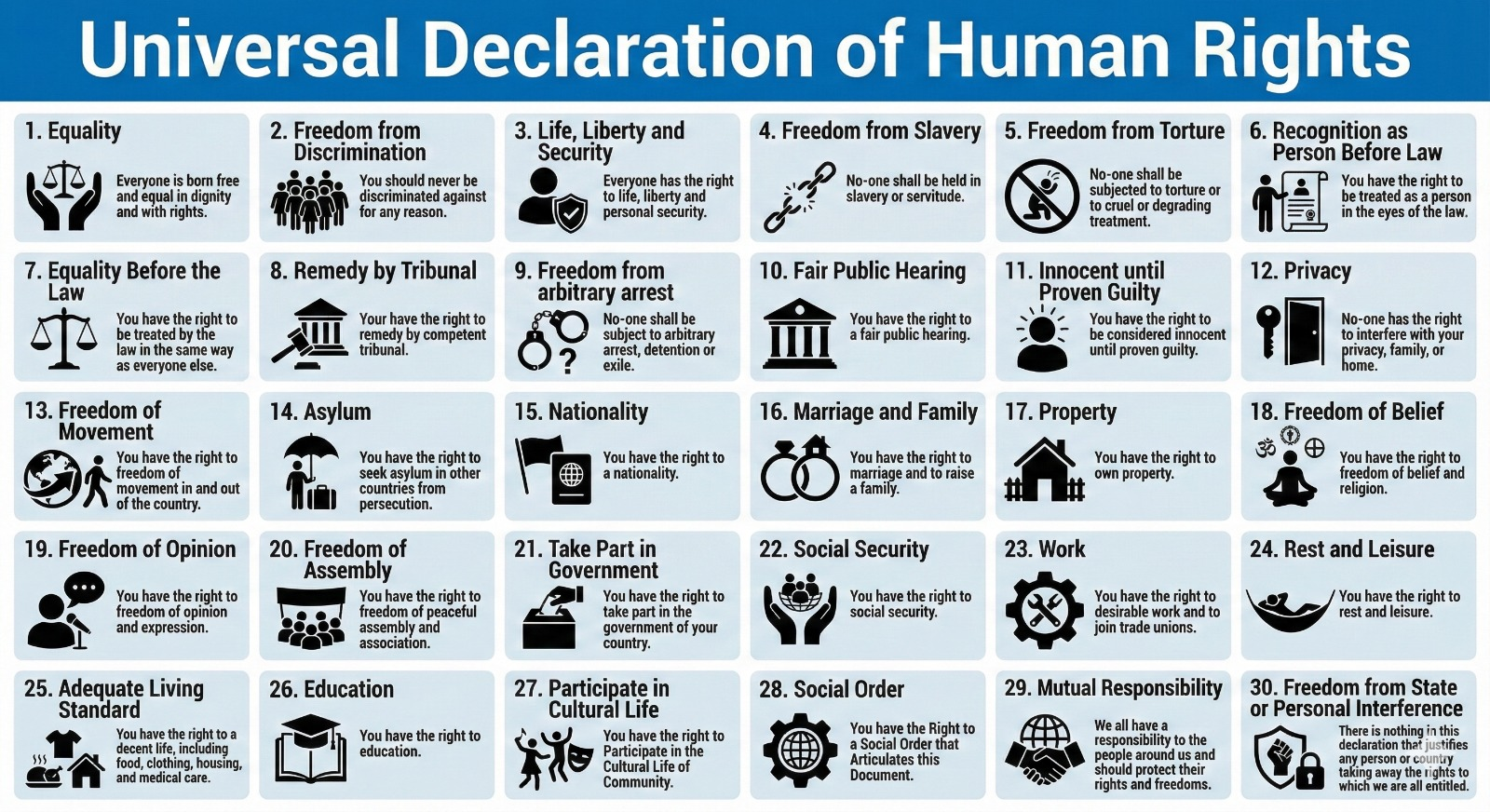
Seventy-seven years later, the principles enshrined in UDHR articles continue to guide international, national, and local laws and policies. The Declaration guarantees rights to every individual everywhere, from the right to life, liberty, and security to freedom of thought, conscience, and expression. These are not just legal concepts but lived realities that touch every aspect of our existence.
2025 Theme: Human Rights as Our Everyday Essentials
In a period marked by turbulence and unpredictability, the UN Human Rights Council highlighted the 2025 theme “Human Rights: Our Everyday Essentials”. This theme reaffirms the values of human rights and shows that they remain a winning proposition for humanity.
The campaign emphasizes three dimensions:
Human Rights Are Positive
Rights are not only protections against harm. Human rights also generate joy, happiness, and safety in our daily lives. They exist in the food we eat, the air we breathe, the words we speak, and the opportunities we pursue. When you enjoy a meal with family, express your opinion, or access healthcare, you are experiencing human rights in action.
Human Rights Are Essential
In a fragmented world, rights represent the common ground uniting humanity across differences. They are the constants we can rely on when everything else feels unstable. Your right to safety, to speak freely, to participate in decisions affecting your life become the bedrock upon which societies are built. When markets fail, governments falter, or international alliances fracture, human rights remain our foundation.
Human Rights Are Attainable
The realization of rights begins with small, everyday choices. Treating others with respect, speaking up against unfairness, listening to marginalized voices build a culture of dignity and fairness. But human rights also depend on collective action, when communities, movements, and nations unite to demand justice and equality.
Global Reality: Challenges to Human Rights Awareness
Despite the aspirations of Human Rights Day, the observance in 2025 occurs against a backdrop of challenges. UN Secretary-General António Guterres noted the "shrinking of civic space" and a "flagrant disregard" for rights that signals "callous indifference to human suffering." From conflict zones like Gaza and Sudan to suppression of dissent in democracies, the gap between human rights principles and lived realities has widened.
High Commissioner for Human Rights Volker Türk acknowledged the spread of "disquiet, disenfranchisement, disillusionment, and disarray" across the globe. Rising inequalities mean that access to "essentials" has become a function of wealth rather than right. Conflicts continue with little regard for international humanitarian law. The climate emergency is a present driver of displacement, impacting the right to life.
Bridging the Gap: From Principle to Practice
Human rights awareness requires more than commemorative speeches and symbolic gestures. It demands concrete action at every level of society. The 2025 observance encourages individuals to recognize how rights manifest in their daily routines and to become active defenders of these essentials.
Individual Action Matters: Every person can contribute to a culture of rights. This includes respecting the dignity of others, challenging discrimination when witnessed, supporting businesses and organizations that uphold ethical standards, and staying informed about rights violations occurring locally and globally. The campaign hashtag #OurEverydayRights invites people to share stories demonstrating how human rights shape their daily experiences.
Collective Mobilization: Beyond individual choices, systemic change requires organized effort. Civil society movements, advocacy groups, and grassroots organizations play a role in holding governments and institutions accountable. From environmental defenders protecting natural resources to journalists documenting injustices, these "everyday defenders" operate on the frontlines of human rights protection.
Indian Context: Constitutional Provision for Human Rights
In India, Human Rights Day observances reflected the nation's constitutional commitment to rights. The National Human Rights Commission organized a commemoration emphasizing India's values and initiatives transforming basic necessities into entitlements rather than charity, a principle deeply rooted in the Constitution itself.
Established in 1993 under the Protection of Human Rights Act, the National Human Rights Commission (NHRC) is an independent body that safeguards and promotes human rights in India. It investigates violations, reviews legal protections, monitors international human rights commitments, and conducts research and awareness initiatives. The Commission also intervenes in relevant court cases, helping bridge the gap between constitutional rights and realities on the ground.
India's Constitution stands as one of the world's most comprehensive documents on human rights. It weaves rights protections into the very fabric of governance through the Preamble, Fundamental Rights, and Directive Principles.
The Preamble establishes the philosophical foundation, declaring India a Sovereign, Socialist, Secular, Democratic Republic committed to securing justice, liberty, equality, and fraternity for all citizens.
Fundamental Rights (Part III) are justiciable protections that citizens can enforce through the courts:
- Right to Equality (Articles 14-18) prohibits discrimination and includes the abolition of untouchability
- Right to Freedom (Articles 19-22) guarantees freedoms of speech, expression, assembly, movement, and Article 21 protecting life and personal liberty, which courts have interpreted to include rights to privacy, clean environment, health, and livelihood
- Right to Education (Article 21A) ensures free and compulsory education for children aged 6-14
- Protection Against Exploitation (Articles 23-24) prohibits human trafficking, forced labor, and child labor in hazardous work
Directive Principles of State Policy (Part IV), while non-justiciable, guide the state in establishing a welfare framework. These provisions cover adequate livelihood, equal pay for equal work, free legal aid, public health, and living wages effectively transforming basic necessities into state-backed entitlements rather than matters of charity.
Conclusion
Human Rights Day serves as an annual checkpoint for humanity's moral progress. The 2025 theme of "Our Everyday Essentials" refocuses attention on the needs that make life worth living. While the international human rights architecture faces challenges, the spirit of the Universal Declaration of Human Rights endures in acts of courage, compassion, and resistance occurring daily across the globe.
The message is clear: human rights begin with us. They live in our choices, expressed in our voices, and protected through our collective action. As we commemorate this day, let us commit not just to remembering the UDHR's adoption but to embodying its principles in our everyday lives. Therefore, human rights awareness means recognizing that every meal shared, every opinion expressed, every act of kindness extended represents the realization of rights that are universal, essential, and ours to defend.

Master Digital Age Governance & Technology Trends with VisionIAS Comprehensive Current Affairs →
Human Rights Day 2025 FAQs
1. When is Human Rights Day celebrated?
Ans. December 10 annually.
2. What is the 2025 Human Rights Day theme?
Ans. "Our Everyday Essentials"
3. When was the Universal Declaration of Human Rights adopted?
Ans. December 10, 1948.
4. Where was the Universal Declaration of Human Rights proclaimed?
Ans. Paris, France.
5. Which organization adopted the Universal Declaration of Human Rights?
Ans. United Nations General Assembly.