Good Governance Day (December 25) commemorates the birth anniversary of the former Prime Minister Atal Bihari Vajpayee.
Good Governance Week, observed from December 19 to 25, represents a shift in India's administrative approach from ceremonial remembrance to outcome-driven service delivery. Culminating in Good Governance Day on December 25, the birth anniversary of former Prime Minister Atal Bihari Vajpayee, this week-long campaign embodies the values of transparency, accountability and inclusive growth that defined his leadership.
The 2025 edition, themed "Prashasan Gaon Ki Ore" (Administration Towards the Village), mobilized India's administrative machinery to bridge the gap between government and citizens at the grassroots level.
Atal Bihari Vajpayee: Architect of Modern Governance
Atal Bihari Vajpayee (1924–2018) served as Prime Minister on three occasions, steering India through critical junctures with a leadership style that emphasized consensus, transparency and nation-building. His parliamentary career spanned nine terms in the Lok Sabha and two in the Rajya Sabha, earning him recognition as "Best Parliamentarian" in 1994. He received the Padma Vibhushan in 1992 and the Bharat Ratna in 2015.
Atal Bihari Vajpayee's governance philosophy centered on Raj Dharma, the ethical duty of rulers to serve all citizens with impartiality. This principle translated into concrete policy initiatives that continue shaping India's development trajectory.
His governance contributions included the Pradhan Mantri Gram Sadak Yojana, connecting rural India through all-weather roads, the Golden Quadrilateral highway project linking metros, and the New Telecom Policy of 1999 that unleashed India's mobile revolution. These infrastructure investments demonstrated his belief that connectivity is fundamental to governance.
Atal Bihari Vajpayee championed democratic ideals, women's empowerment and social equality while prioritizing economic development. His doctrine of "Insaniyat, Jamhooriyat, Kashmiriyat" (Humanity, Democracy, Identity) offered an approach to conflict resolution, emphasizing solutions rooted in humanity.
Good Governance Week 2025: Structure and Implementation
The Department of Administrative Reforms and Public Grievances (DARPG) designed Good Governance Week 2025 as a results-oriented administrative campaign. Its core focus was saturation coverage of welfare schemes, time-bound grievance redressal, and digital onboarding of citizens to reduce reliance on intermediaries.
The campaign followed a two-phase approach. During the Preparatory Phase (December 11–18), districts uploaded data to the portal, identified pending CPGRAMS grievances, formed teams, and conducted village-level awareness drives.
The Implementation Phase (December 19–25) emphasized doorstep governance, with district collectors organizing camps at tehsil, block, and panchayat levels. This shifted administration closer to citizens, particularly in remote areas, by taking services and grievance redressal beyond district headquarters.
Measuring Progress: Good Governance Index
To evaluate governance performance, DARPG introduced the Good Governance Index in 2019. This tool measures governance across ten sectors using 58 indicators designed with citizen-centricity in mind.
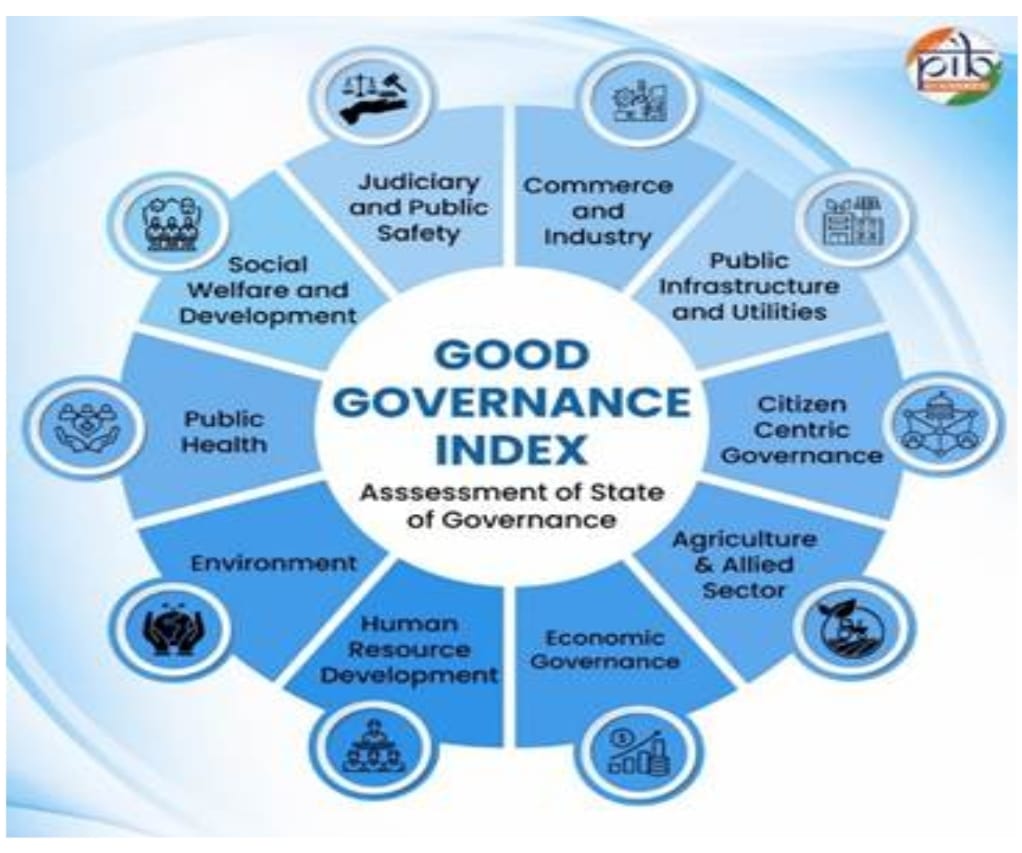
The sectors assessed include Agriculture and Allied Activities, Commerce and Industry, Human Resource Development, Public Health, Public Infrastructure and Utilities, Economic Governance, Social Welfare and Development, Judiciary and Public Safety, Environment, and Citizen-Centric Governance.
States and Union Territories are categorized into four groups for comparison: Group A States (economically advanced), Group B States (developing), North-East and Hill States, and Union Territories. This framework accounts for disparities in geography, population and development levels.
Top performers in the 2020-21 edition included Gujarat, Maharashtra and Goa in Group A; Madhya Pradesh, Rajasthan and Chhattisgarh in Group B; Himachal Pradesh and Mizoram among North-East and Hill States; and Delhi among Union Territories.
The Good Governance Index serves as both a benchmark and a catalyst, driving reforms through competition among states and UTs.
On December 25, 2025, the Union Minister inaugurated the National Workshop on Good Governance Practices, launching five digital initiatives that leverage Artificial Intelligence to address administrative limitations.
The AI-Powered Recruitment Rules Generator Tool reduces drafting time from months to minutes. This web-based system guides officials through a questionnaire, generating recruitment notifications. This accelerates the filling of vacancies and reduces litigation from drafting errors.
The e-HRMS 2.0 Mobile Application empowers government employees with access to their Service Books, leave management, tour reimbursements and advances. By enabling self-service, this reform improves employee morale while freeing HR staff for planning.
Additional innovations included a Compendium of Guidelines for Ex-Servicemen, ensuring those who served the nation face zero friction in accessing post-retirement benefits. The iGOT Karmayogi platform introduced features like personalized course recommendations and intelligent tutoring, fostering continuous learning among civil servants.
The Karmayogi Digital Learning Lab 2.0 utilizes Augmented Reality and Virtual Reality to create training scenarios, allowing officers to practice handling situations like disaster management or law and order challenges in simulated environments.
Regional Impact: Governance Across Diverse Terrains
Good Governance Week's success is measured in districts across India's geography.
In Jammu and Kashmir, the administration conducted camps in Anantnag, Shopian and Budgam, using the Single Window approach where officers from all departments sat together. Public Darbars revived the concept of the ruler's court in democratized form, allowing citizens to air grievances and fostering trust.
The North Eastern states faced challenges of terrain and connectivity. In Arunachal Pradesh's Lower Subansiri district, the campaign integrated tribal governance structures with state machinery, involving Gaon Buras (village elders) alongside District Collectors. Despite security challenges, Manipur's districts focused on departmental convergence to maximize impact.
In Ladakh's villages like Tia and Wanla, Good Governance Week addressed concerns like winter stocking of rations, fuel supply and solar power maintenance, demonstrating state presence even when roads are snowbound.
Haryana showcased governance through its Family ID system, which identifies eligible beneficiaries and delivers benefits before citizens apply, representing anticipatory service delivery.
Connecting to the Viksit Bharat 2047 Vision
The Quality Council of India announced quality reforms aligned with the Viksit Bharat 2047 (Developed India 2047) vision. The Q Mark initiative introduced QR-coded integrity marks for products, enabling citizens to verify authenticity through smartphones. This brings marketplace transparency, a core governance principle.
Digital accreditation processes eliminate human discretion and corruption, while simplified compliance for MSMEs allows small businesses to compete globally. These reforms honor Atal Bihari Vajpayee's legacy by ensuring "Made in India" becomes synonymous with quality.
Conclusion
Good Governance Day demonstrated the Indian state's capacity to deliver at scale when mobilized with clear purpose. The disposal of over 1.5 crore service delivery applications during the campaign reflects administrative surge capacity.
Atal Bihari Vajpayee's vision of an India connected by roads, united by shared values and governed ethically remains alive in these initiatives. The Golden Quadrilateral of highways has been supplemented by a Digital Quadrilateral of Aadhaar, Mobile, Banking and CPGRAMS.

Master Digital Age Governance & Technology Trends with VisionIAS Comprehensive Current Affairs →
Good Governance Day 2025 FAQs
1. When is Good Governance Day celebrated in India?
Ans. December 25 annually.
2. Whose birth anniversary does Good Governance Day commemorate?
Ans. Prime Minister Atal Bihari Vajpayee.
3. What was the theme of Good Governance Week 2025?
Ans. "Prashasan Gaon Ki Ore" (Administration Towards the Village).
4. What is the Good Governance Index?
Ans. A tool measuring governance across 10 sectors using 58 indicators.
5. Which ministry organizes Good Governance Week in India?
Ans. Department of Administrative Reforms and Public Grievances (DARPG).