Current Affairs
CBDC Integration in Public Distribution System: Pilot Digital Food Coupon Initiative launched in Gujarat
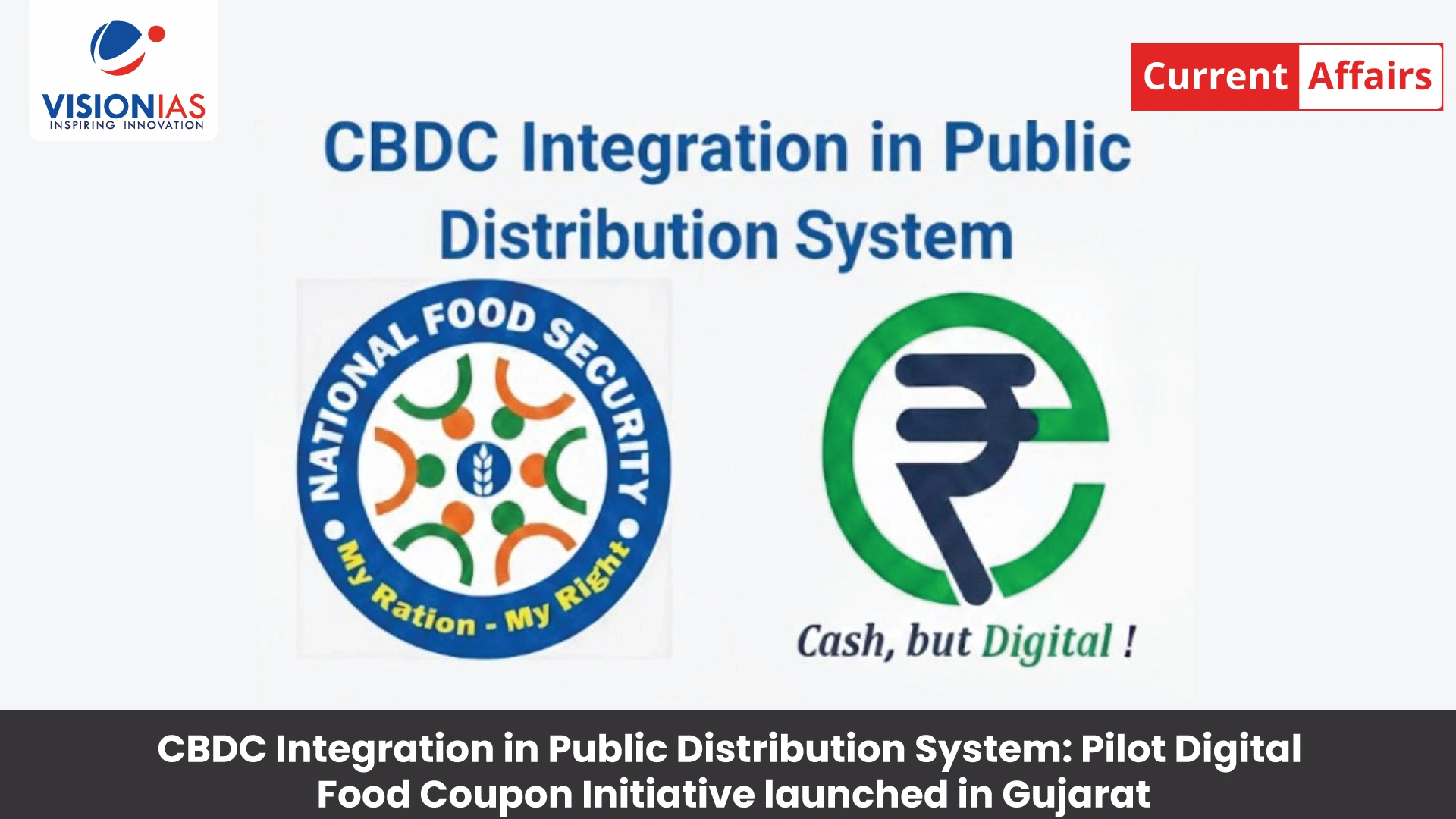













The Government of India has launched a Central Bank Digital Currency (CBDC)-based Digital Food Currency pilot in Gujarat.
The Government of India has initiated a CBDC-based Digital Food Coupon pilot in Gujarat, marking a step towards transforming the country’s Public Distribution System (PDS). Launched by the Union Home Minister in the presence of the Union Minister for Consumer Affairs, Food and Public Distribution, and the Gujarat Chief Minister, this initiative leverages Central Bank Digital Currency (CBDC) to transform food subsidy delivery.
With the slogan “Har Dana, Har Rupiya, Har Adhikar” (Every Grain, Every Rupee, Every Right), the pilot aims to eliminate leakages, enhance transparency, and ensure that India’s PDS beneficiaries receive their entitlements efficiently and securely. This initiative represents a significant expansion of the Digital India vision, bringing cutting-edge financial technology to the core of India’s social welfare infrastructure and demonstrating how digital innovation can transform governance and public service delivery at scale.
What is the CBDC-Based Digital Food Coupon System?
Central Bank Digital Currency (CBDC) is a digital form of sovereign currency issued and regulated by the Reserve Bank of India (RBI). Unlike cryptocurrencies, CBDC represents legal tender backed by government authority. It enables programmable money, allowing specific use-case restrictions, time-bound validity, and transaction-level transparency while maintaining the security and trust associated with traditional fiat currency.
The CBDC-based Digital Food Coupon system represents a shift from traditional subsidy distribution methods. Under this framework, the Reserve Bank of India (RBI) issues programmable digital rupees (e₹) in the form of digital coupons that are credited to beneficiaries’ digital wallets. Unlike conventional cash transfers where funds can be diverted to non-essential items, these digital food coupons are purpose-bound. They can only be redeemed at authorized Fair Price Shops (FPS) for specific foodgrains such as rice, wheat, pulses, and chickpeas mandated under the National Food Security Act (NFSA).
This programmability ensures that every rupee allocated for food security serves its intended purpose. Beneficiaries can redeem their entitled quantity of foodgrains by presenting CBDC voucher codes or scanning QR codes at Fair Price Shops or Grain ATMs. The system creates a real-time digital trail, enabling the government to monitor transactions and address any discrepancies or fraudulent activities.
Technical Architecture: How Programmable Digital Currency Works
The core innovation of the CBDC-based Digital Food Coupon pilot lies in the use of programmable money. Unlike conventional digital payments where money is transferred between bank accounts, the digital rupee (e₹) functions as sovereign digital currency with embedded smart contracts that define its usage parameters.
Each digital food coupon contains specific instructions:
- Commodity Binding: The coupon is valid for entitled foodgrains covered under NFSA rules.
- Merchant Binding: Redemption is restricted to authorized Fair Price Shops and Grain ATMs that have been onboarded onto the CBDC merchant platform.
- Time-Bound Validity: Coupons expire within a timeframe, preventing hoarding and helping identify inactive or ghost beneficiaries.
The system operates on a two-tier model where the RBI issues the digital rupee, but commercial banks like Punjab National Bank (PNB) will manage distribution and front-end services through dedicated CBDC wallet apps. The underlying technology is a permissioned blockchain or Distributed Ledger Technology (DLT), which provides a tamper-proof, shared ledger accessible to authorized government agencies and banks for real-time auditing and monitoring.
CBDC: Legal and Privacy Considerations
The legal basis for CBDC was established through the Finance Bill 2022, which amended the Reserve Bank of India Act, 1934, to include digital currency under the definition of banknotes. The Payment and Settlement Systems Act, 2007, provides the regulatory framework for oversight of digital wallet providers and intermediaries.
Privacy concerns are addressed through a tiered privacy model. For low-value daily transactions, the RBI allows a level of anonymity similar to cash to protect user privacy. Larger transactions or suspicious patterns remain traceable to comply with Anti-Money Laundering (AML) and Combatting the Financing of Terrorism (CFT) requirements.
All participants in the CBDC ecosystem must comply with the Digital Personal Data Protection Act (DPDPA), 2023, which mandates that personal data be used for its intended purpose, and protected with high security standards.
Beneficiary Experience: Bridging the Digital Divide
One of the advantages of the CBDC-based Digital Food Coupon system is its inclusive design. The government has ensured that the technology does not become a barrier for citizens with varying levels of digital literacy or smartphone access.
For smartphone users, the process is seamless. Beneficiaries download the PNB Digital Rupee app or similar CBDC wallets, where their digital food coupons are credited as programmable e₹ tokens. Redemption requires scanning a QR code at the Fair Price Shop or Grain ATM.
For feature phone users, the system provides SMS-based vouchers containing smart codes or coupon strings. This allows them to complete transactions without internet connectivity or smartphone apps.
A relief for beneficiaries, particularly the elderly and manual laborers, is the elimination of repeated biometric authentication. In the traditional e-POS system, worn fingerprints and poor network connectivity led to transaction failures and multiple visits to ration shops. The CBDC-based system removes this friction. Possession of the digital wallet or verified SMS voucher serves as sufficient proof of entitlement.
Digital Transformation of India’s Public Distribution System
Over the past several years, the Department of Food and Public Distribution has undertaken extensive digital transformation of India’s food security ecosystem. Key initiatives include end-to-end digitisation of ration cards and nationwide portability under the One Nation One Ration Card (ONORC) framework, deployment of e-POS devices for Aadhaar-enabled authentication and real-time transaction capture, and implementation of data-driven validation through the Rightful Targeting Dashboard.
Digital supply-chain optimisation through Ann Chakra and strengthened grievance redressal mechanisms such as Ann Sahayata have further enhanced transparency, efficiency and citizen-centric service delivery. The CBDC-based Digital Food Currency pilot represents the next stage of this reform journey by integrating a programmable sovereign digital payment layer into the PDS architecture.
The Gujarat pilot includes Annapurti Grain ATMs in Ahmedabad’s Sabarmati zone. These automated machines dispense grain with operational accuracy and 24/7 accessibility. Beneficiaries access them using CBDC wallet apps via QR code scanning or OTP verification for those without smartphones. The pilot will soon be expanded to the Union Territories of Chandigarh, Puducherry and Dadra & Nagar Haveli and Daman & Diu while states are being encouraged to adopt it.
Conclusion
The CBDC-based Digital Food Coupon pilot in Gujarat represents a re-engineering of India’s welfare architecture. By embedding policy intent into the currency through programmable digital rupees, the Government of India is creating a system where leak-proof delivery of benefits is guaranteed by code and technology rather than bureaucratic discretion.
This initiative demonstrates India’s leadership in financial innovation, proving that FinTech can be harnessed for social equity. The digital food coupon system enhances transparency and reduces leakages while empowering beneficiaries by providing them with 24/7 access to their entitlements through solutions like Grain ATMs and multi-modal authentication pathways.
Master Digital Age Governance & Technology Trends with VisionIAS Comprehensive Current Affairs →

CBDC India FAQs
1. What is the full form of CBDC?
Ans. Central Bank Digital Currency.
2. Where was the CBDC food coupon pilot launched in India?
Ans. Gujarat.
3. What are Annapurti Grain ATMs?
Ans. An Annapurti Grain ATM is an automated multi-commodity dispensing machine that allows beneficiaries to withdraw precise amounts of food grains.
4. What is the slogan of the CBDC food coupon initiative?
Ans. “Har Dana, Har Rupiya, Har Adhikar” (Every Grain, Every Rupee, Every Right).
5. What foodgrains can be purchased with digital food coupons?
Ans. Entitled foodgrains like rice, wheat, pulses, and chickpeas under NFSA.