Current Affairs
Artemis 2 Astronauts Splash Down Safely After Historic Moon Orbit Mission



















First crewed lunar voyage in over 50 years marks a defining moment for NASA and global space exploration.
NASA’s Artemis 2 mission has made history. On April 10, 2026, four astronauts splashed down in the Pacific Ocean off the coast of San Diego, completing the first crewed moon orbit mission since Apollo 17 in 1972. The 10-day journey aboard NASA’s Orion spacecraft signals a turning point in humanity’s return to deep space.
The crew traveled further from Earth than any humans in history, reaching a peak distance of 252,756 miles (406,771 km) and breaking the record held by the Apollo 13 crew.
What is Artemis 2 and Why Does It Matter?
Artemis 2 is the first crewed mission of NASA’s Artemis program, designed to test every system of the Space Launch System (SLS) rocket and the Orion spacecraft in a deep-space environment with human lives on board.
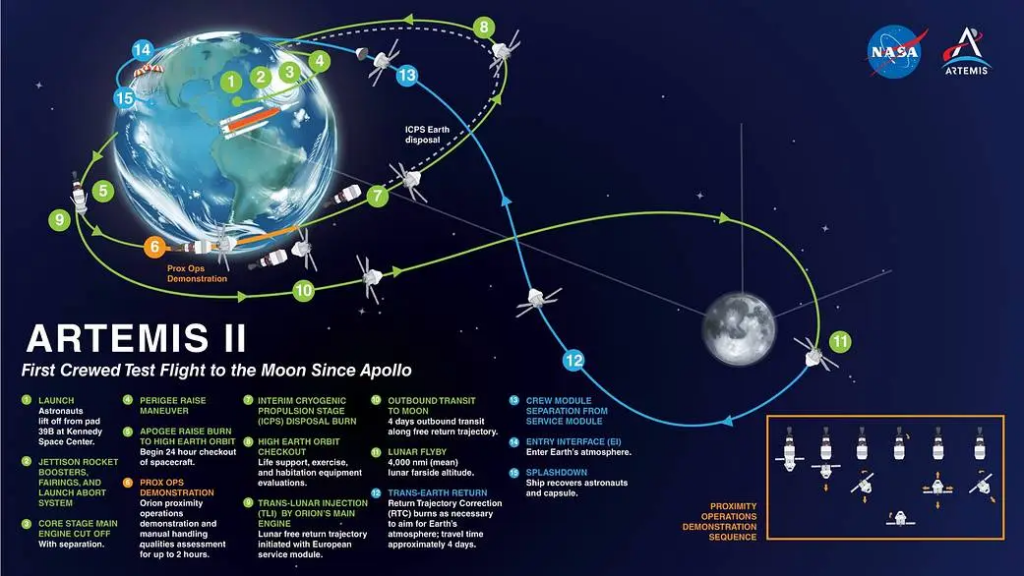
Unlike the Apollo missions, Artemis 2 did not land on the Moon. Instead, it executed a free-return lunar flyby, a figure-eight trajectory that uses the Moon’s gravity to return the spacecraft toward Earth. This approach provided a safety mechanism, ensuring the crew could return home even if propulsion systems encountered issues.
The mission is seen as the bridge between Artemis I’s uncrewed test flight (2022) and the planned Artemis III lunar landing, targeted for 2027.
The Crew: A Historic Team
The four-member Artemis 2 crew made history on multiple fronts:
- Reid Wiseman (Commander): U.S. Navy Captain with 165 days of ISS experience, overseeing the entire mission.
- Victor Glover (Pilot): The first Black astronaut assigned to a lunar mission, responsible for manual piloting of the Orion spacecraft.
- Christina Koch (Mission Specialist): Holder of the record for the longest single spaceflight by a woman (328 days), contributing to habitat validation and observations. After the Artemis 2 mission, she became the first woman to journey into deep space and conduct a lunar flyby.
- Jeremy Hansen (Mission Specialist, Canadian Space Agency): The first non-American to travel beyond low Earth orbit, representing the role of international partners in the Artemis program.
Mission Highlights: From Launch to Splashdown
Launch and Early Objectives
Artemis 2 launched on April 1, 2026, from Kennedy Space Center, Florida, USA. The SLS rocket placed the Orion spacecraft, named Integrity, into an initial elliptical orbit. The crew successfully completed the proximity operations demonstration, concluding one of the mission’s early objectives and providing valuable data on how the Orion spacecraft performs during manual close‑range maneuvering around another spacecraft.
The Lunar Flyby
On Flight Day 6, Orion executed its moon orbit approach, flying between 4,000 and 6,000 miles above the lunar surface. As the crew swung around the far side of the Moon, they experienced:
- A 40-minute communications blackout, cut off from Earth
- A solar eclipse as the Moon blocked the Sun, enabling observations of the solar corona
- Six meteoroid impact flashes recorded on the lunar surface in real time
- Views of “Earthrise” and “Earthset” from beyond the Moon
The crew broke the Apollo 13 distance record during this phase, making Artemis 2 the farthest crewed journey in human history.
Reentry and Splashdown
Reentry was one of the most demanding phases.
The Orion spacecraft re-entered Earth’s atmosphere at roughly 35 times the speed of sound, enduring surface temperatures of approximately 5,000°F. After a six-minute communications blackout caused by plasma, parachutes helped them to land safely. The crew was recovered by the USS John P. Murtha.
Science and Technology Aboard Artemis 2
Beyond navigation and survival, the Artemis II mission advanced research across several key areas.
AVATAR: Organ-on-a-Chip Experiment
The mission carried USB-sized organ chips containing living bone marrow tissue grown from each crew member’s own cells, allowing researchers to study the effects of microgravity and deep-space radiation on human tissue in real time. Scientists will apply single-cell RNA sequencing to the returned samples, with implications for cancer research and personalized medicine on future Mars missions.
O2O: Laser Communications
The Orion Artemis II Optical Communications system achieved a downlink rate of 260 Mbps, enabling the first live 4K video transmission from near the Moon to improve over radio-frequency systems. This technology will be critical for the Lunar Gateway and future deep-space missions.
ARCHeR: Deep Space Health Monitoring
ARCHeR monitored astronauts’ well-being, activity, and sleep patterns in deep space, an environment where these factors had never been formally studied before. The data will inform health protocols and interventions for future long-duration lunar and Mars missions.
Lunar Geology Observations
As the first humans to fly by the Moon in over 50 years, the Artemis II crew captured geological observations of the lunar surface guided in real time by scientists on the ground. This exercise tested the workflows and collaboration models that surface crews will rely on during future Artemis landing missions.
Road Ahead
The success of recent lunar orbit missions has opened what NASA describes as “the path to the lunar surface,” marking a significant step toward the return of humans to the Moon.
Artemis III, scheduled for around 2027, is designed to test critical technologies, including docking between NASA’s Orion spacecraft and commercial lunar landers such as SpaceX’s Starship in Earth orbit. Artemis III will focus on validating systems essential for future missions.
The first crewed lunar landing is now planned for Artemis IV in 2028, which aims to send astronauts to the Moon’s south pole. This region is of particular scientific and strategic interest due to the presence of water ice, which could support long-duration human exploration. Artemis V, also targeted for 2028, will build on this effort with another landing mission and initial steps toward establishing a sustained human presence on the Moon. Notably, these missions are expected to include the first woman and the first person of color to walk on the lunar surface.
Beyond its scientific and exploratory objectives, the Artemis program reflects a broader geopolitical dimension. As the United States advances its lunar ambitions, China has announced plans to land humans on the Moon by around 2030 and is simultaneously developing its own International Lunar Research Station, underscoring an emerging competition in space exploration.
Conclusion
Artemis 2 was not a technical test flight alone. It was a statement of intent. By returning humans to the vicinity of the Moon for the first time in over 50 years, NASA and its international partners have demonstrated that the hardware, the teams, and the will to explore deep space are in place. It also strengthens the Artemis Accords’ principles of a safe, peaceful and prosperous future in space.
The splashdown of the Orion spacecraft on April 8, 2026 marks the end of a mission and the beginning of humanity’s return to the Moon.
Master Digital Age Governance & Technology Trends with VisionIAS Comprehensive Current Affairs →
Artemis 2 mission FAQs
1: When did Artemis 2 launch?
Ans. April 1, 2026.
2: Who are the crew members of Artemis 2?
Ans. Reid Wiseman, Victor Glover, Christina Koch, and Jeremy Hansen.
3: How far did Artemis 2 travel from Earth?
Ans. 252,756 miles which is the farthest any humans have ever traveled.
4: Where did Artemis 2 launch from?
Ans. Kennedy Space Center, Florida, USA.
5: How long was the Artemis 2 mission?
Ans. 10 days.